Henry's Analogue Synthesiser Studio
Equipment
If you're enjoying these pages
and you have an interest in hobby type electronics or repair
jobs, you might like to visit my other website www.usefulcomponents.com,
where there are details of some good radio and other kits.
The first part of this page shows the situation in Farnborough
in 2005 for historical purposes. Lower down the situation at
Southampton in 2026 is shown. The change is relevant because
there's a pretty neat idea about practical and cheap mounting of
19" rack cases and full width Hi-Fi equipment.
The Three Studio And Synthesiser
Stacks
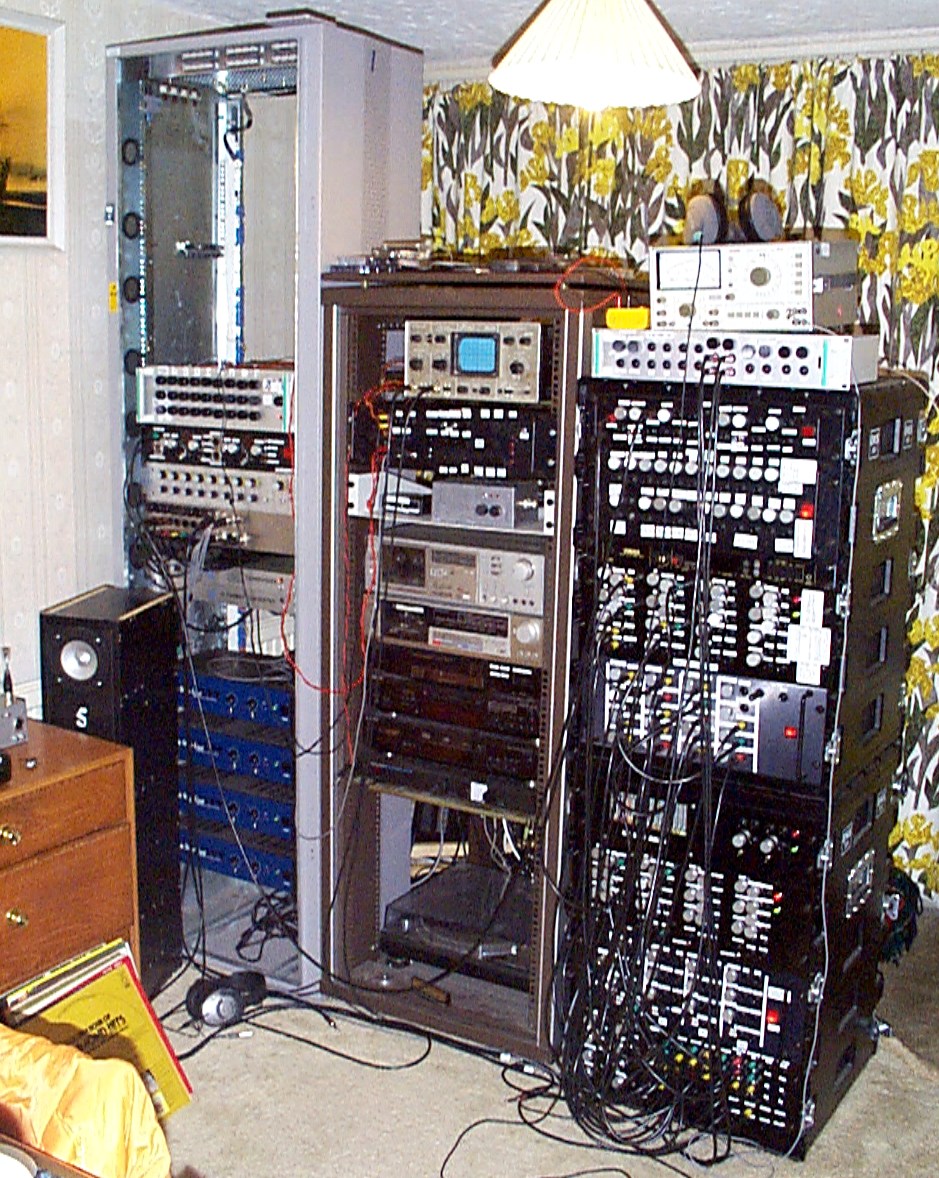
The synth stack consists of the following modules, a combination
of Oakley Sound PCBs mounted on 19" panels and home-made custom
units in 19" rack mounted boxes.
Right Hand Synth Stack From The Top
It looks like there was a pretty
serious patch going on when I took this photograph, which was
not atypical. Entire Saturday afternoons could be spent getting
something to sound right before putting a track down from a MIDI
part.
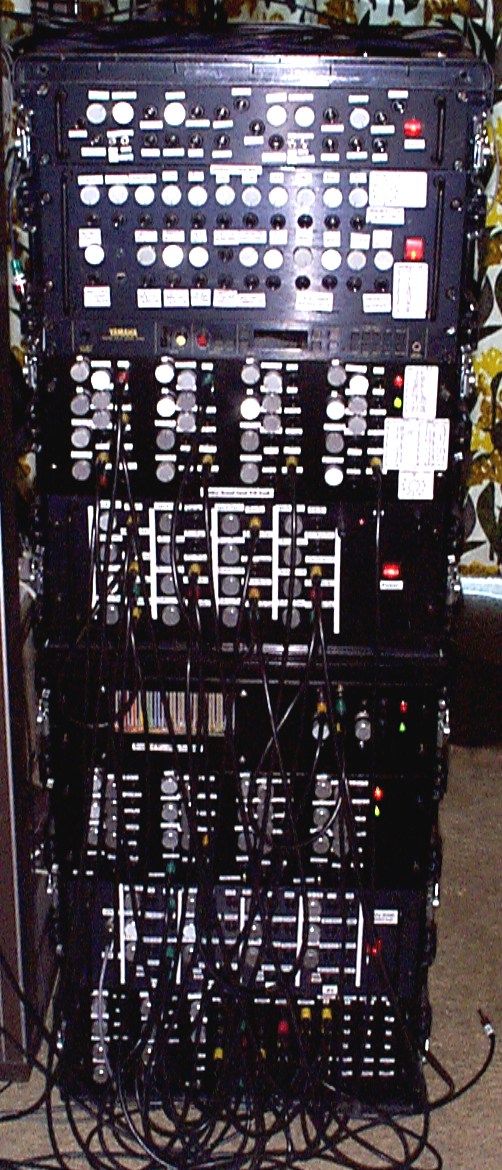
1 DIY
Dual Frequency Shifter
1 DIY
Hammond Emulator
1 Donated Yamaha Digital Delay - (not used as yet)
4 Oakley
SV-VCF
4 Oakley
ADSR + VCA
1 DIY
Graphic Arbitrary Waveform Generator
4 Oakley
Oscillators
4 Oakley
MidiDac
1 Mixed
Panel
The mixed panel consists of the following
2 Oakley Phasers
1 Oakley Little LFO
5 passive splitters
2 DIY 4-input +/- output summer
2 DIY 4-input +/- output summer-subtracter
Left Hand Ambisonic Surround Sound
And Amplifier Rack From The Top
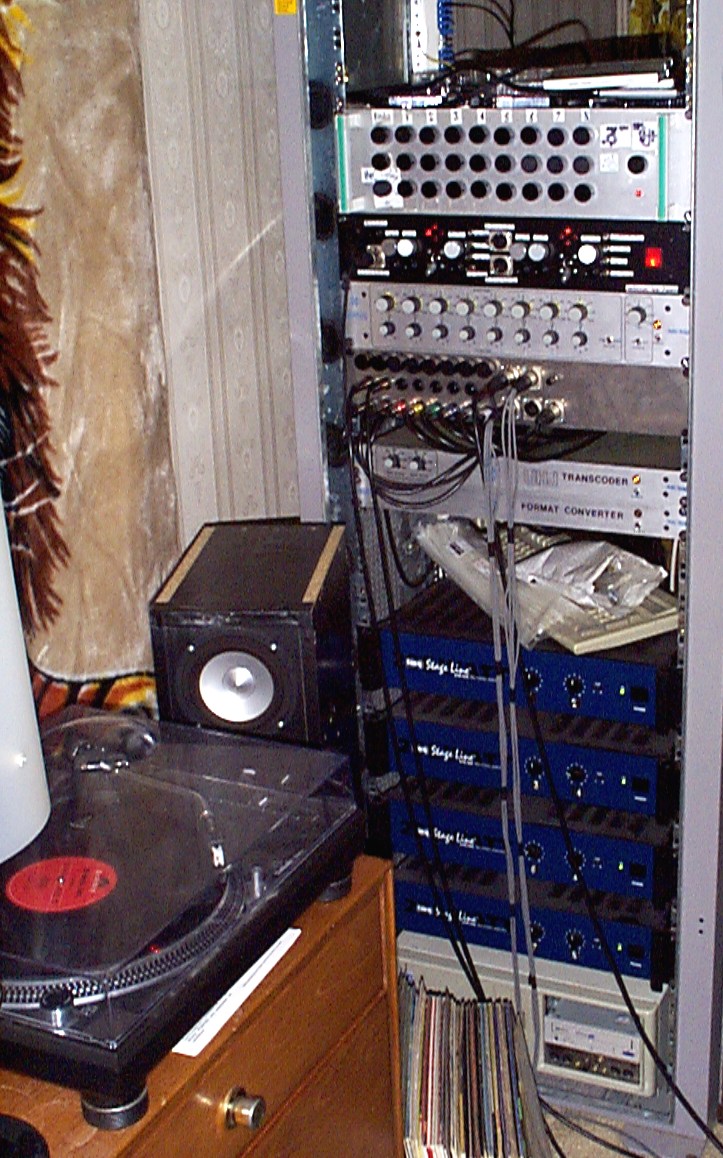
1 DIY
Flexible Ambisonic UHJ Decoder And 8 channel B-Format To
Speaker Feed Generator
1 DIY
Ambisonic Auto-Rotator Linked Into A&D Expansion Input
1 Audio & Design Ambisonic Pan-Rotate Unit
1 Passive attenuator and input panel for A &D Ambisonic
Pan-Rotate unit, B-format switch for pre and post record
monitoring.
1 A & D UHJ Encoder/Transcoder
1 A & D B Format Converter (not used)
4 Stage Line 50W Stereo Amplifiers
1 Ye Olde 120MHz AMD P5 PC containing a Terratec EWS64XL card to
be a sampling synth when I can be bothered with it.
Far Left Secondary Equipment
1 DIY Transmission Line Speaker No. 5 of 8
1 Technics SL1210 Mk.II Turntable for those SQ Stereo
Quadraphonic Switched On Bach and Mike Oldfield Boxed moments.
Middle Rack Various Equipment
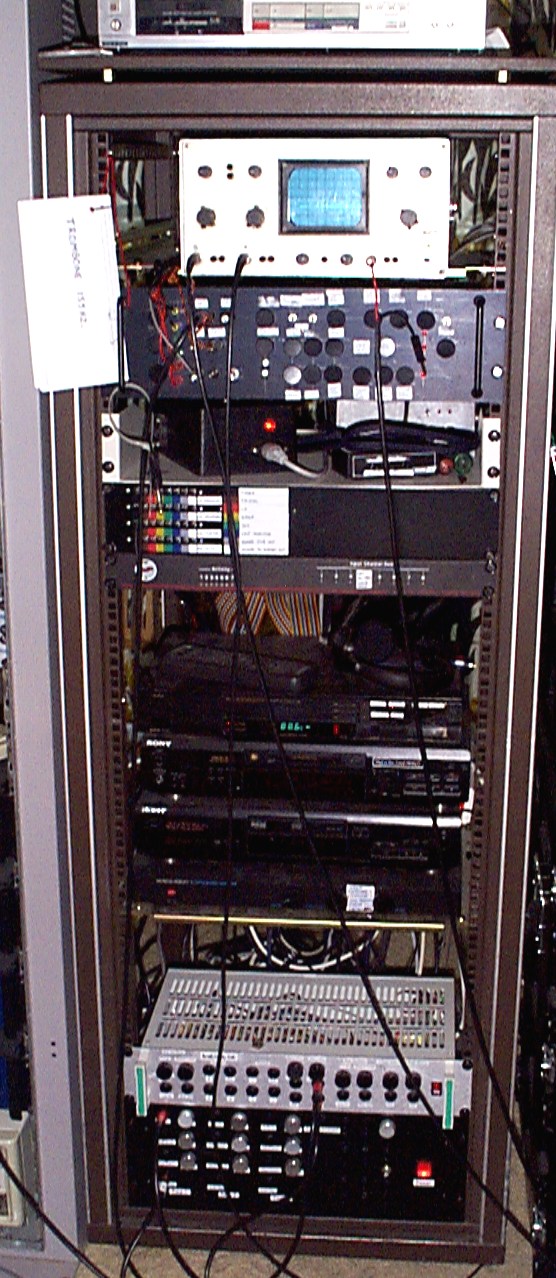
From The Top
4 X 3 head cassette deck collection for future "Itchycoo"
Flanger project or student radio stylee tape delay generation
(yay!)
Inter-head delays are 85mS, 87mS, 93mS and 32mS.
1 Scopex 4D10A old scope for synth monitoring and testing
1 Unit with >60 second period LFSR pseudo-random white noise
generator, amoung other redundant bits.
1 To the left, white envelope holding laser printed
transparencies of instrument waveforms for placing over the
oscilloscope screen and then adjusting the waveform generator
to.
1 Utility shelf with PSU for Matrix Switcher and extra short
range FM radio transmitter, and old bits of cage nuts,
screwdrivers and cable ties.
1 DIY
Latching Push Button Selector Panel For Matrix Switcher
Control
1 Radio Design Labs AMX-84 Audio Matrix Switcher / Summer
1 Tuner
1 Minidisc
1 CD
1 Musical Fidelity amp used to drive headphones and as a Gram
pre-amp
Space
1 DIY Synth Utility Unit Consisting Of
1 buffered continuously variable attenuators
2 three range sine oscillators
1 three input summer
1 three-input summer subtractor
2 precision voltage sources, 1V steps 0 to 9V
1 DIY
Triple Accutronics Spring Reverb
Extras on this unit...
Two additional passive splitters
Two attenuators with gain, +6dB to -infinityish dB
The Updated Situation In 2026
I bought a house in Southampton
in 2012 and moved. Hurrah! No more officious,
beauraucratic,
parasitic, compulsive lieing, money grabbing letting agent
thieves to deal with. All the synth and surround gear was
sitting still packed in their flight cases or boxes for quite
some time after the move. Then I found a nice little under-desk
return in a charity shop in Totton for £5. It was the perfect
width for putting full size Hi-Fi gear into. I noticed that with
very little or no modification, it was also ideal for mounting
19" rack gear. Here's a picture as it is now.
The Under Desk Hi-Fi Return
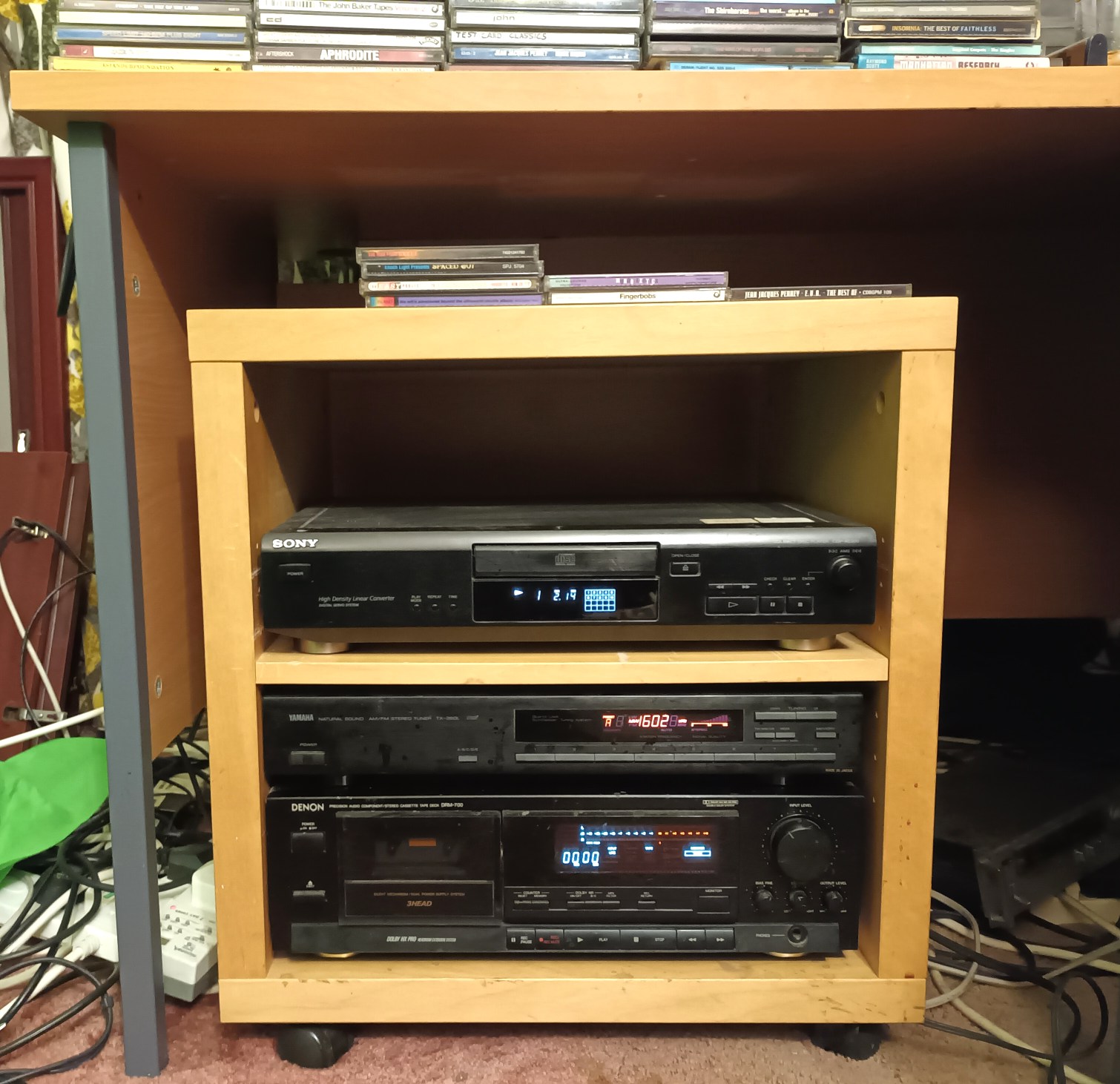
It's even got castors. That got me thinking that it was about time
that the modular synthesiser was dragged out of retirement. There
followed a few weeks of looking for suitable second hand
furniture. After much walking around charity shops with a tape
measure, I found a big modern sideboard in the same shop in
Totton, who even delivered it three miles for a small fee. It did
not cost much. And so the Sideboard Synthesiser was born.
The Sideboard Synthesiser
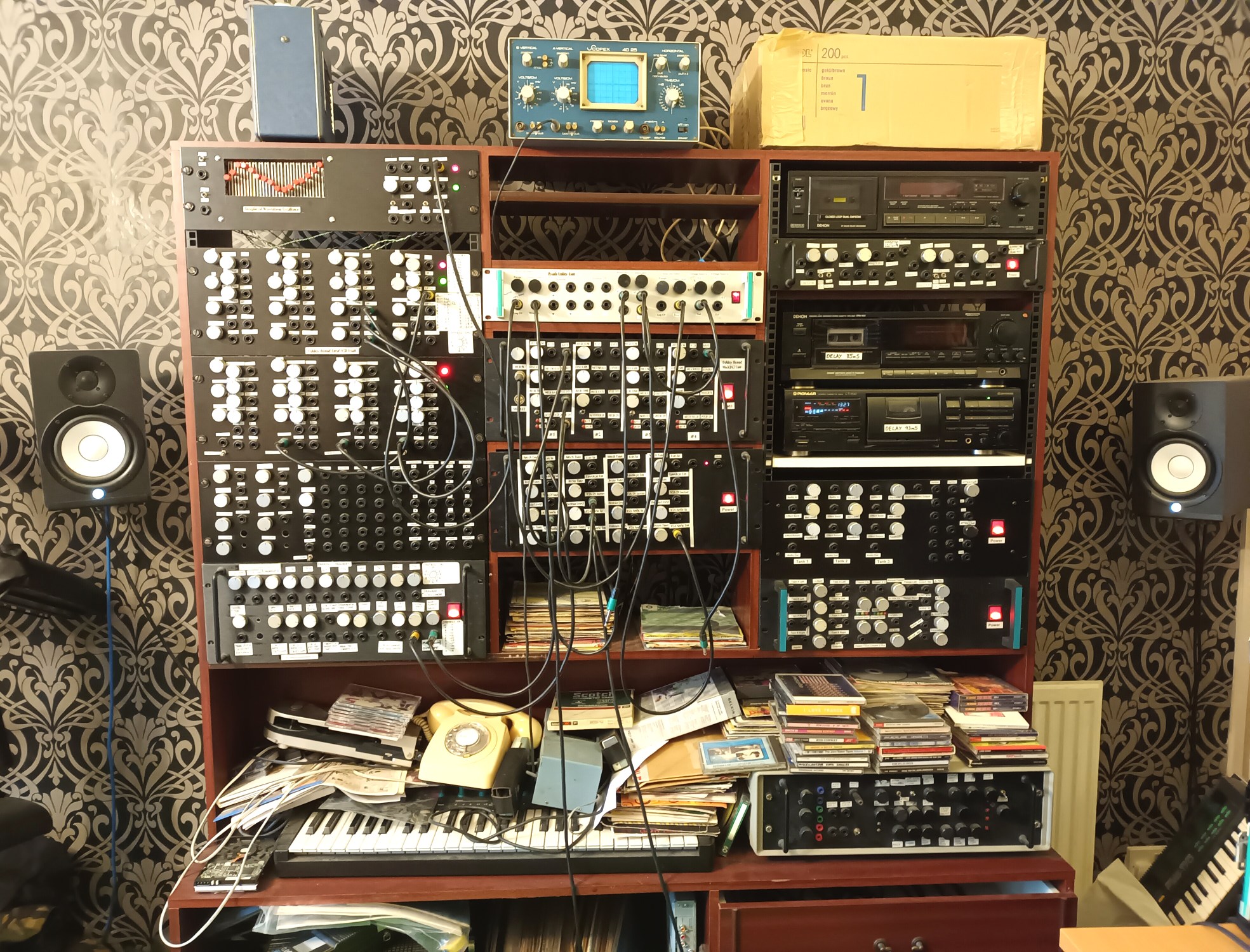
What? A 1980s
furniture-board constructed sideboard with three perfect
width vertical sections? It's as if it was purpose
made. You can move the shelves up and down using the plug-in
side pieces, and the pre-drilled holes in the vertical
supports. You would never rely on that for heavy stuff, so I
used chipboard screws coming in from the sides to fix the
shelves. When you've done that it will support a 3U rack
case easily, and you can even pile another on top without
needing another shelf. The monitoring oscilloscope has been
upgraded from my ancient Scopex 4D-10A which I sold a while
back to a Scopex 4D-25. The front board part of the
sideboard can be used to put the MIDI keyboard on. The
drawers bottom right are used to store the patch leads.
The Ambisonic Surround Sound
Control Stack
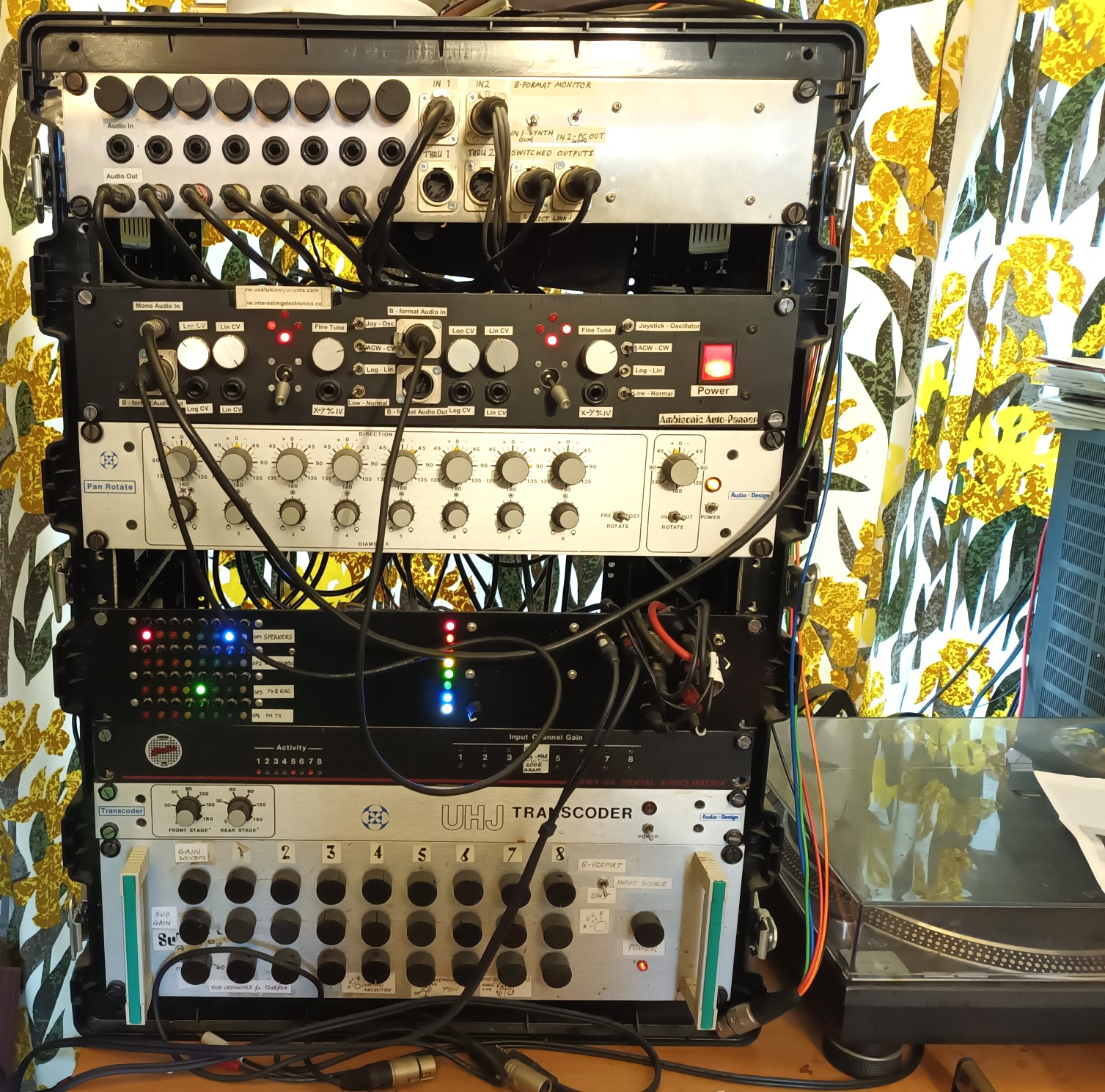
Close observers may note that the
AMX-84 control panel no longer has rainbow coloured insulation
tape labels. No. Now it has a full complement of rainbow
coloured LEDs for each individual channel. There's even a
dimmer. The top section has eight passive attenuator pots that
used to feed a Terratec EWS 88 eight input and output posh
sound card. It was good but died for no reason. Good old
Terratec. Good but fatally flawed. There's some necessary
B-Format switchery and through-feeding included there too.
Outputs from the sideboard synth go into those attenuators to
be level adjusted prior to going into the computer analogue
input.
In case you were interested, those curtains are fab. They are,
in fact, late 1960's designer curtains, gifted to me a
long time ago by a good friend.
Yamaha HS-50M Powered Monitor
Speakers
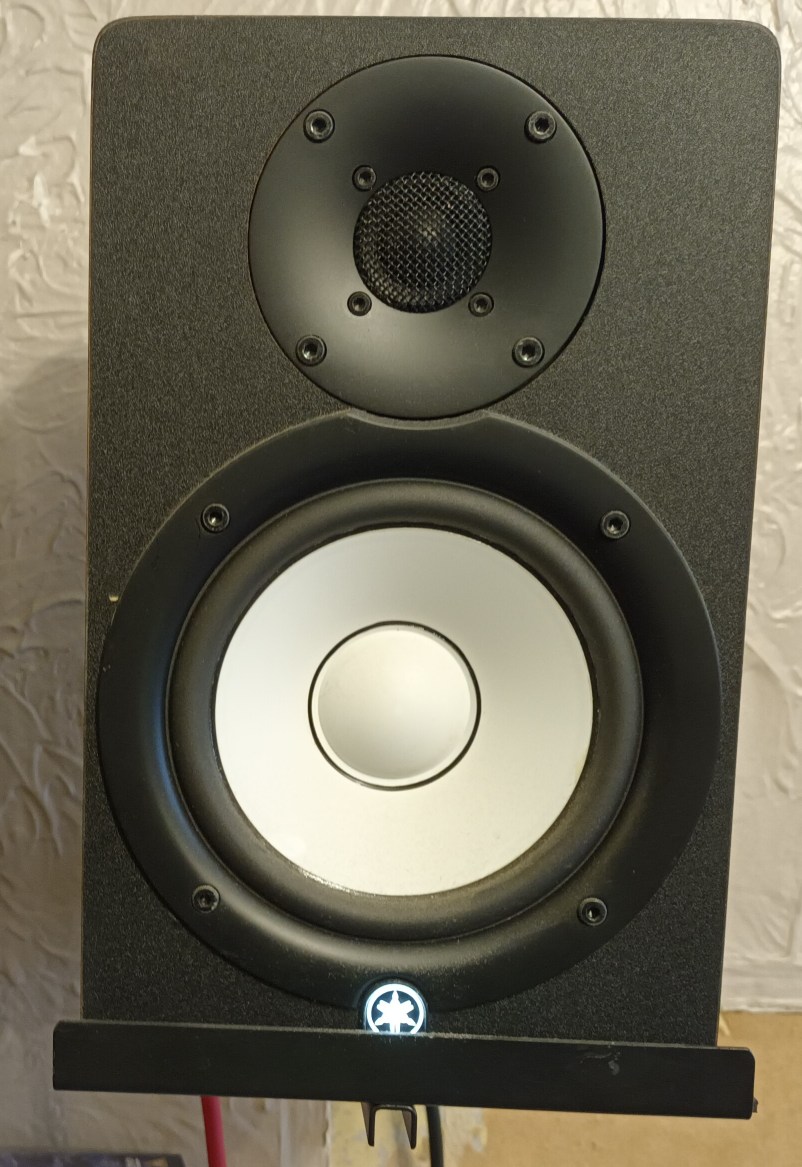
I got some new speakers. Here is a Yamaha HS-50M from the
front.
Yamaha Powered
Monitor Speaker From The Rear
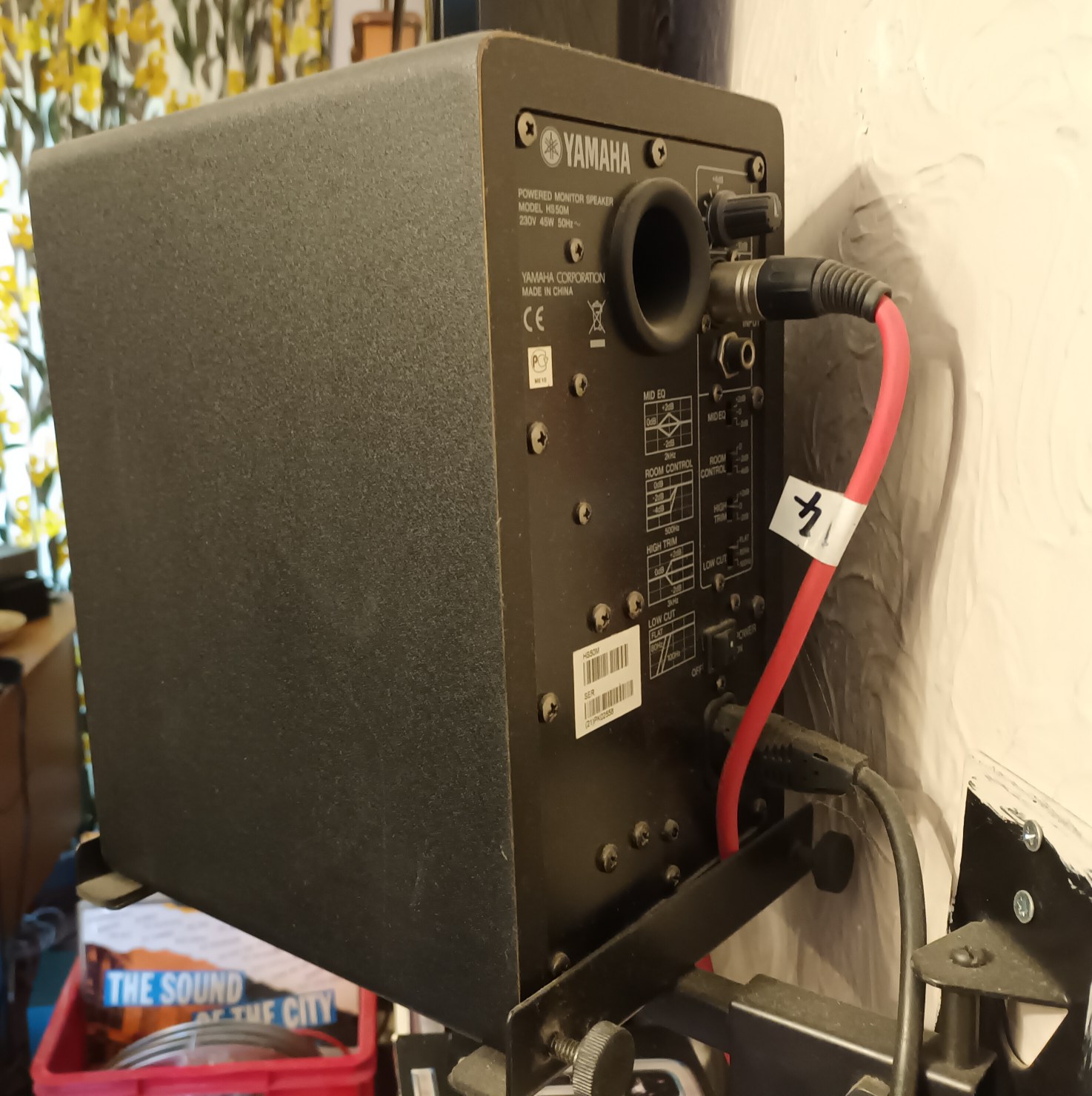
Here is a Yamaha HS-50M from the rear. 30 Watts? There are great
things to be said about having the amplifiers really close to the
speaker, and inside the speaker is about as close as you can get.
Using two separate amplifiers and active crossovers for the bass
and treble units should have been standard hi-fi practice a long
time ago. Are they any good? Yes. But I wasn't overpowered by
their brilliance compared to my previous home-made single driver
speakers driven along 12 foot of cable. They were about the same.
Older Transmission Line Speakers
Put To Use
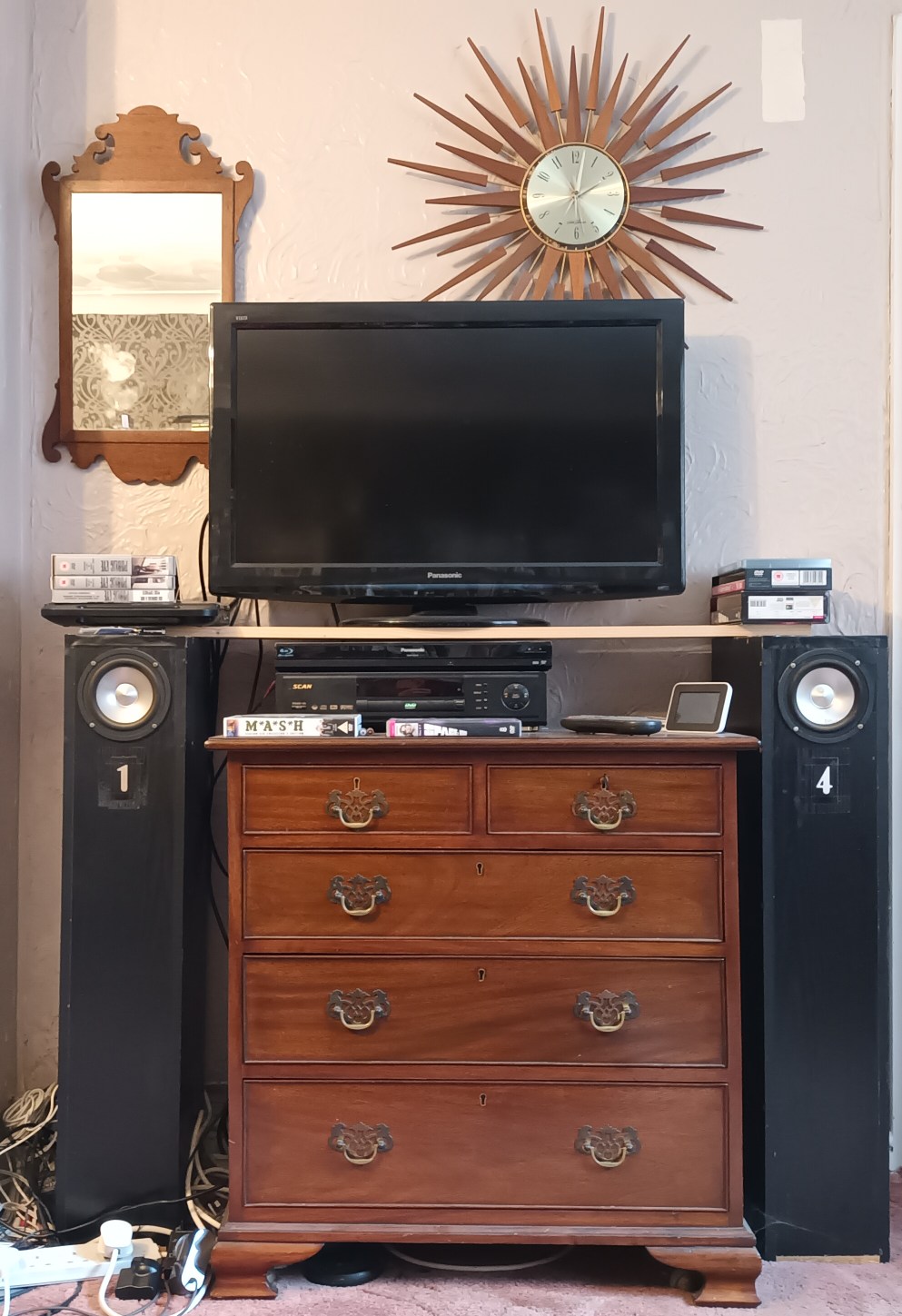
The older TX line speakers were
moved to the lounge area and are used for watching films in
surround sound. Here's a link where you can see how to build
these particular DIY
transmission line speaker enclosures.
Transmission Line Speaker Enclosure
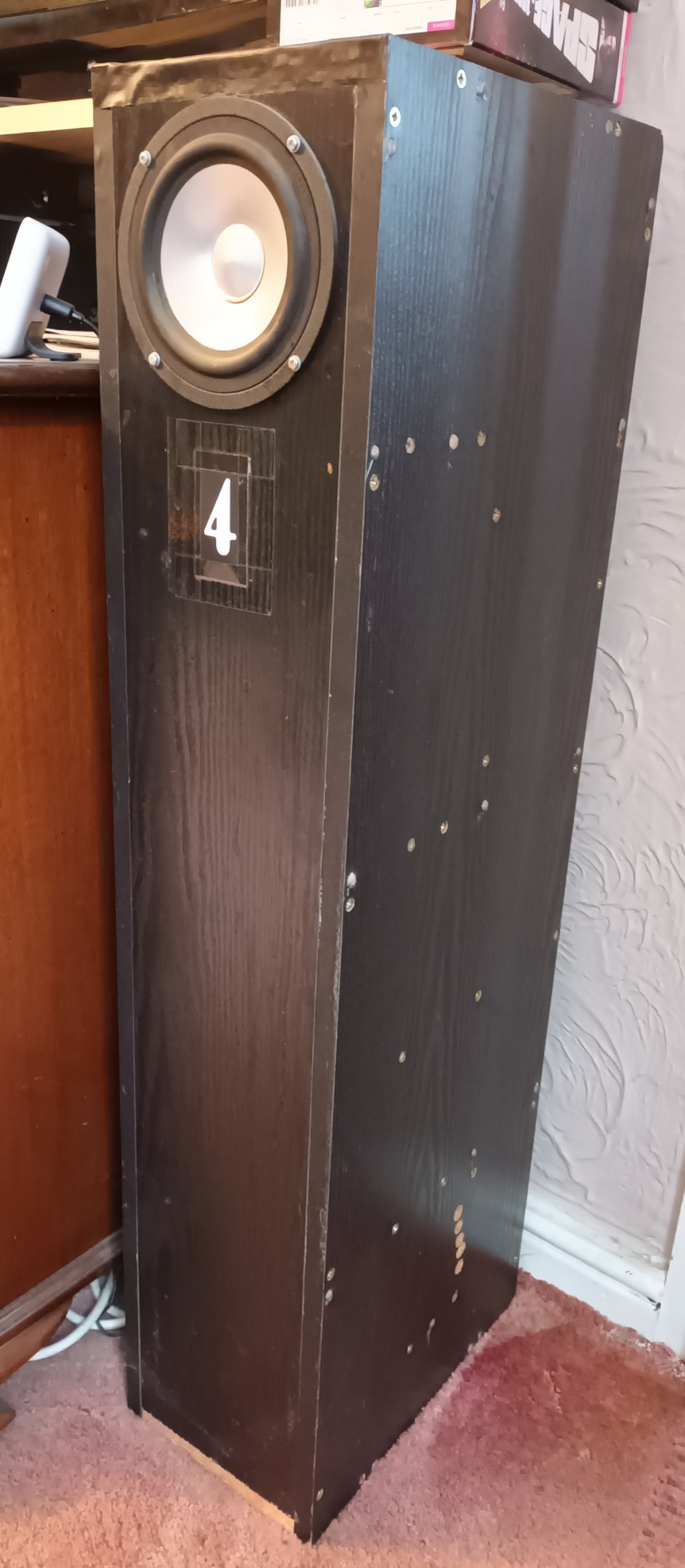
I can't really comment on speaker
quality nowadays because like most middle-aged codgers, my
hearing is about that of the original VHS standard, about
10kHz with a bit more if you're lucky. Gone are the days of
being irritated by the 15.625 kHz whine of the deflection
coils of a 625 line television set running in an adjacent
room.
E.J. Jordan 4" Wide Range Driver
Close-Up
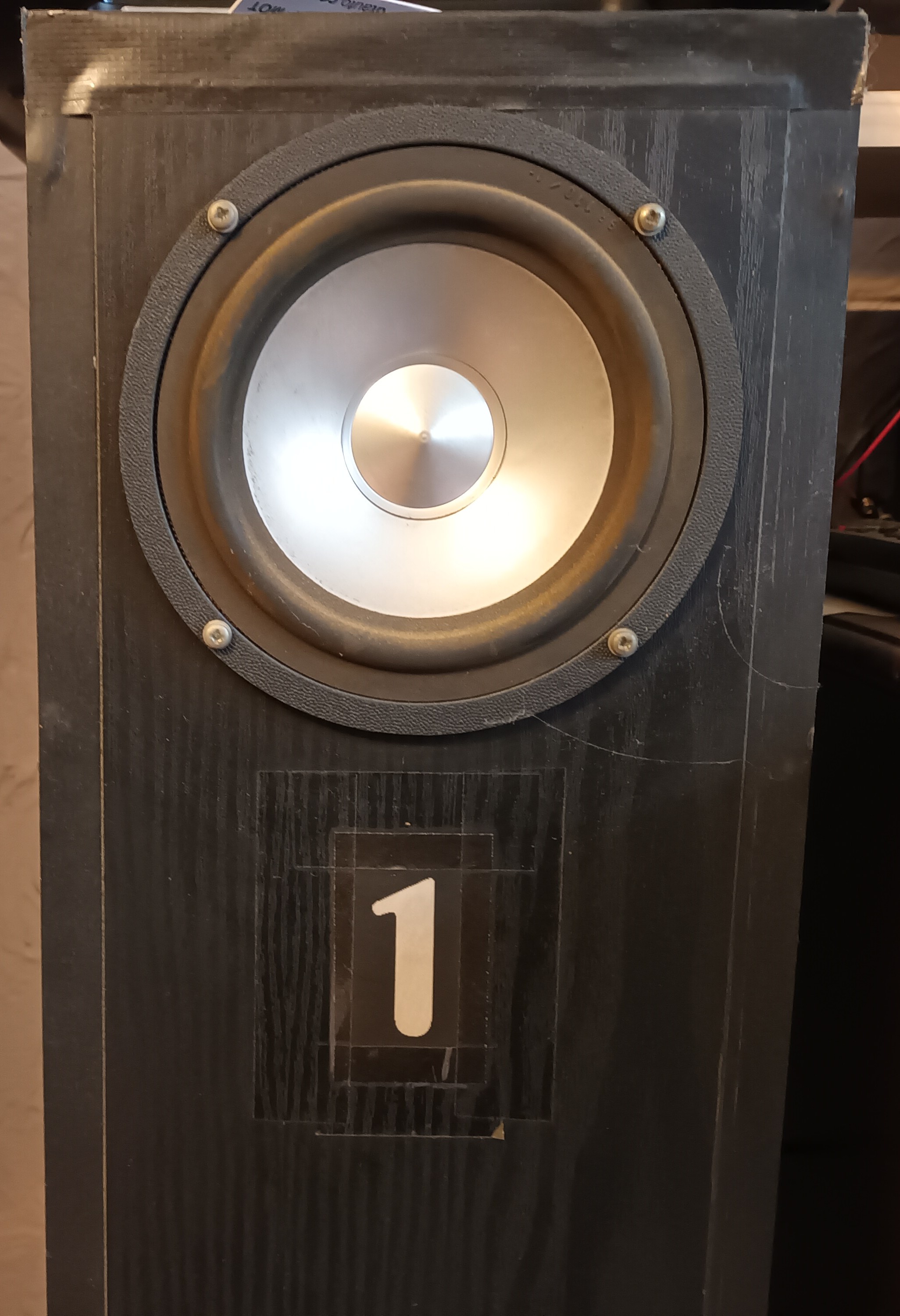
Despite my above comment, I'm
still very impressed with these 4" drivers and enclosures.
The Ambisonic Clock Outputs Decoder
Used For Watching Movies In Analogue Dolby Stereo Surround
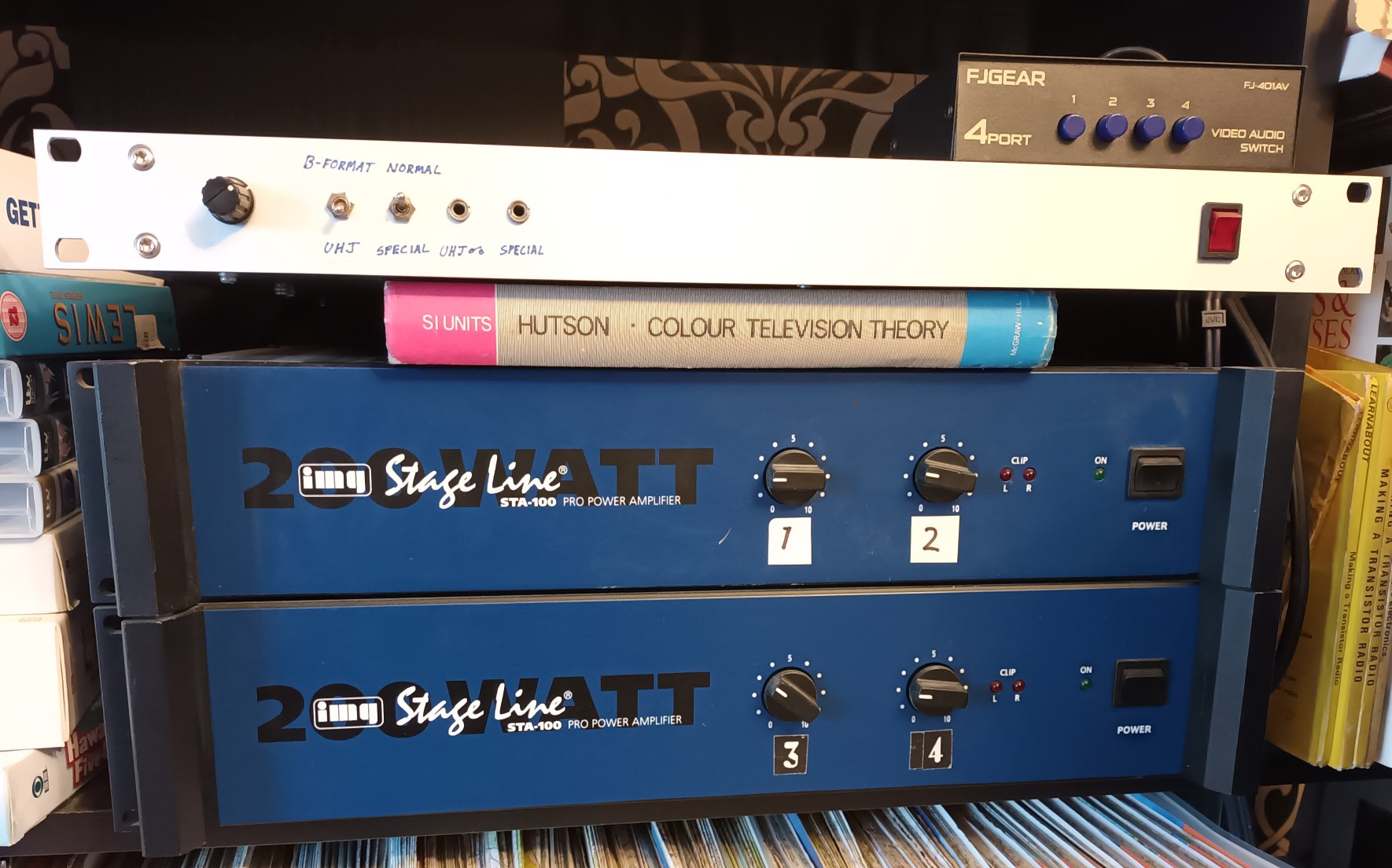
The old
amplifiers were moved over to the television leisure area, along
with the speakers. Can you really still watch current movies
using an analog decoder and get surround sound from it? You're
supposed to be able to, yes. The analogue stereo soundtrack
should still have the old Dobley Stereo phase encoding as part
of their own specified hierarchy. Here you can read more about
the Ambisonic
UHJ Clock Output Decoder seen in the picture. It sounds
pretty good to me. I am occasionally very impressed. This
usually occurs on movies from about 1978 to 1988 when people
were trying particularly hard to work with the analogue
limitations. If you listen to the commentary on the DVD, I think
that "Invasion Of The Bodysnatchers," starring Donald Sutherland
and Spock got particular praise from Dolby for being the first
film to really manage to work with their adequate system.
Henry's main email address:
Navigate
Up
Recent Edit
History
12-MAY-2005: page created
01-FEB-2025: small update
08-FEB-2026: major update, bigger more pictures, html
incantations