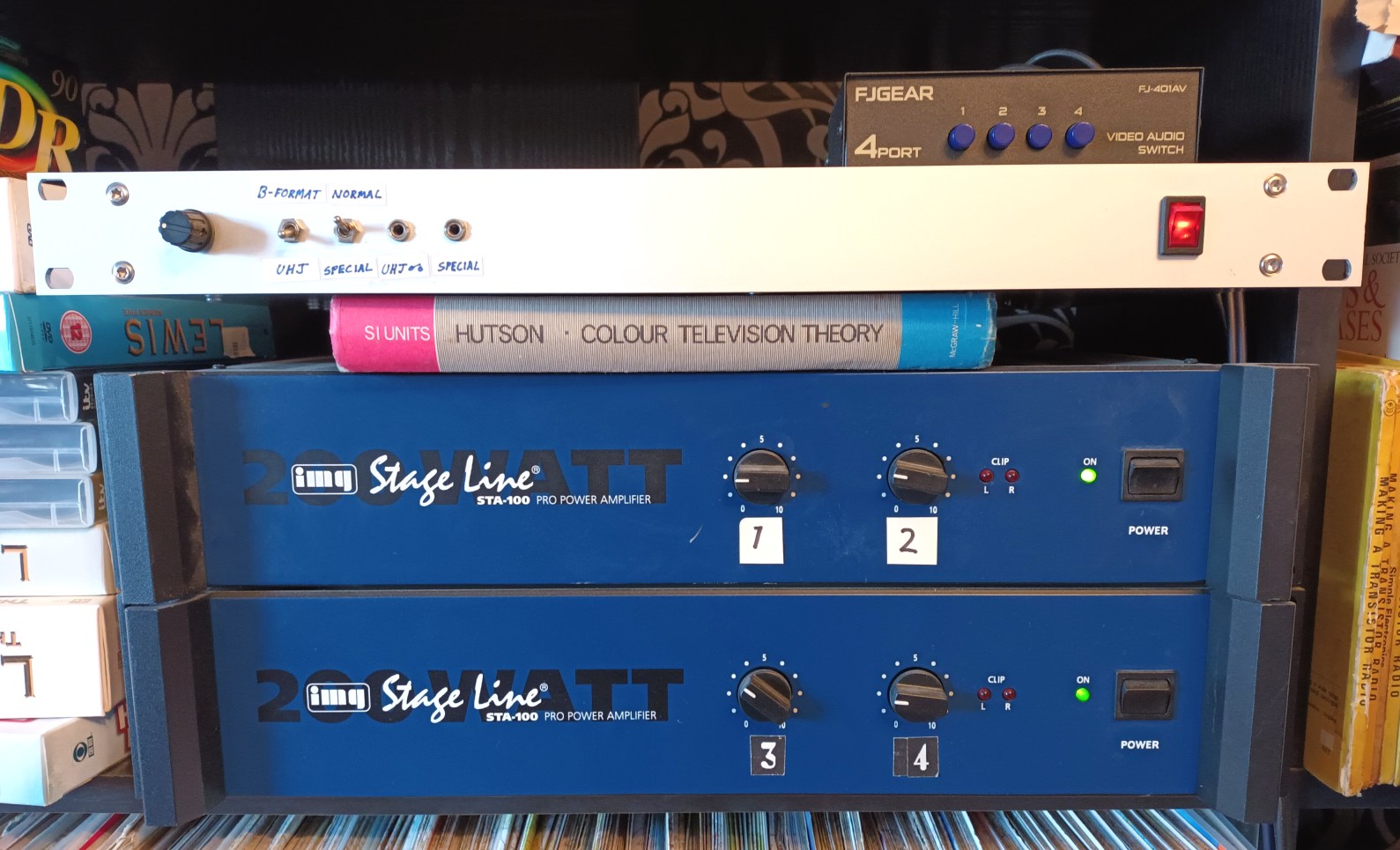
Here is a practical analogue Ambisonic decoder design that's better in many ways than the first one that I built. If you're that way inclined, please feel free to go down the sensible route and do it all in DSP, or buy such a thing off the shelf. It is for horizontal surround only.
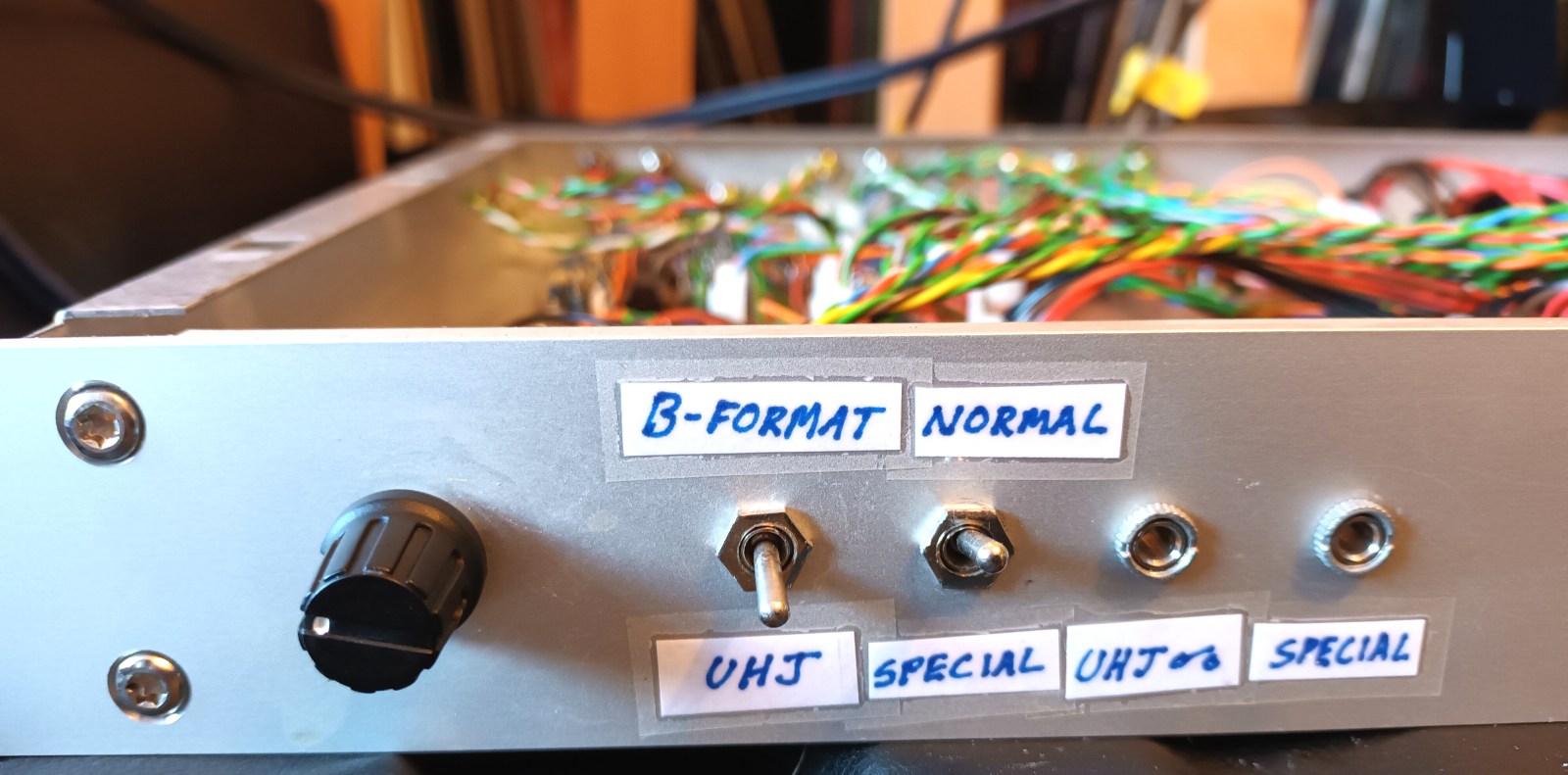
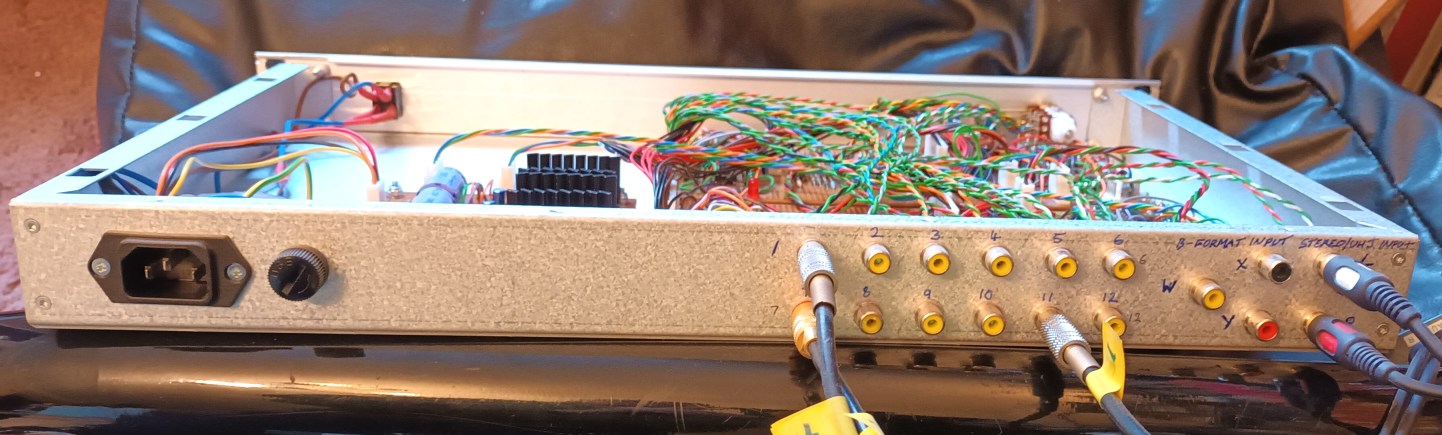
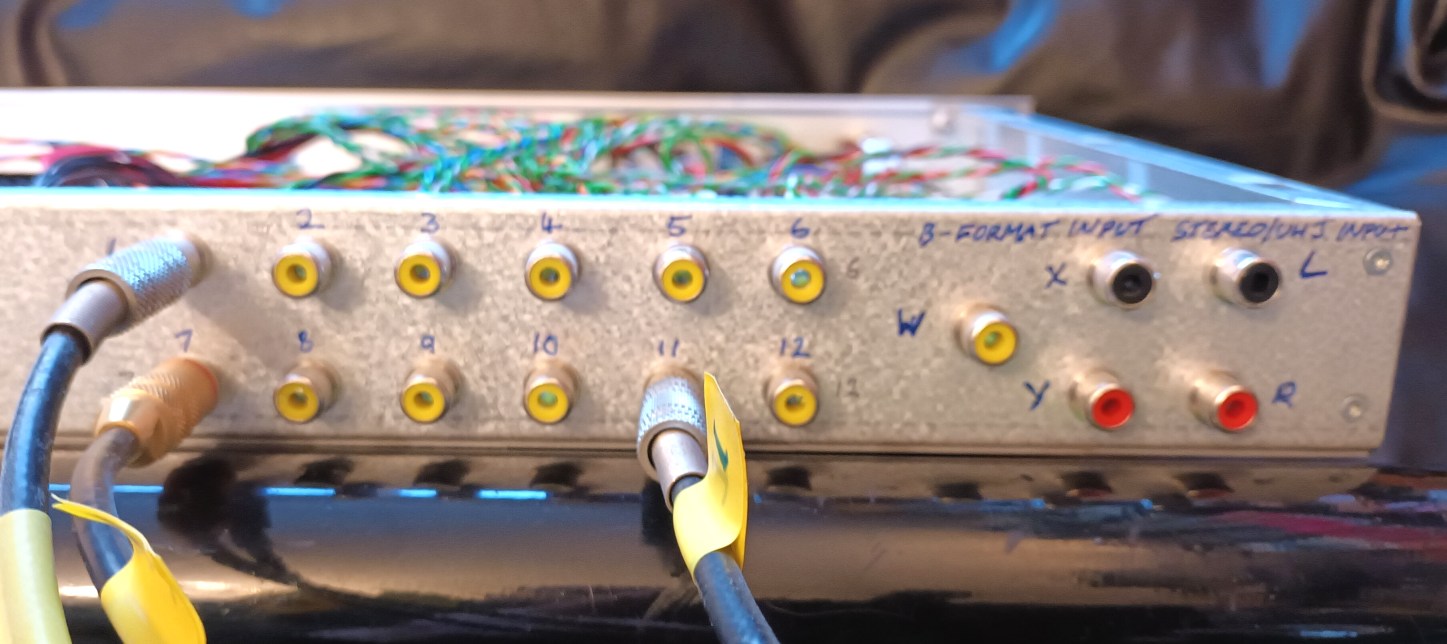
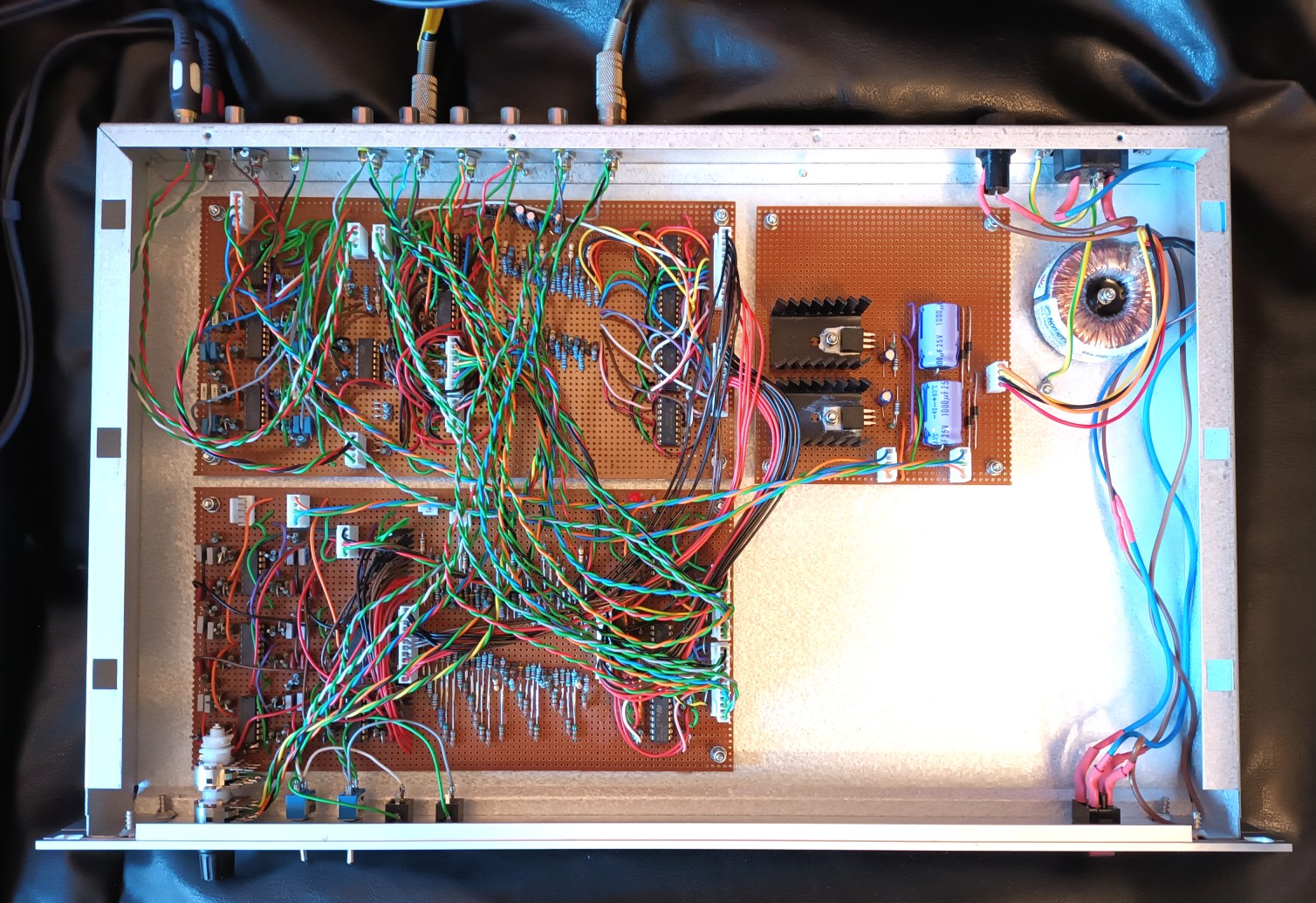
The whole of the insides.
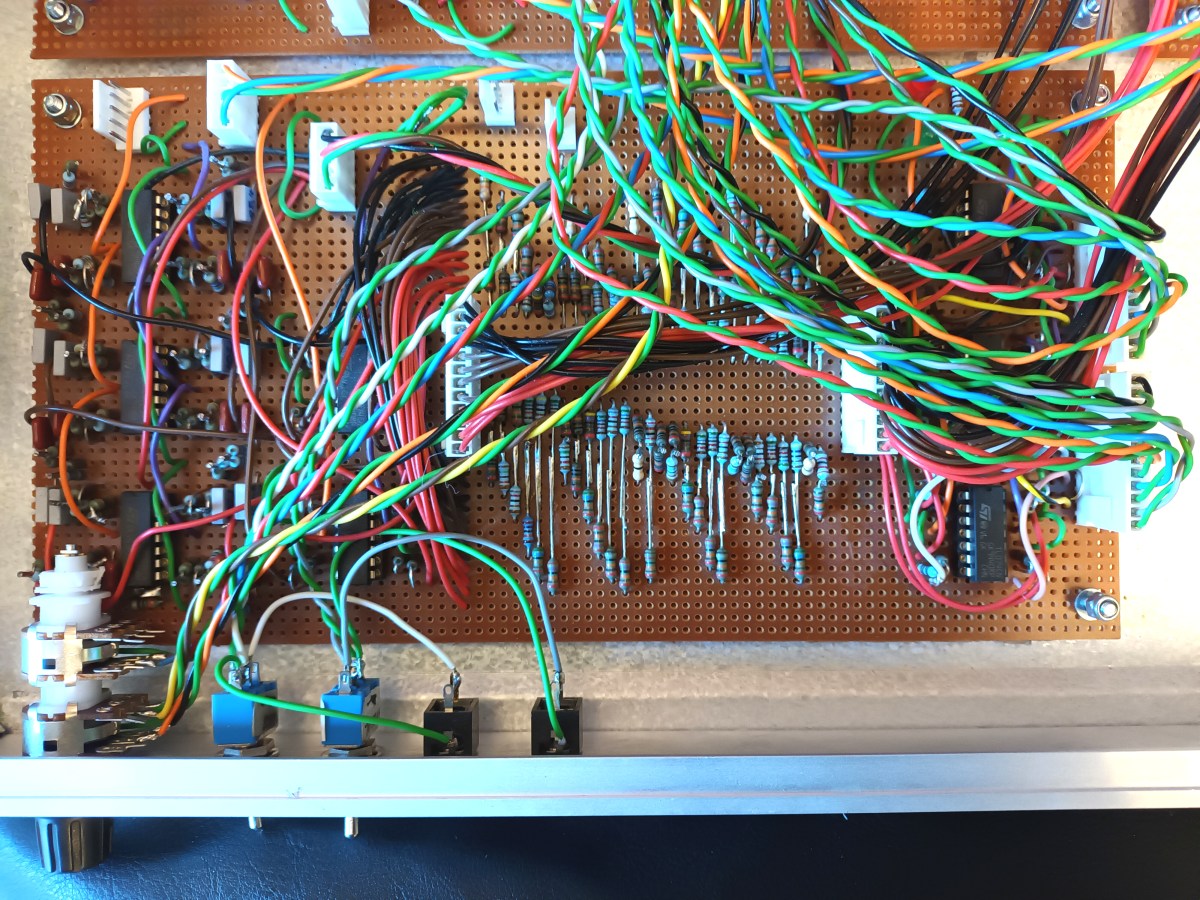
Front Board
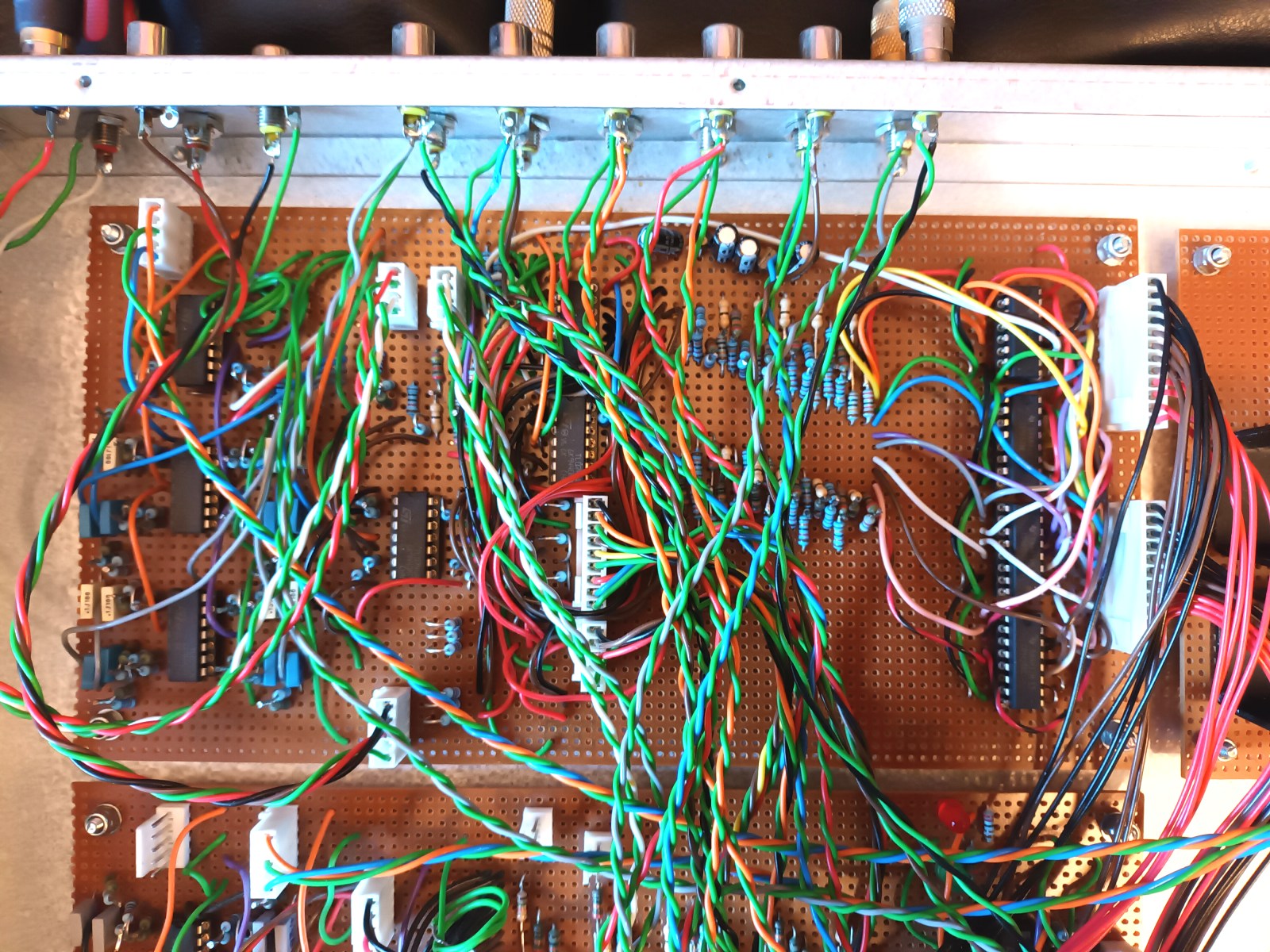
Rear Board
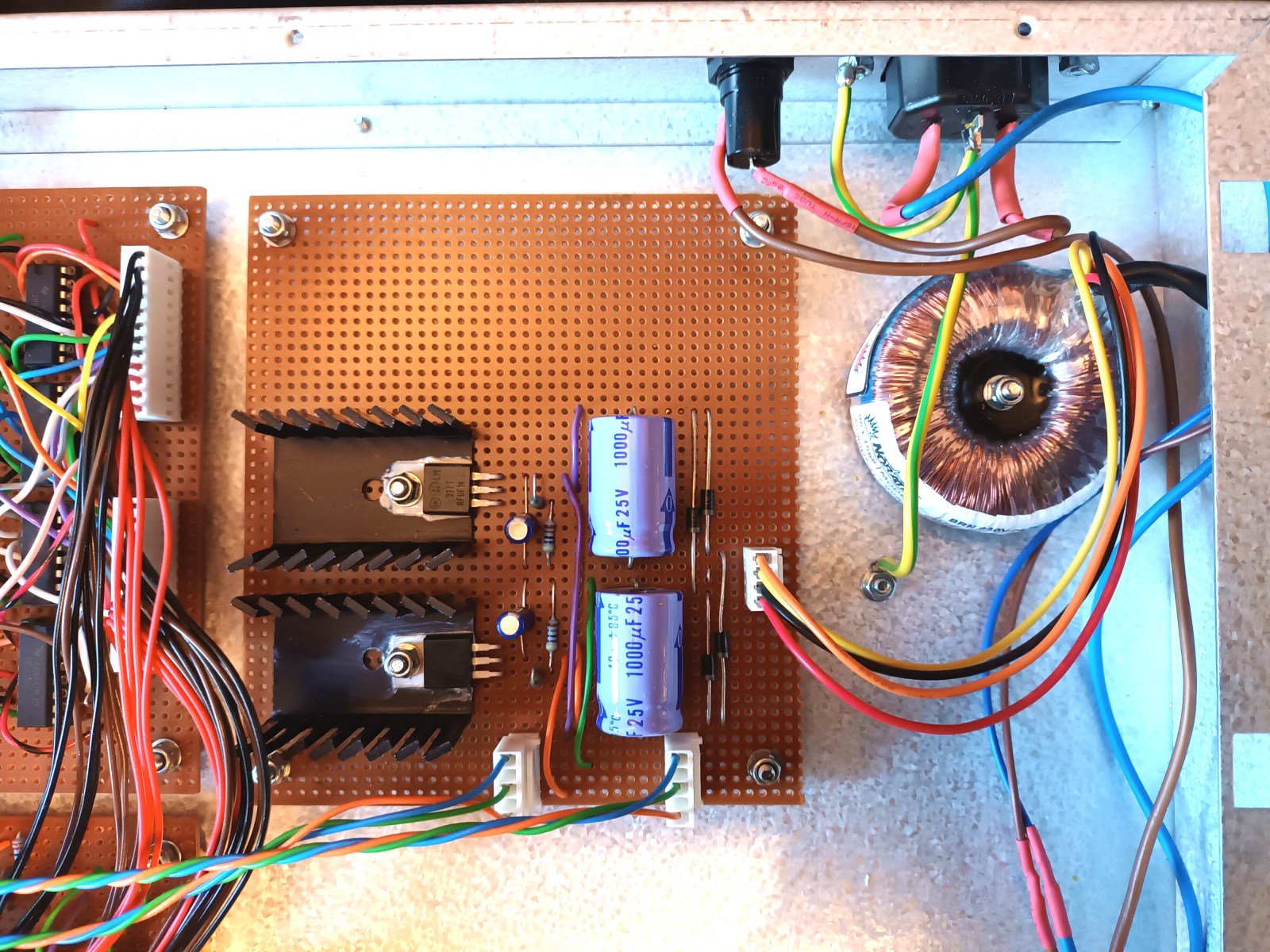
PSU Board
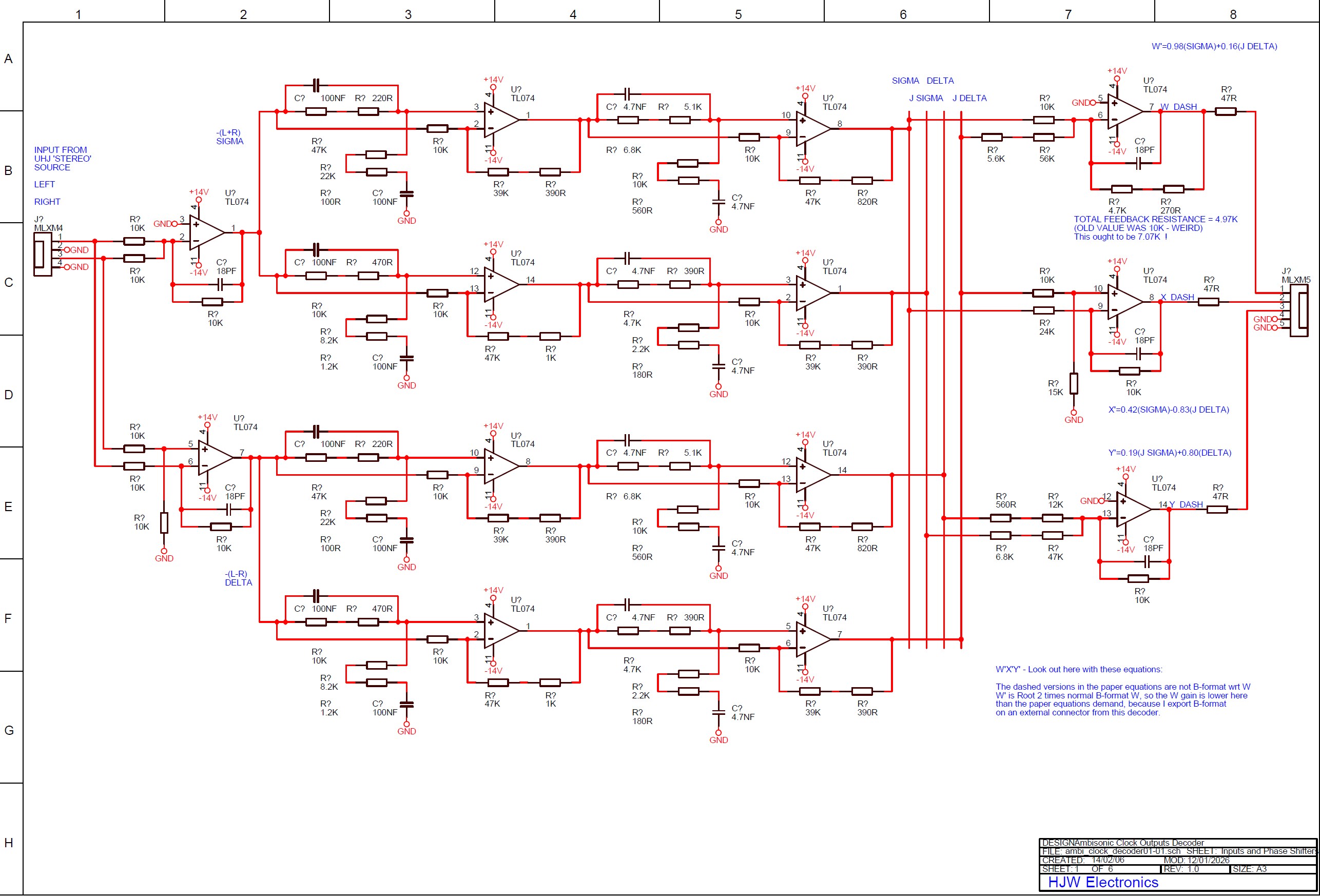
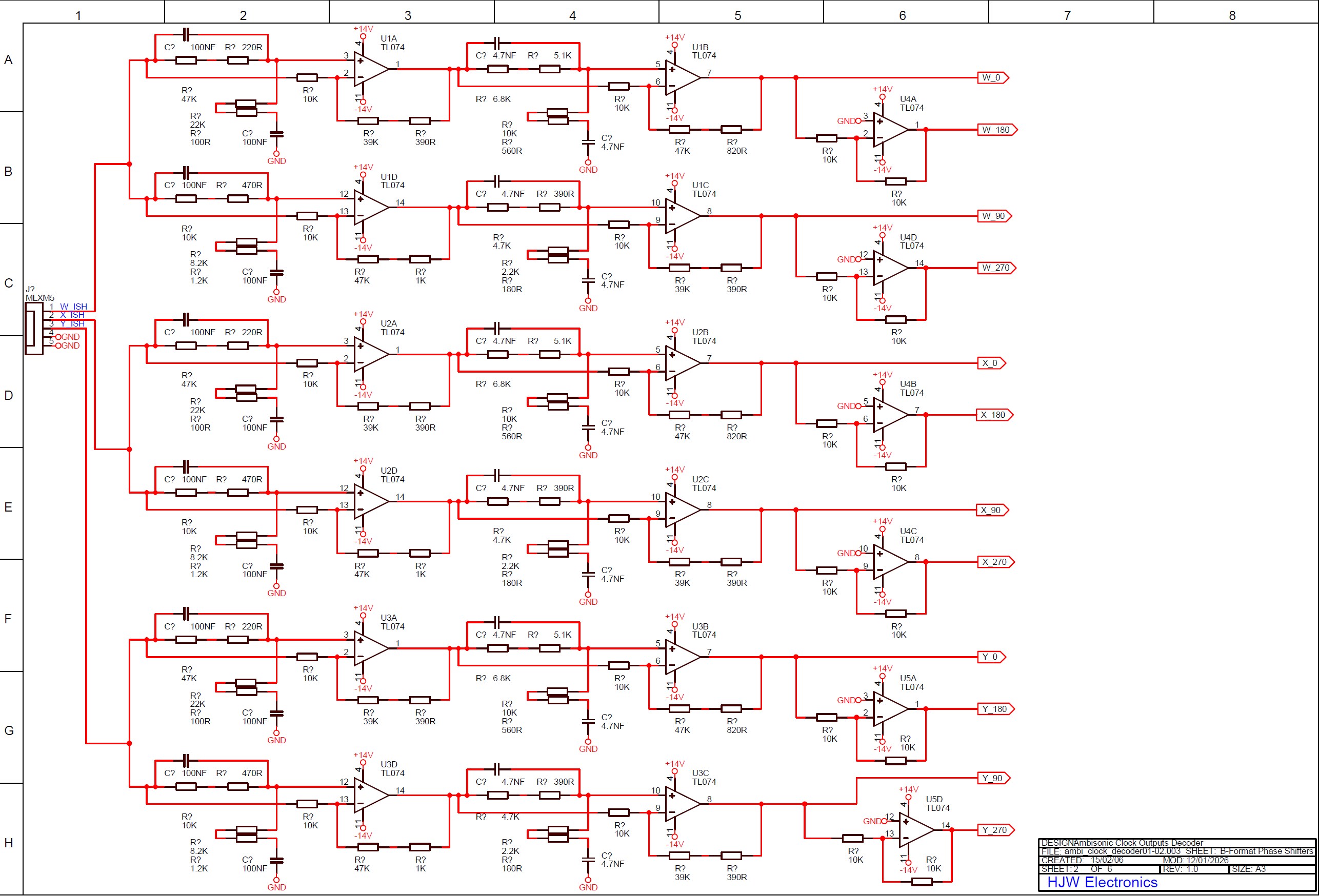
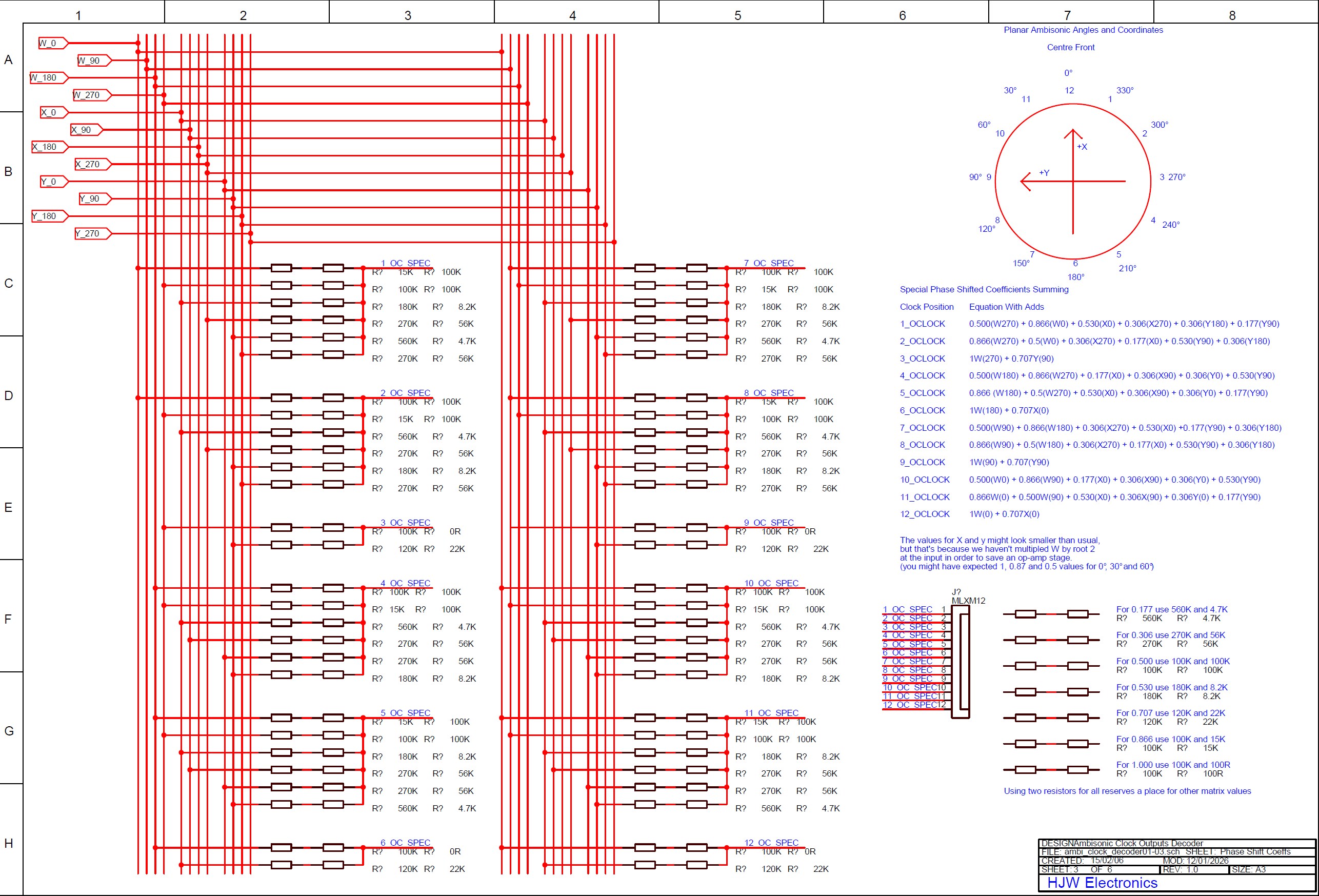
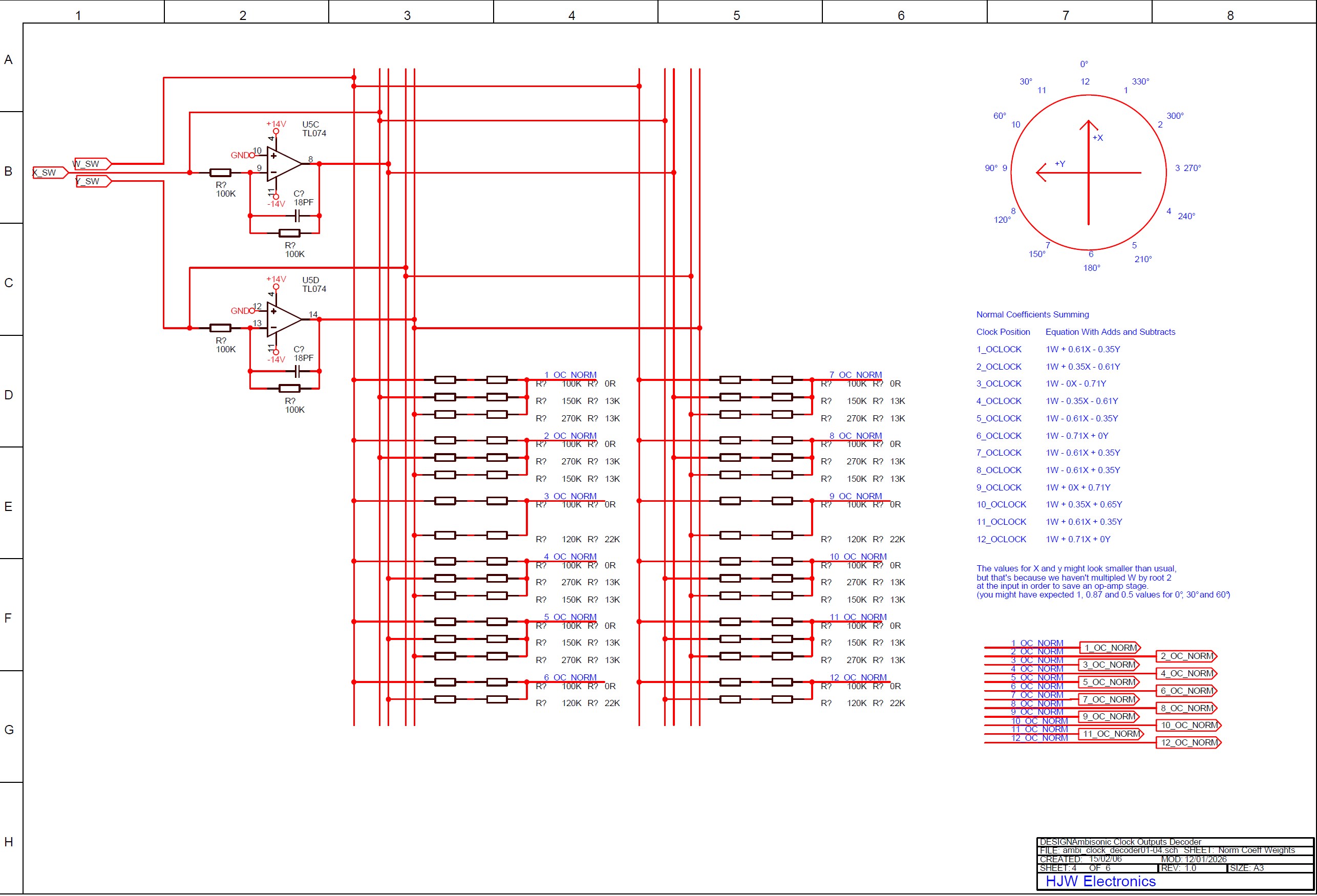
UHJ Decoder
The UHJ decoder uses standard design practices and equations as detailed in the original design papers on the subject. The phase shifters are implemented with standard 2-pole per op-amp circuits rather than the phase sequence networks used in my previous decoder. This has the advantage of flat frequency response and use of fewer capacitors in their reactive region in the signal chain. Recovered B-format is presented externally on the standard 5-pin male XLR output and an external lead feeds this back into the decoder for normal straight through operation. This can be disconnected and used to feed in B-format sources from the outside world if desired.
B-Format Decoder- General
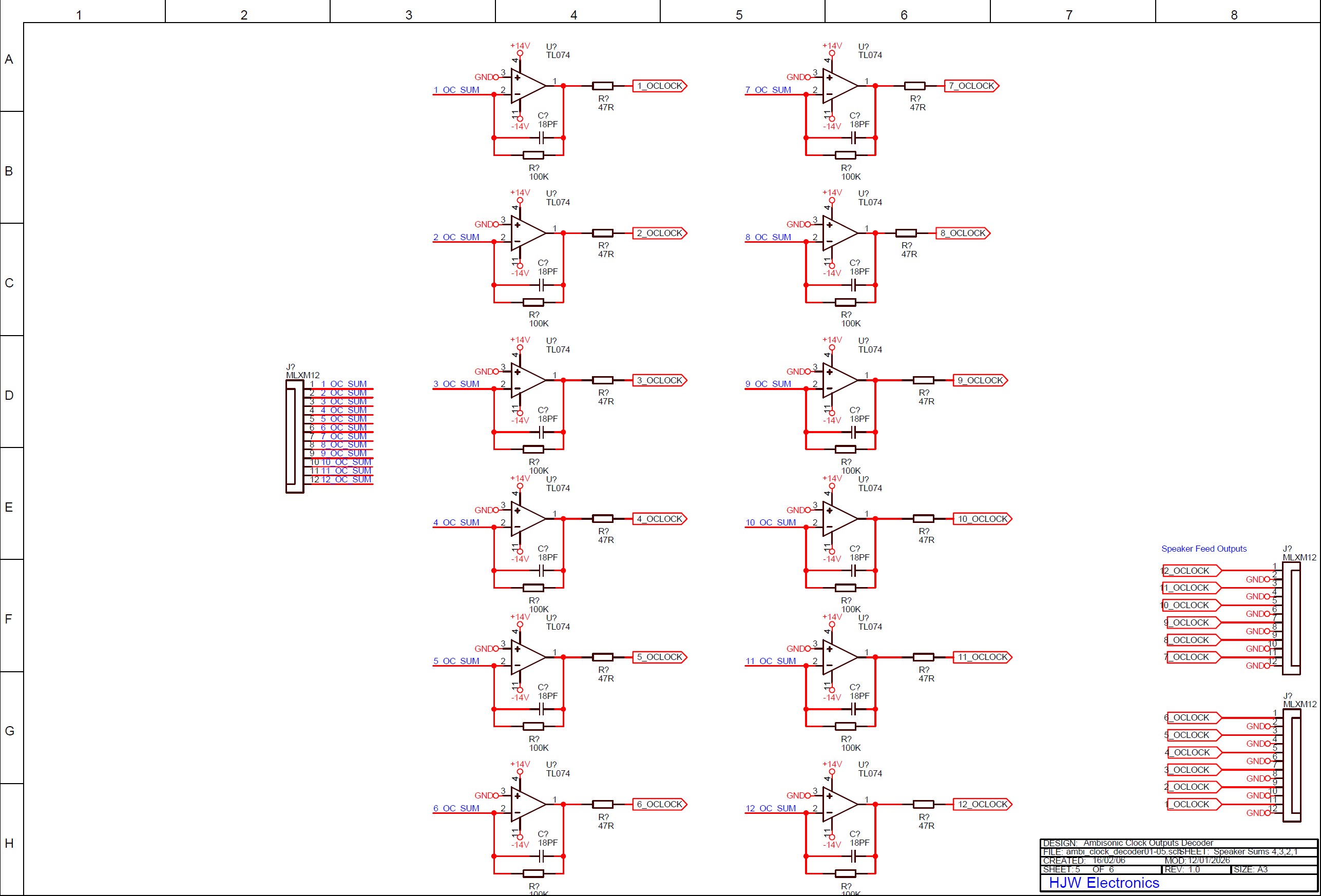
In general the B-format to speaker feed decoder presented here is substantially simplified from the usual concepts. It is assumed that the user has gain controls on each of the external amplifiers so that they can use recorded ambisonic material to set the gain of each speaker to give good results in a listening test. this removes the need for gain controls on this unit. It is further assumed that if the user requires more front gain then the external controls can be adjusted for this too. This decoder has outputs for twelve speaker feeds which have angles fixed internally, spread at 30 degree intervals around the soundstage. Each of the outputs labelled 1 to 12 creates a speaker feed designed for a speaker placed at that clock position, with the 12 O'Clock output being centre forward etc. It is expected that the user can find speaker positions close enough to these 12 possible positions to make errors practically undetectable in a home listening environment. In an experimental environment the speakers can be positioned exactly in any case. The O'Clock nomenclature gives an extremely simple and internationally understood method of expressing approximate angular direction and is seen as a significant advantage of this design. No complex front panel switching or programming is required to assign speaker feeds: The amplifier for a certain speaker is simply plugged into the appropriate output socket. The absence of front panel controls brings down cost and reduces both the perceived and actual complexity of operation. By making some reasonable compromises we have reduced front panel controls to a mains switch and a neon power indicator, which are combined in a rocker switch.
Standard B-Format Decoder Matrix
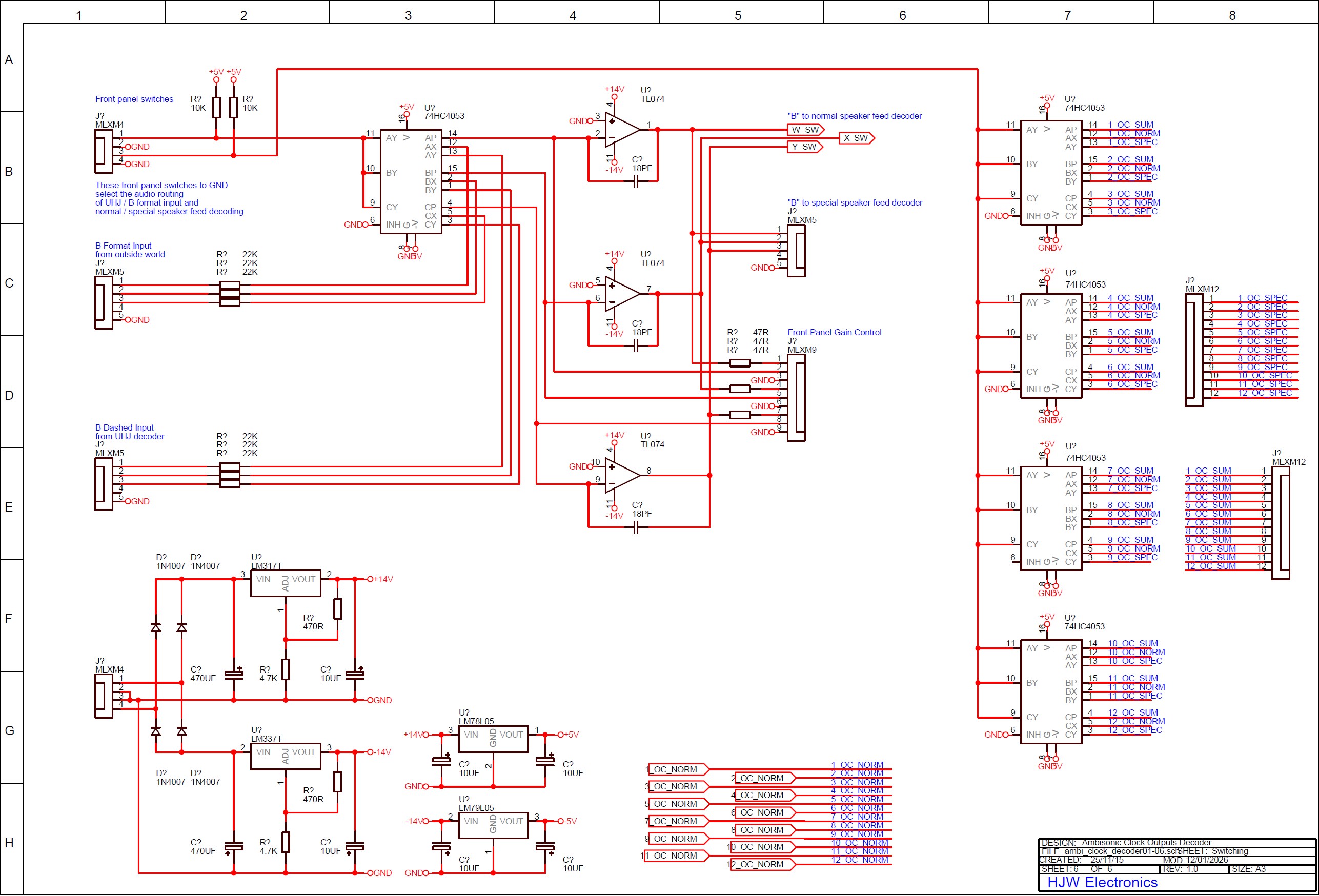
An internal 12-way jumper can be plugged to give completely standard B-format to speaker feed decoding coefficients for the twelve outputs. In common with the previous design, no shelf filtering options are included. The decoding coefficients produce a cardiod shape around the speaker circle, hence zero output from the speaker directly opposite the maximum direction of a panned sound.
Experimental Phase Shifted Speaker Feed Matrix
The W, X and Y signals are first passed through all-pass phase shift networks. These are the familiar imperfect phase-shift filters as used in UHJ encoding and decoding. This creates 0 and 90 degree versions of W, X and Y signals and 180 and 270 degree versions can then be generated by inversion. Now, using appropriate sine weighted sums of these signals will allow any arbitray phase of W X and Y to be generated. As these phase shifts are wideband and relative, any speaker feed with the correct ambisonic amplitude output can be created, only now it can be created with an arbitrary phase relative to the other speakers. The proposal is to apply a phase angle to a speaker feed which is numerically identical to its angle from centre front. So for speakers at the twelve positions of the clock, the relative phase shift will be as follows.
Clock Position Phase Shift
1 +330
2 +300
3 +270
4 +240
5 +210
6 +180
7 +150
8 +120
9 +90
10 +60
11 +30
12 0
From this you can see that each pair of opposite speakers are now driven in antiphase.
Mono signals with purely W content will tend to cancel at a point in the exact centre of a perfectly circular and balanced speaker array. Looking at the system slightly differently you can also see that a mono sine wave will spin around the array at its own frequency, with each speaker cone receiving the signal phase-shifted by the angle of it's physical position; A mono sine wave will create a spiralling wavefront. (A dual spiralling wavefront?)
A sine signal presented at position 12 for example, will have equal amplitude cancelling signals coming from positions 3 and 9, and less equal cancelling signals from other opposing speakers. Only the centre front signal from position 12 will have no interfering signal, as its opposite feed position 6 has no signal due to normal ambisonic amplitude based speaker feed generation.
It is hoped that this might provide
an enhancement to the usually rather vague directional imaging
of first-order ambisonic decoding. The normal amplitudes of a
non-shelf filtered speaker feed decoder are maintained with just
the phases being altered, so it is difficult to see how it can
be made worse. As a cancellation strategy this method, to me,
seems more logical than shelf filters as it at least avoids
allowing antiphase components to emanate from the speaker
opposite the desired maximum sound direction.
Nope. Everything checks out on the
'scope when I've tested it using outputs from standard classic
ambisonic equipment like the A+D Pan-Rotate and UHJ encoder, but
while actually listening to that, or standard UHJ CDs including
the Nimbus walkround, the standard decode gives better angular
performance. The "NORMAL - SPECIAL" toggle switch spends its
entire life in the NORMAL position. It's either a rubbish idea,
or I've done something wrong. Or both.
Q: How many speakers do you need in
a first order horizontal ambisonic surround-sound set up?
A: This is not a variation on the light-bulb joke. A very
long time ago, the answer was, "As many as possible."
That's not true. The answer from a mere long time ago is, "about
four, maybe five, definitely not eight." If you have too
many, a phenomenon called spatial aliasing occurs which actually
reduces the surround effect. I can attest to this in
practice. My 'clever' system was an attempt to get around
this. If you have a higher order ambisonic system, more speakers
is a good thing, but again there will be a limit. You'll have to
ask the academics for the maths. I just change the light
bulbs:)
Henry's email address:
Recent Edit History
23-FEB-2006: first publication of clock
outputs and phase shifted crosstalk cancellation concept
12-JAN-2026: major update, incantations, and I did actually make
it