12 Volt Photovoltaic Solar Battery
Regulator And Load Controller
If you're enjoying these pages and you
have an interest in hobby type electronics or repair jobs, you
might like to visit my other website www.usefulcomponents.com,
where there are details of some components for sale and some good
electronics kits.
Introduction
The first part of this page has a
somewhat historical 2004 perspective. An updated section is
provided lower down the page.
This device allows solar cell arrays to be connected to either
conventional lead-acid, sealed lead-acid, or lithium storage
batteries without fear of overcharging. It allows two different
electrical loads to be driven from the batteries at two different
charge states to maximise power usage efficiency.
This project came about after I purchased a Camping Gaz
thermoelectric portable refrigerator for keeping drinks cool while
out camping. The existing power control circuit in this fridge
aims to avoid discharging a car battery by ensuring that it only
runs down to a certain voltage. This means that it will only run
for a short time after the engine is turned off. While a sensible
precaution, this prevents efficient use of solar power to drive
it. The existing circuit also suffers from oscillation caused by
voltage drops in the wiring from the unit to the power source,
generally a cigarette lighter socket; Rather than switching off
cleanly the load relay spends several tens of minutes clicking on
and off uselessly as the car battery voltage slowly drops back
from its on-charge voltage. I wanted to be able to get some level
of refrigeration for a few minutes even if the weather was not
especially sunny. What I needed was a storage battery of a few
amp-hours, a solar panel for charging, and a controller circuit to
turn on the fridge when enough charge had built up for a few
minutes operation. The original relay based power control circuit
in the fridge was removed and the power input wired direct to the
fan and Peltier effect cooling unit. The nominal current draw of
the fridge is 4A.
Batteries
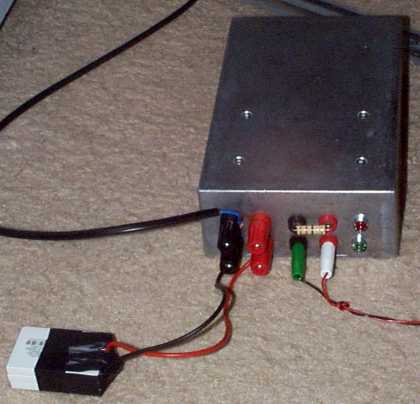
There is space inside the regulator
enclosure for about 7Amp-Hours worth of surplus mobile phone
lithium batteries. Three 3.6V nominal voltage cells are wired in
series which produces a battery of 10.8V, then multiple banks of
three are wired in parallel. The voltage varies over the charge
cycle from 3 X 3.0 = 9.0V when fully discharged to 3 X 4.1 = 12.3
V which is the maximum allowable on-charge voltage. Higher
voltages will destroy these cells. The 12.3V maximum charge
voltage allows the battery to be charged from 12V solar panels and
the 9.0V full discharge voltage allows most non-critical 12V
equipment to run the batteries right down to empty without
over-discharging them.
An external battery can be connected if needed but if it is a
different technology the internal one must be disconnected first.
The external battery may be lithium as described, conventional
lead acid, or sealed lead acid and the appropriate voltages are
selected on an internal DIP switch. The circuit is designed to
draw very little current so that some charge can be accumulated
even when the weather is quite dull.
12V Solar Regulator Circuit
Operation
Electronic
Schematic Diagram Of 12V Solar Regulator
solar_regulator01-01.pdf PDF
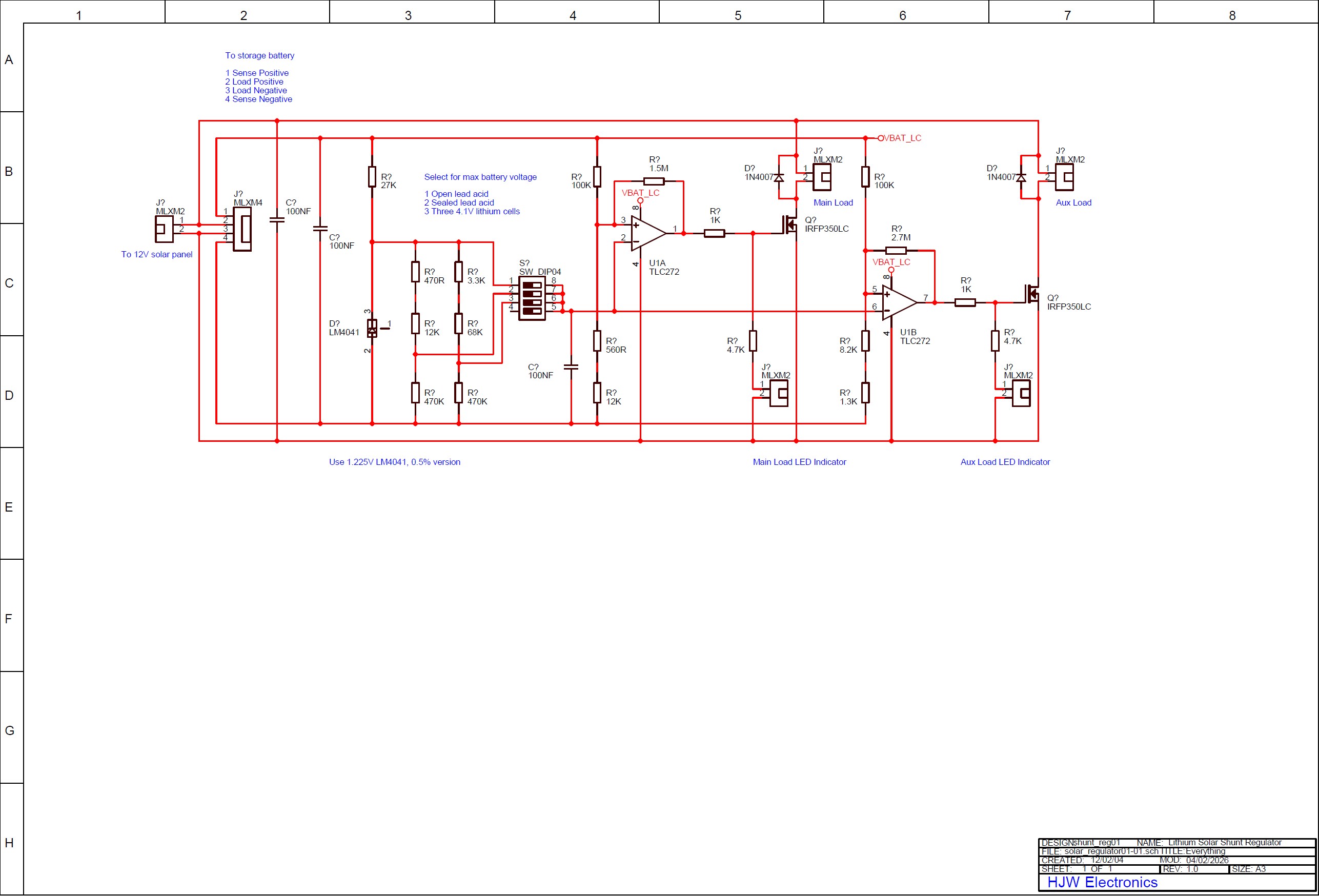
In the actual device the transistors are bolted to the aluminium
case. The schematic diagram shown here represents how the circuit
would be built if all components were on-board. Separate paths for
load current and voltage sensing allow the battery voltage to be
measured accurately even under loads of several amps. The LM4041
provides an accurate low-power voltage reference for the sensing
circuit. This 1.225V reference is used directly for the
conventional lead-acid setting and via two alternative dividers
for the sealed lead acid and lithium voltages. Using a 1% version
for the voltage reference and 1% resistors in these dividers keeps
us from going too far above the magic 4.1V limit on standard
lithium cells without having a pesky trimmer, or worse, a set of
trimmers. As the voltage across the battery rises under charge,
the main load output will be switched on when a voltage some way
above the fully discharged level is reached.
If the load current exceeds the available solar charge current,
the batteries will drain back down to the fully discharged state
and the load will be disconnected again. Some hysteresis avoids
the load switching on and off too frequently, but this all depends
on the available charge current, battery capacity and load
current. If the charge current exceeds the load, the battery
voltage will continue rising until the full charge voltage is
reached. At this point the secondary load is turned on to prevent
overcharging. If no secondary load is naturally available, one
must be provided in the form of a resistor. If the standard load
current exceeds the maximum output of the solar array this is not
needed. IRF350LC MOSFETS are used for load switching which allows
loads of more than 10 amps to be switched. A dual CMOS
rail-to-rail output op-amp is used which simplifies the
calculation of the switching voltages. LED indicators drawing
about 2mA each show which loads are turned on. If lead acid
batteries are used then it's worth noting that there is no
temperature compensation on the charge voltages, so it's best to
keep them between 10 and 30 degrees C, or the -2mV/K coefficient
of this technology might result in overcharging of sealed gel
units.
|
Main Load V rising |
Main Load V falling |
Second Load V rising |
Second Load V falling |
| Conventional Lead-Acid |
11.06 |
10.37 |
14.16 |
13.66 |
| Sealed Lead-Acid |
10.77 |
10.10 |
13.79 |
13.30 |
| Lithium |
9.606 |
9.006 |
12.30 |
11.86 |
Use In The Field
Applying a load only to the secondary
output, you can choose to charge up the batteries to near maximum
and dump excess power into the load only to stop overcharging.
Applying the load to the main load output extracts as much power
from the system immediately as it is generated. For camping fridge
operation one might typically connect to the main load output most
of the time, possibly switching to the secondary output if power
was needed for some other purpose on the main load e.g. charging a
mobile phone battery, or if it was desired to store up charge for
a period of prolonged fridge operation.
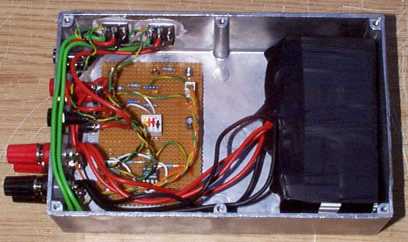
Picture Of The Insides While Under Test
The battery connected here is just one group of three
lithium-ion cells.

Picture Of Two Panels Out In The Garden Under The Solar
Intensity Levels Typically Found In The UK

The panel on the left is a 5 Watt cheaper amorphous silicon panel.
They have a higher leakage current and must have a Schottky diode
in series with them to avoid the battery discharging through the
panel in dark conditions. They are cheap but you have to spend
time sealing the edges against moisture with epoxy, so its not
really worth the hassle. The weatherproof crystalline silicon
panel on the right is rated at 12V 10 Watts under full
sunlight. The panels here are connected in parallel after the
Schottky diode to provide test power for the regulator circuit. One advantage
of using solar power for outdoor activities refrigeration is
that the power is most available when it is most needed.
A Nominally 10.8V 5Ah Lithium-ion Battery Exposed, And Then
Wrapped Up In The Box.
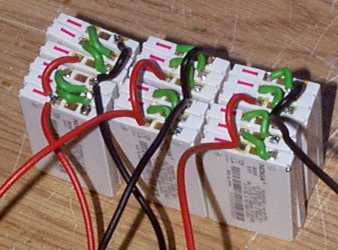
Note the use of good thick battery wiring to avoid losses when
on-load. Mobile phone lithium batteries are designed to supply up
to 2A current pulses in GSM phones. I may need to parallel up
another two series batteries of 3 X cells and squeeze them into
the box in order to avoid the protection circuits internal to the
cells tripping when driving the fridge.
12 Volt Solar Regulator And Load
Controller From A 2026 Perspective
A lot has changed in the solar world
over 22 years, but less so in the 12V charging world. I still
have this box connected up and running.
That Camping Gaz Peltier Fridge
Was rubbish! 4 Amps, and
it never did any cooling that was detectable inside, while blowing
off a good 48 Watts of heat outside. After literally a few hours
use, the bearing in the fan failed and turned into one of those
fan motors which carries on going, but sounds like a diesel
engine. This is in common with every bathroom extractor fan that
I've ever met in the entire world. When someone has the bright
idea of properly moisture proofing a bathroom fan motor bearing,
you could capture the world market. Back then you could get a
proper 12V fridge box with a miniature compressor, made by Engels,
or EuroEngels. You can still get then now. They can make ice and
use much less power. Don't bother with a Peltier anything. It's
not worth the plastic box.
You Should Probably Put A 2 Amp
Fuse On That
Yes. The 12V input needs a 2 A fuse
near to the controller box and battery in series with the solar
panel to avoid meltdown if the cable gets shorted. Anything
connected to the loads also needs a suitable fuse in series with
it. I've since retro-fitted everything where appropriate using the
automotive spade connector type fuses. Don't use the old style
tubular inline fuse-holders with the springy terminals inside.
They are universally terrible. I didn't have the fuses fitted
originally because the mobile phone cells have highly effective
short circuit protection circuits fitted internally, and I didn't
have that many cells to produce serious wire melting currents. The
fuses are crucial when using big lead acid batteries.
Lithium Ion Batteries Are Now 4.2V
Maximum Charge Voltage
Typical mobile phone batteries like the
white hard cased ones originally used here had an all important
maximum charge voltage of 4.1V. This crept up to 4.2V for the
later ones, and may be even higher now with certain chemistries.
I've seen 4.25V. You'll need to do that calculation and change the
resistors accordingly. I was happy to leave it at 4.1V to achieve
greater charge cycle longevity from the batteries. What happens if
you put too much charge voltage on any kind of lithium ion
battery? It depends who manufactured it, but don't try to find
out. The ones used here have over voltage protection, under
voltage protection, and short circuit over current protection
provided by a special circuit board inside each cell case.
The Big Battery And More Recent
Pictures
As time went by, I wanted a bigger
battery to charge laptops, run USB chargers, and everything else
like that. You couldn't get "powerbanks" or similar things then.
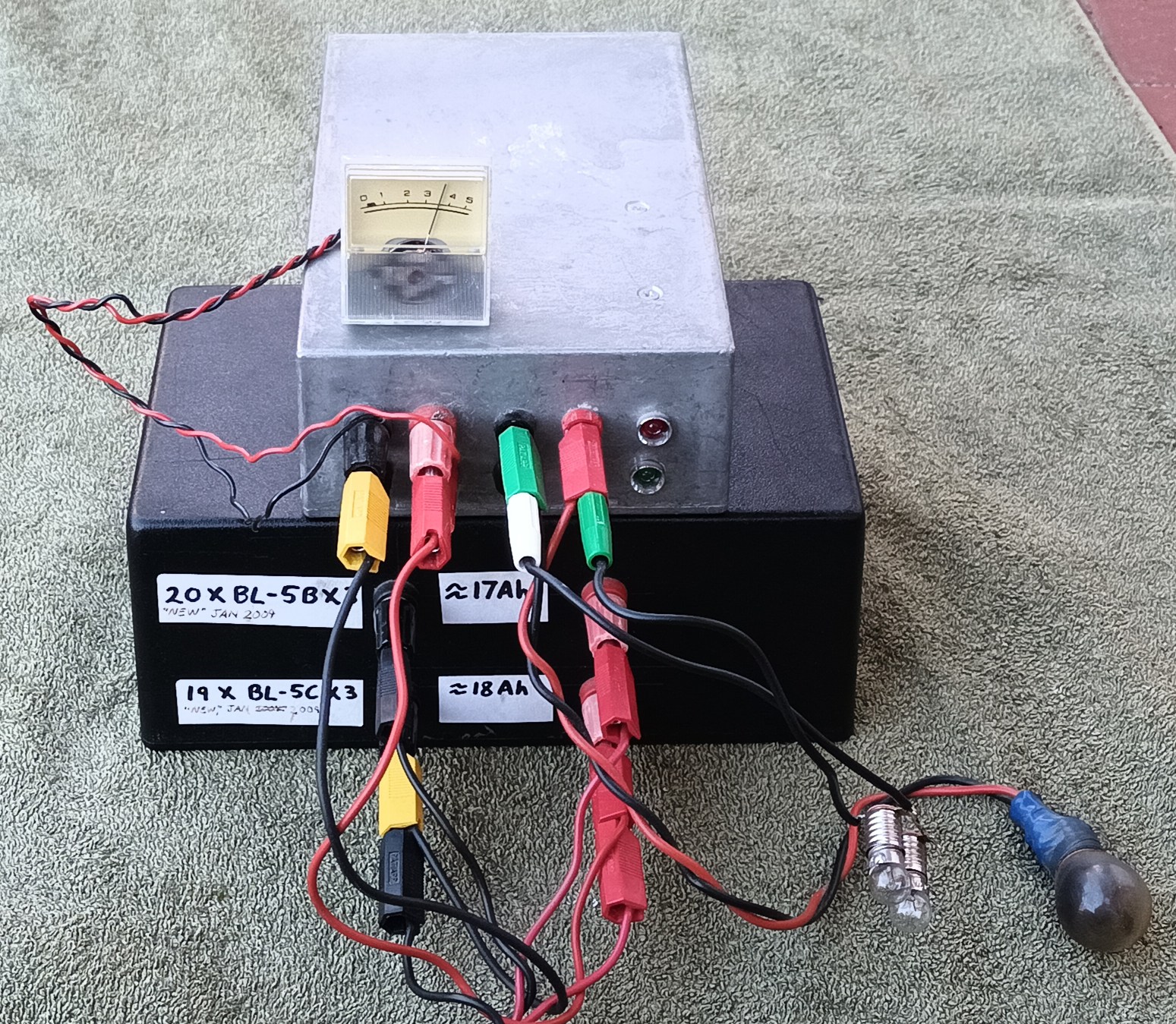
The Bigger Battery
I use several bulbs in parallel to provide the voltage limit load.
It's handy to see when it's operating. Using several in parallel
avoids losing the load when one of the bulbs finally burns out.
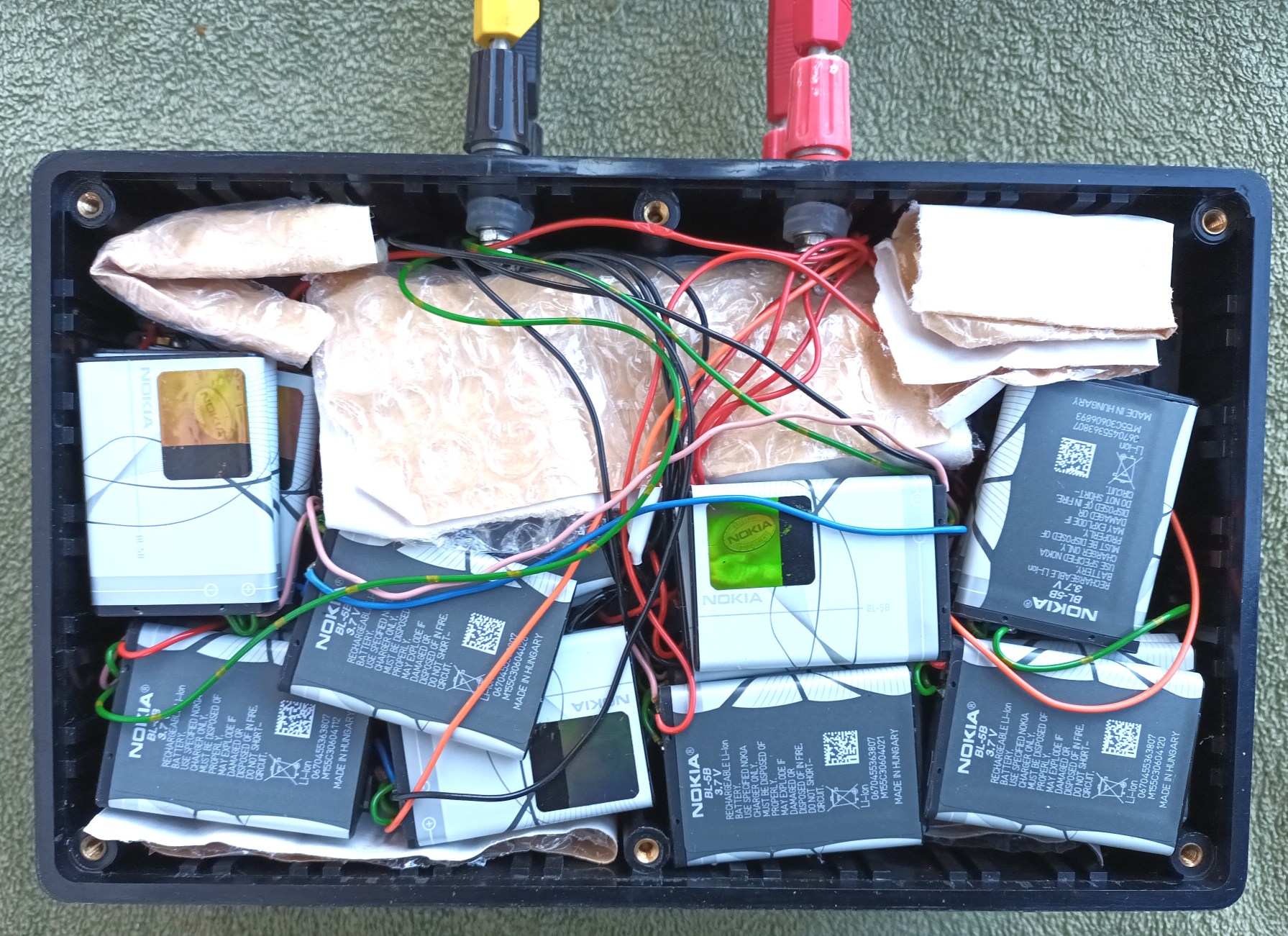
The Bigger Battery Insides
This is comprised of many, obsolete mobile phone batteries. I
decided to use two banks for two reasons. You can charge both in
parallel and then use one bank until it is exhausted, at which
point you know for certain that you still have half power left.
Also, you can connect both banks in series to get 24V should you
need it. This has proved handy when I've occasionally had a flat
car starting battery. Connect the bulb load in series diagonally
across the four 4mm sockets, and the other ends to the car
battery. Leave for 30 minutes, then you should have at least
enough car battery power for the ignition and a successful push
start, if not actual engine cranking.
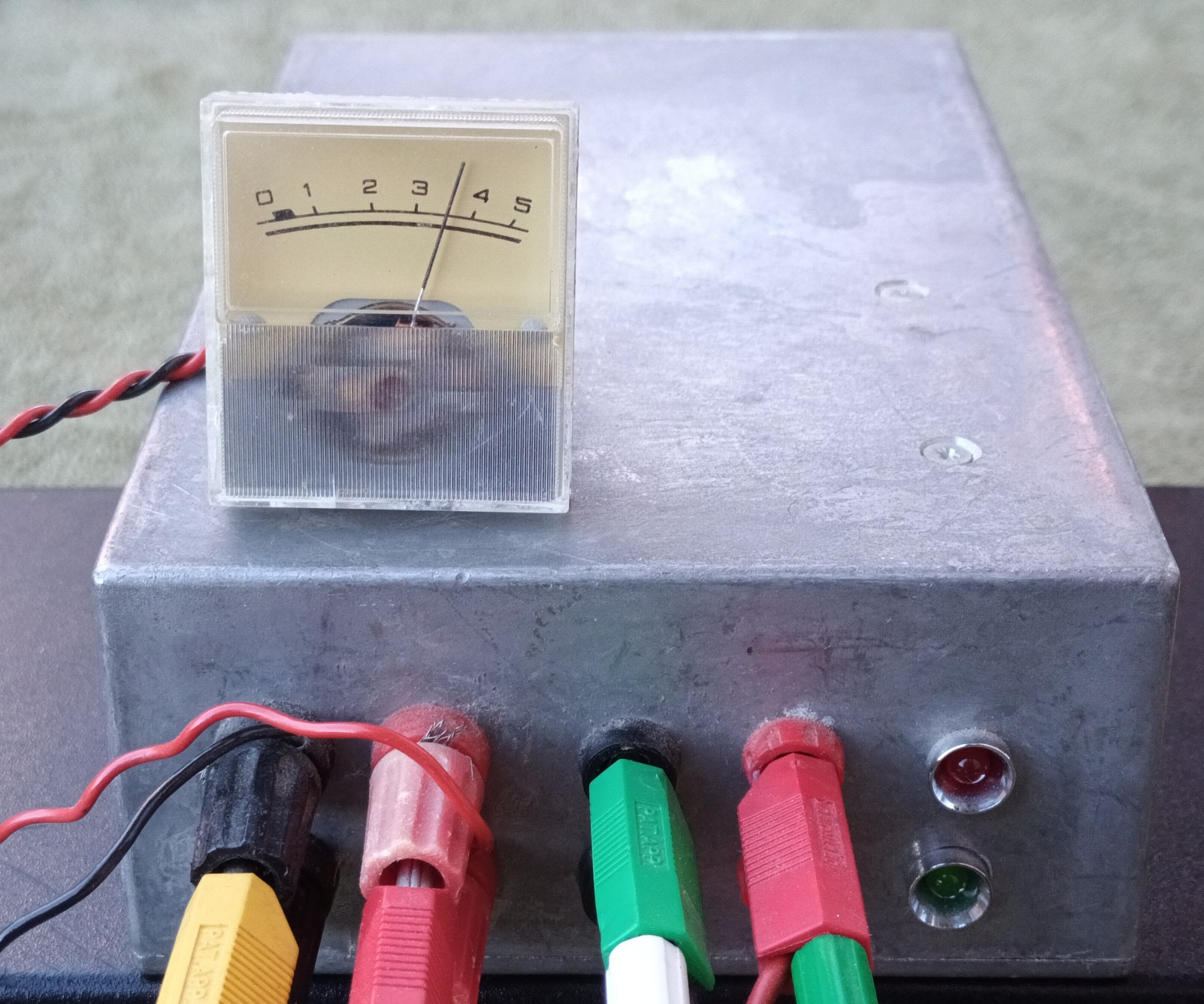
The Approximate Charge Level Indicator
This is an old Soviet panel meter with a zener diode and resistor
in series, such that it indicates just over "4" before the charge
limiting load turns on. Main load cut-off is at about "2".
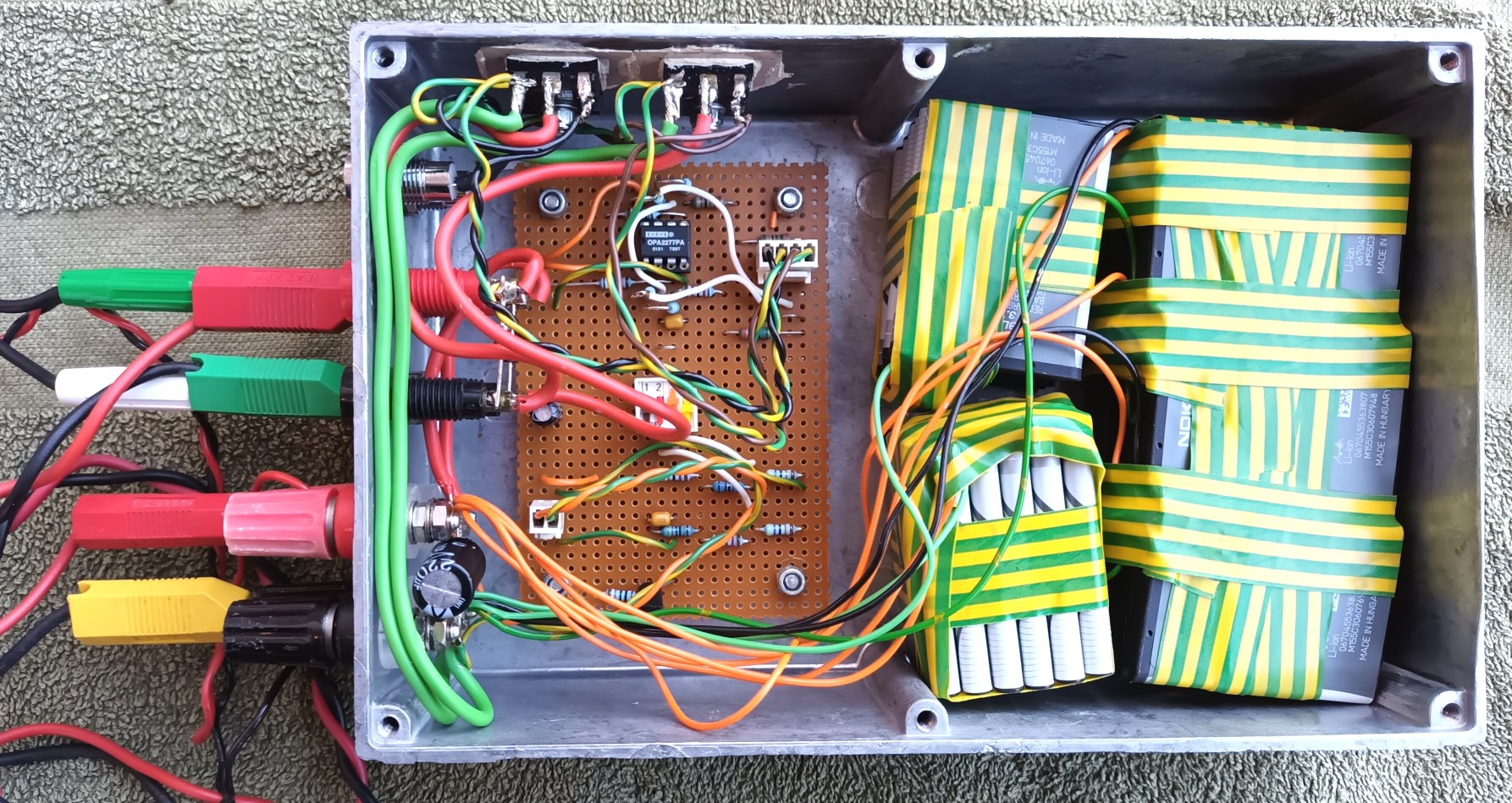
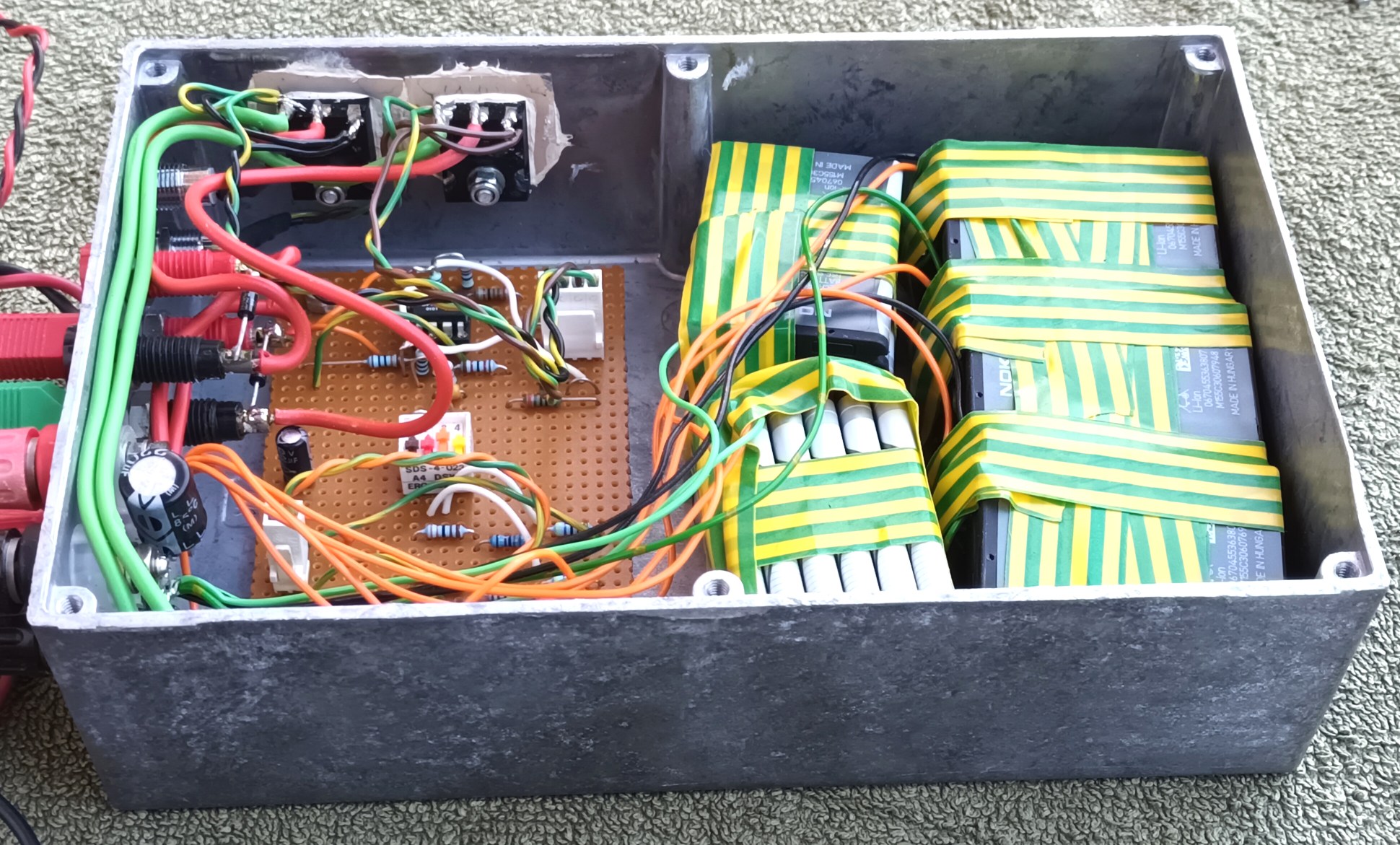
Insides Of The Box In 2026 Top View
It looks like I made a sneaky design change and plugged in an
OPA chip instead of the TLC272 in the original schematic.
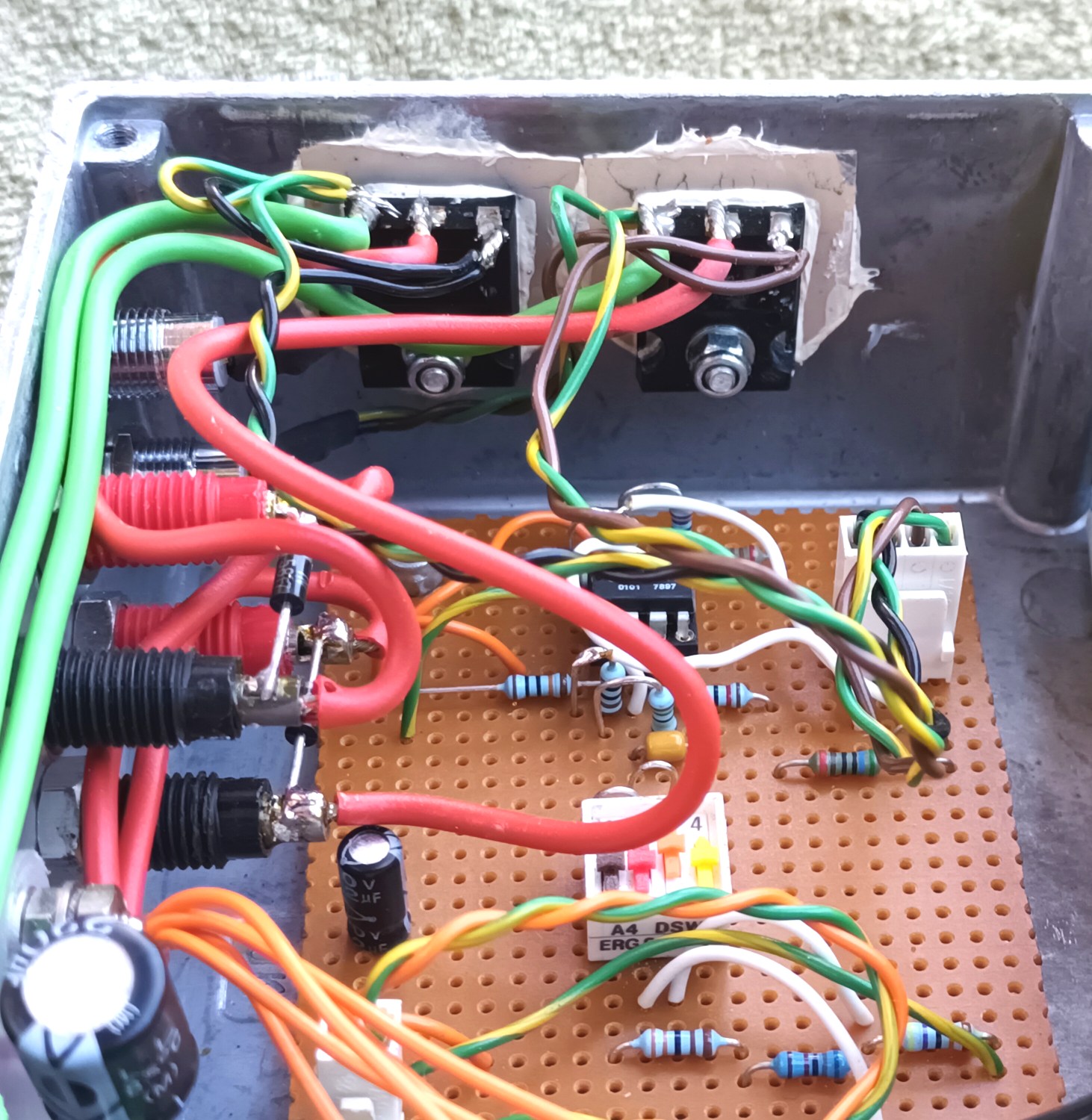
Insides Of The Box In 2026 Angle View Showing The Power MOSFETs
The whopping power MOSFETs do not have insulated cases, so there
you can see the two mica washers and the horrible white heatsink
grease where they are bolted to the grounded case.
Power MOSFETs Close-Up
I've been quite sensible and used nuts which have an anti
vibration nylon insert.
Repairing The 10 Watt Solar Panel
This has been generating power
sitting outside in the rain for 22 years. When I went to update
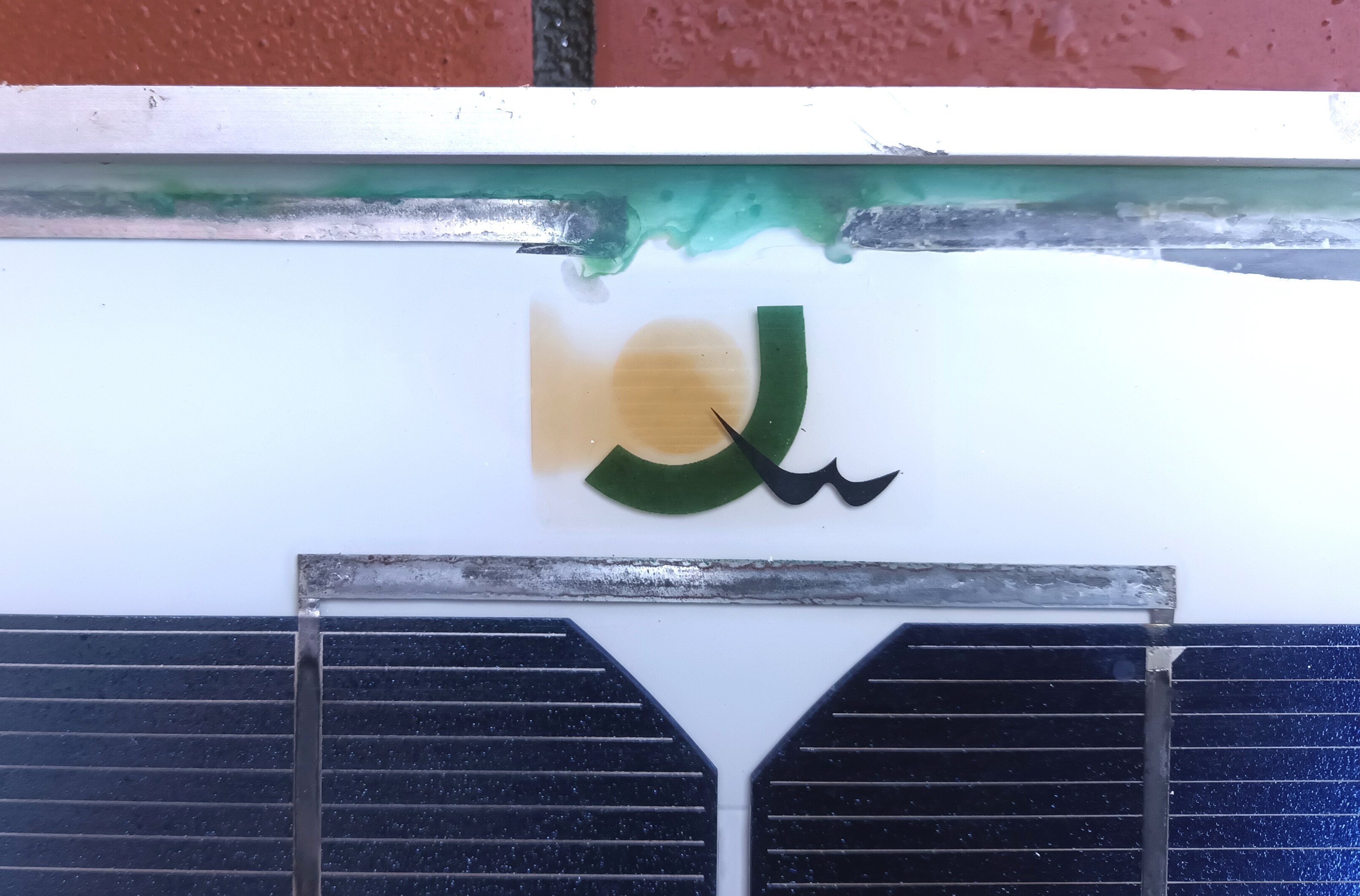
this page, I found that there was some small voltage present,
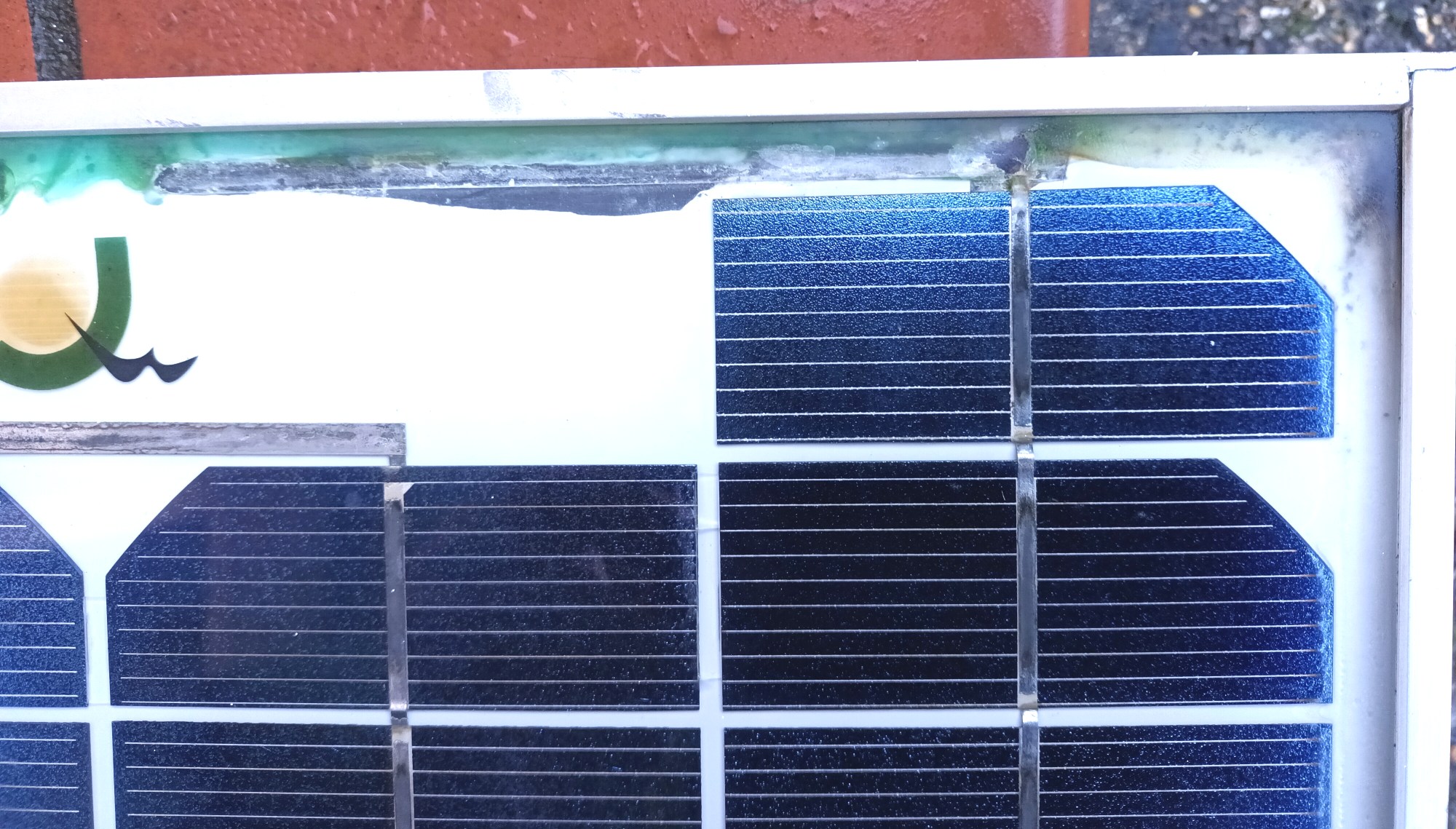
but no actual charging current. You can see that there has been
some water ingress where the transparent silicone sealant has
turned green with copper ion contamination from the internal
connection strips. What you end up having to do in such
situations, is cut and peel back the various layers and trace
back along the connection strips until you find the point of
failure, and then use some solder and epoxy handicraft to
re-make the connections from the good point.
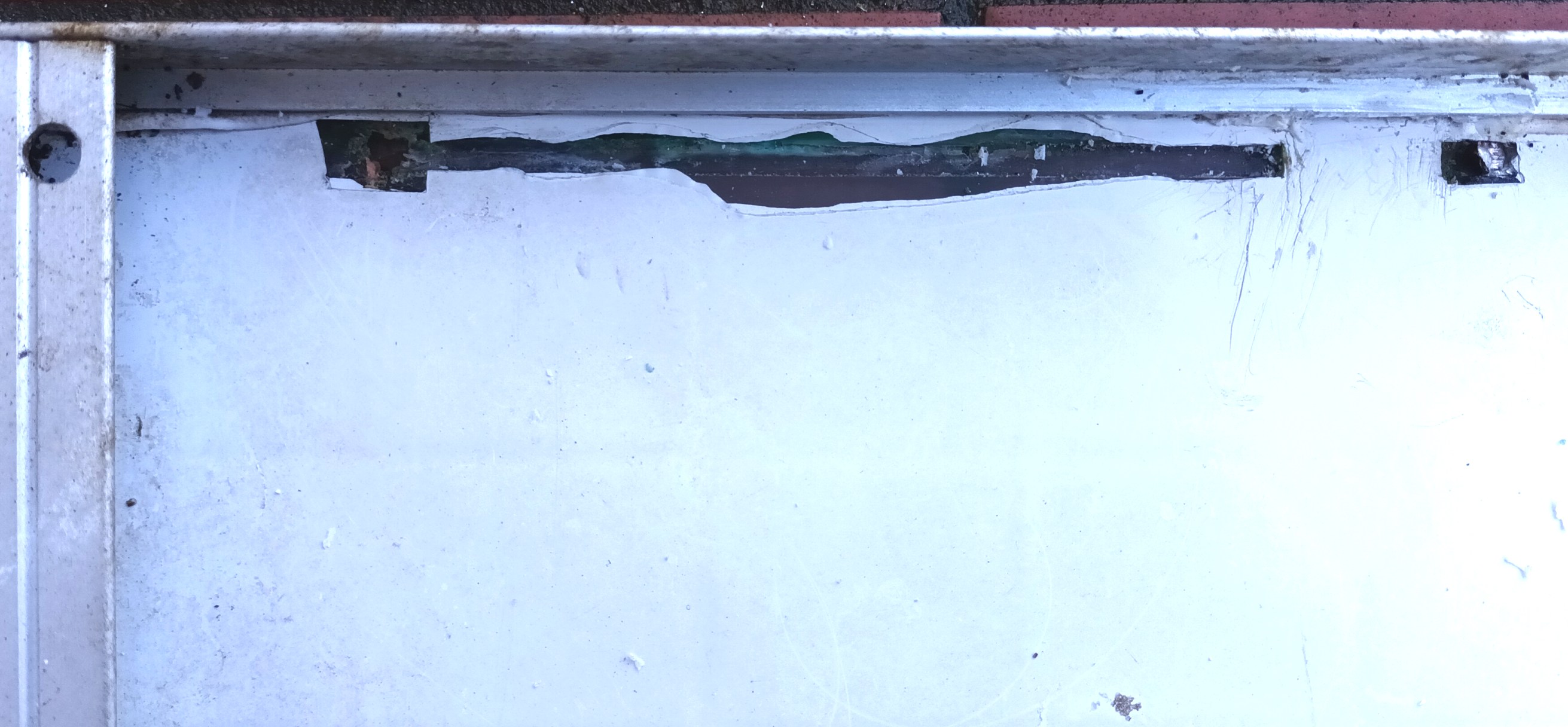
Paring Back Various Panel Layers
12V Solar Panel Water Ingress
12V Solar Panel Water Ingress Point Of Failure
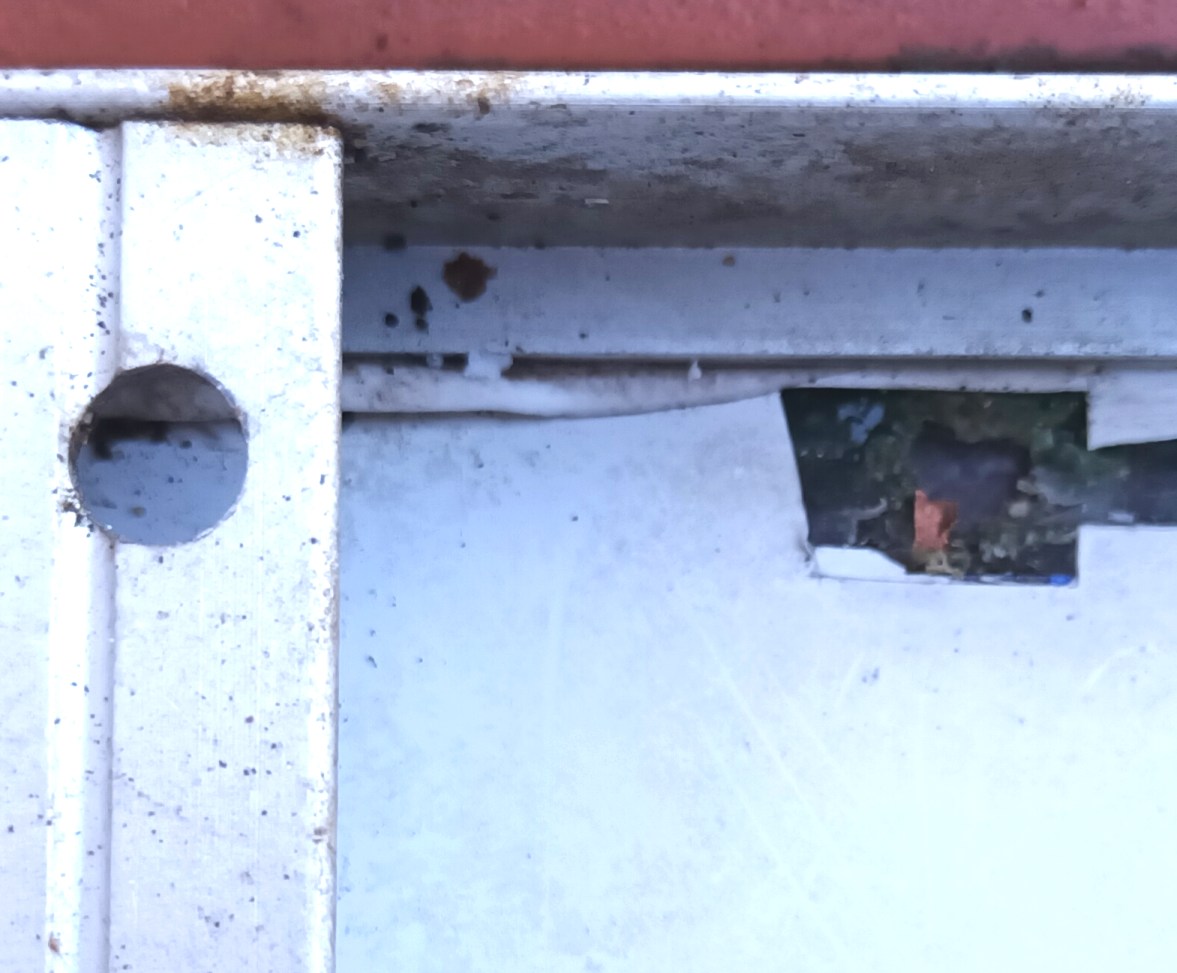
The point of failure was on the negative connection where it
makes a 90 degree turn downwards from the top horizontal.
12V Solar Panel Point Of Failure From The Rear
You are often left with a very small piece of copper strip which
requires soldering and then protecting. Here's the point of
failure on the negative connection side, scraped off ready to
make a new connection.
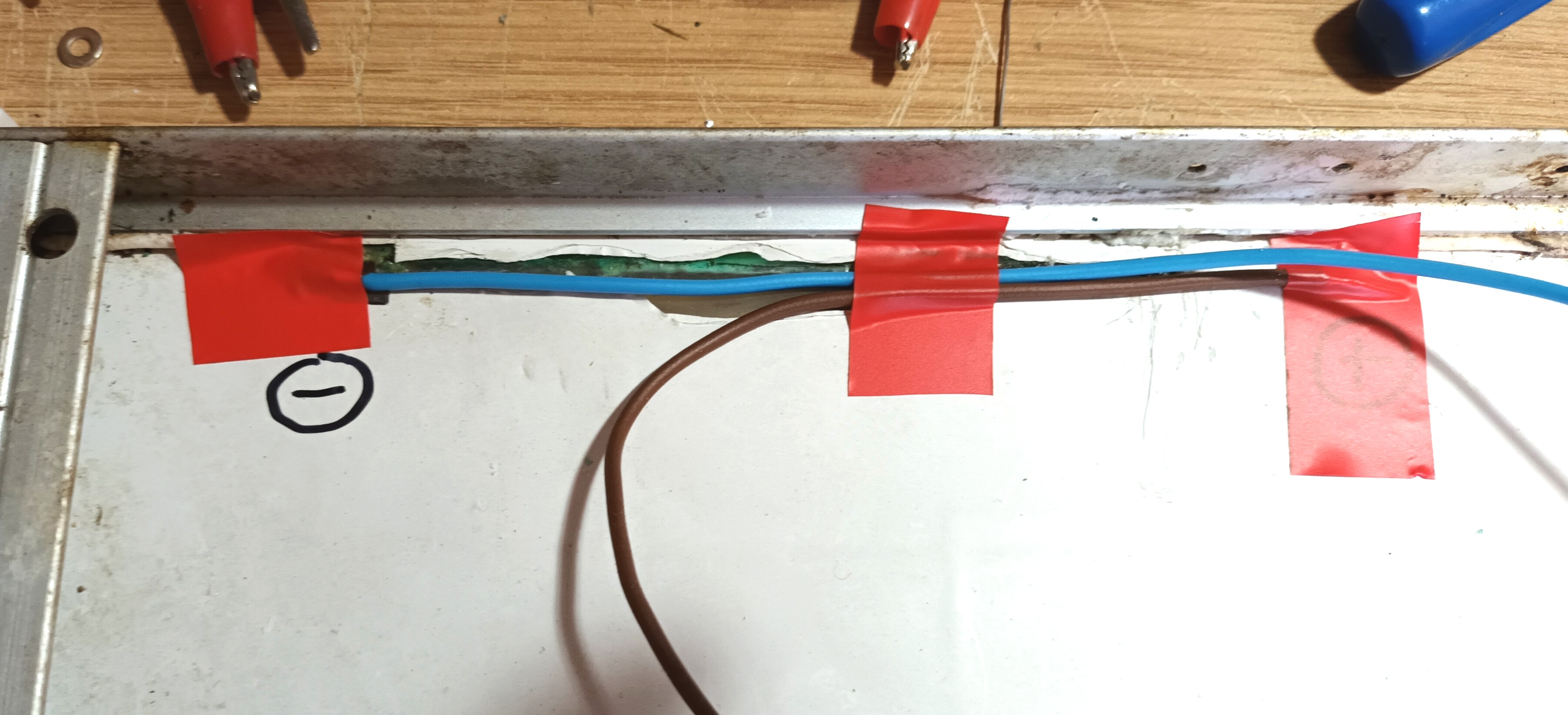
To avoid stress on the tiny connections, you first have to
arrange the new wiring before soldering. I used insulating tape
first, then cyanoacrylate super-glue to temporarily fix the
wires in position. To speed-up super glue setting, use a very
small amount of fine spray of ammonia based window cleaner. You
can buy special spray liquid to do this, but it smells just like
window cleaner, and the window cleaner worked just as well.
Pre-Positioning The New 12V Solar Panel Wiring For
Super-Glue Using Tape
Wires Shaped As Required On Broken 12V Solar Panel
When the super-glue has set, you can safely manipulate the new
wiring into shape and solder the ends onto the delicate internal
bus bar strips.
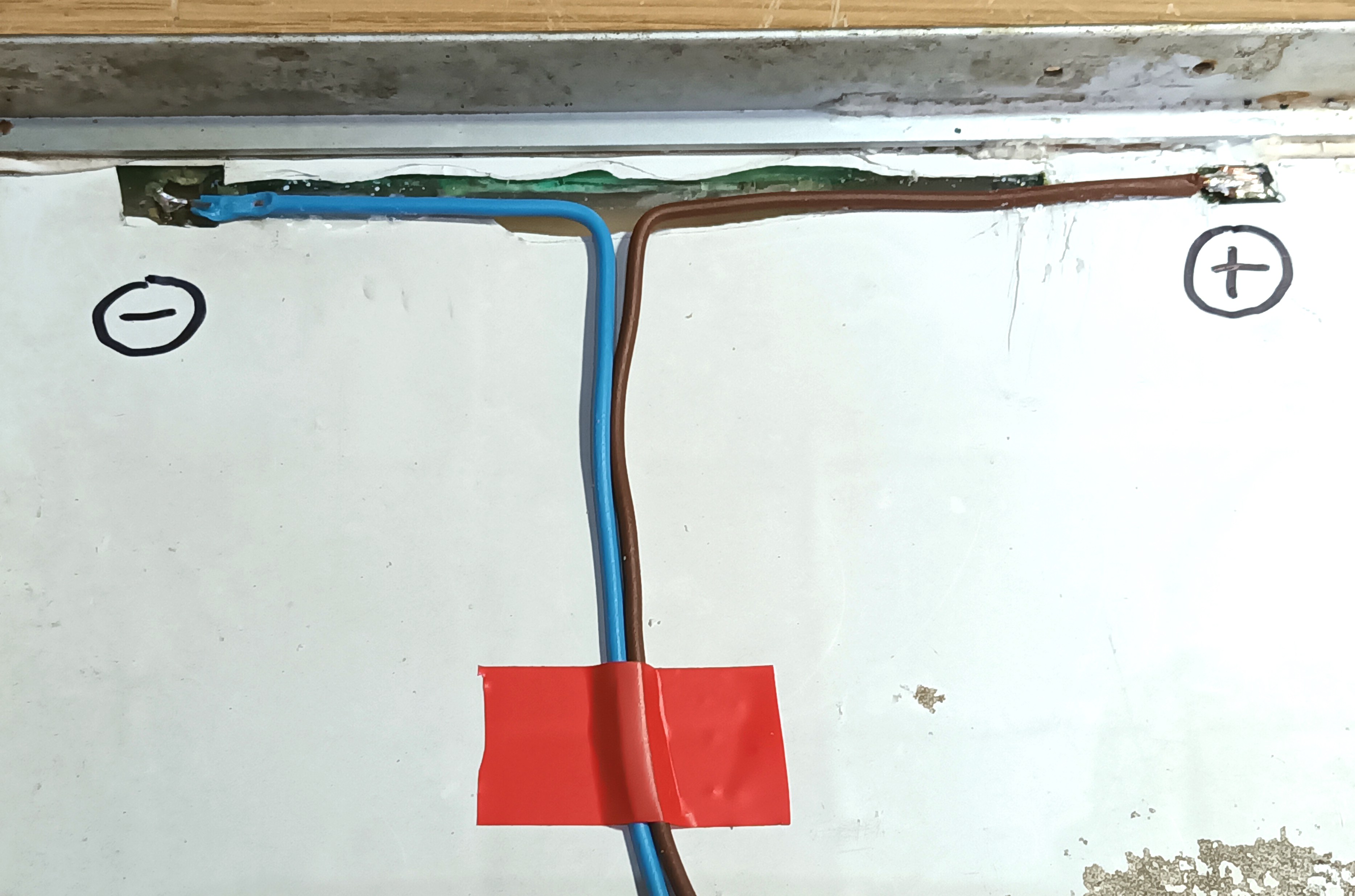
Broken 12V Solar Panel Replacement Wiring Epoxy Resin Sealing
Finally, it's a matter of getting out the epoxy resin and
blobbing it generously over the area. This avoids more moisture
ingress and avoids the replacement wires getting torn off too
easily. This is the point where you wish you'd super-glued the
whole lot down all over first, as the wires tend to rise up
through the setting epoxy. I thought that this particular resin
was never going to set, and had to keep poking the wires back
down. Fitting an old 40 Watt incandescent light bulb in a desk
lamp and using that as a heater set the resin rock hard in an
hour. It's still possible to accidentally rip off your carefully
made connections, so you need to tie them off securely
somewhere.
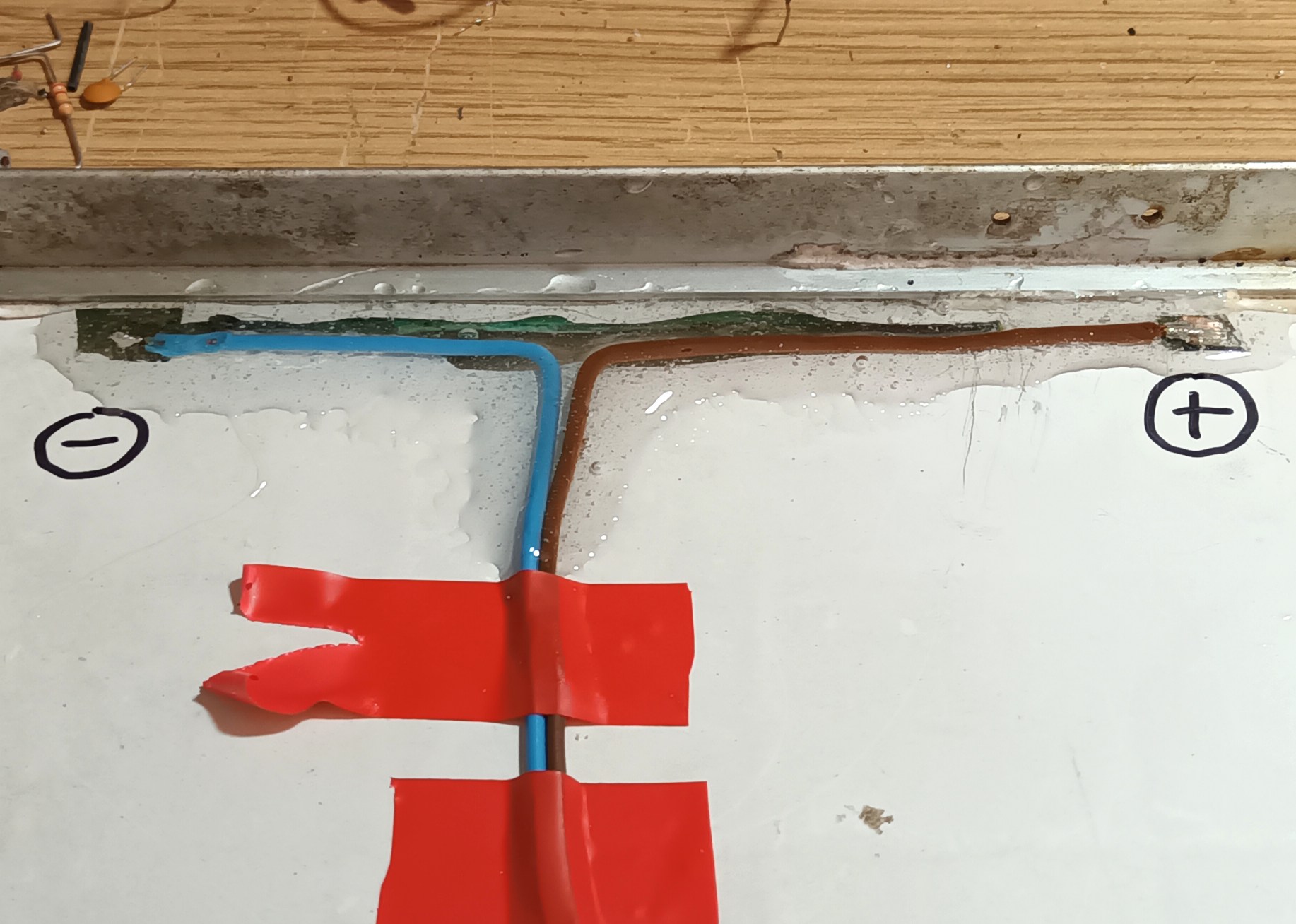
And that's how you rescue a 25 year old broken 12V solar panel.
Henry's main email address:
Navigate
Up
Recent Edit History
20-APR-2004: page created
13-MAR-2020: some updates
04-FEB-2026: major update, html incantations, new pictures