DIY Transmission Line Speaker
Enclosures
If you're enjoying these pages and you
have an interest in hobby type electronics or repair jobs, you
might like to visit my other website www.usefulcomponents.com,
where there are details of some components for sale and some good
electronic kits.
Introduction
This project started with a
requirement for eight matching speakers with good phase
characteristics for use in an Ambisonic surround setup. There is some
more recent information lower down the page.
In practice it would be cheaper and much less effort to just go to
Richer sounds and buy four pairs of decent budget loudspeakers,
but I was curious to see how this design could be made to turn
out, and I very much wanted to try to use a single wide-range
driver. I also wanted floor standers to save buying stands.
I've not gone into too much detail on the construction, but you
can pretty much see how it's done from the pictures and my
original plans. As mentioned above, I'd recommend just buying some
normal floor standing speakers instead. It is less back breaking.
Crossovers
I don't like passive crossovers. So
much for sound engineering judgements based on science and
measurement! Passive crossover units in speakers have always
seemed to be a very poor way to go about the task of separating
drive to the two or more drivers. Building electronic crossovers
is a doddle but then you need all those extra pesky amplifiers -
OK for stereo but not for an eight channel system. So I did lots
of web searching for decent wide-range drivers that went high
enough to cover the top end well and low enough so that the
compromised low frequency response could be compensated for with a
sub-woofer. And I found some. E.J. Jordan makes the JX92S which
can be seen on their website.
They are not cheap, and I could only justify the expense after
some internal mental trickery.
Henry: "Look how much you've saved by building the boxes
yourself."
Henry: "Oh yes. You've convinced me."
Transmission Line Design
I once read a Babani Press book by V.
Capel where he espouses TX line design and wide range drivers.
That's fair enough, but I'm deeply unconvinced about his enclosure
design. I'm not an acoustics or a loudspeaker enclosure expert but
I have some problems with it. So much so that I actually did a
couple of slightly less than full-size trial speakers which were
very close to his design to see if I could get a decent bass
response from a couple of cheap-ish 6 inch drivers. I got the
response I expected, which was somewhat worse that putting the
speaker straight into a very small sealed chipboard box. I think
he stuffs his line with far too much wadding. If you actually try
this much wadding the tube is pretty much sealed. I also deeply
dislike the way the speaker feeds into the box sideways and
somehow he expects the air movement or sound to just couple nicely
into the TX line tube sticking sideways off the end. I thought I
would have a go at my own design using some of the principles he
described though. A friend insisted that it's a great idea to
taper the line as it goes along, so I elected to go that way too.
I like the custom of putting a 45 degree ceramic reflector
directly behind the speaker which directs the sound down into the
line. This surely totally does away with the problems of
reflections from the back of the cabinet coming back out through
the speaker cone, as long as the area into which this wave is
reflected isn't fully rectangular itself.
As you can see, my line spirals around and vents out of the
side(s) via a number of holes drilled in the side panels.
Materials
I hate cutting up wood. But if you
choose your material carefully you can minimise how much cutting
has to be done. DIY shops sell 15mm thickness furniture board in
various standard sizes, and I chose my dimensions so that I could
use 6" wide furniture board for the front and rear panels, all the
internals, and standard width board for the two left and right
sides. This has a pleasant side effect, that standard width 6"
ceramic tiles can be used for the sound reflectors internally. The
internal baffles are glued and screwed securely to the side
panels. You need to use real chipboard screws for this and all the
other screws. 15mm furniture board is only just wide enough to
take chipboard screws into the edges without cracking up, and
normal wood screws will simply break up the stuck together sawdust
and become loose. When all the internal panels are in, the ceramic
reflectors are hot glue gunned into place. You need lots of glue
and it helps the adhesion if you warm the tiles up first.
Half Built Transmission Line
Speakers Under Construction
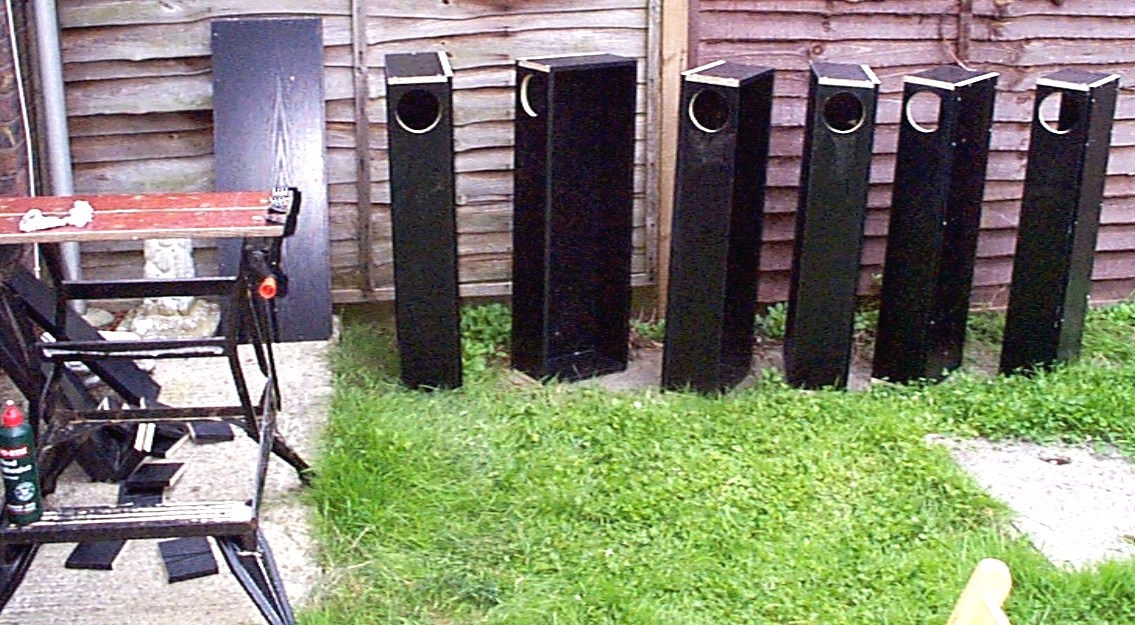
Here are six of the half built speaker enclosures looking like so
many Open University logos or Barbara Hepworth sculpture
knock-offs lined up in the garden. In fact this is clearly an
artistic installation, I just didn't realise at the time, due to
being crippled from leaning over the Black & Decker Workmate
guiding the jigsaw. I did six first off before doing the final
two, and I can not remember why. I think maybe the local Homebase
ran out of black furniture board. The drivers were then purchased
two at a time, as funds allowed.
BAF Wadding
Transmission Line Speaker
Enclosure Showing Wadding
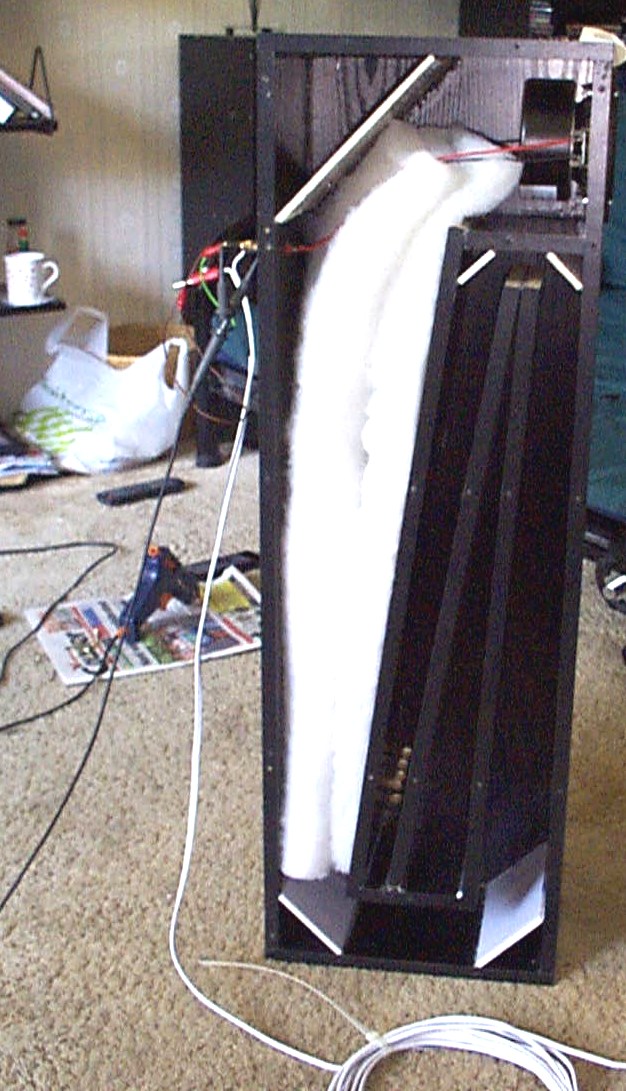
What does BAF stand for? Bonded Acetate Fibre. "Stuff enough in to
stop it sounding boomy in the bass," is the usual advice. Well
they don't sound very boomy even with nothing in. Is this because
I've made a fully tapered line which disappears almost to nothing
before the vent? It seems intuitive that this will be less of a
pipe like resonator than a line that is the same cross section all
the way along. I've since removed the wadding as it seems to make
no discernible difference to the sound. The vents are now 5 11 mm
drilled holes in each side panel at the end of the line. These can
be blocked up with blu-tack to check the effect.
Transmission Line Speaker Enclosure With Wadding Removed
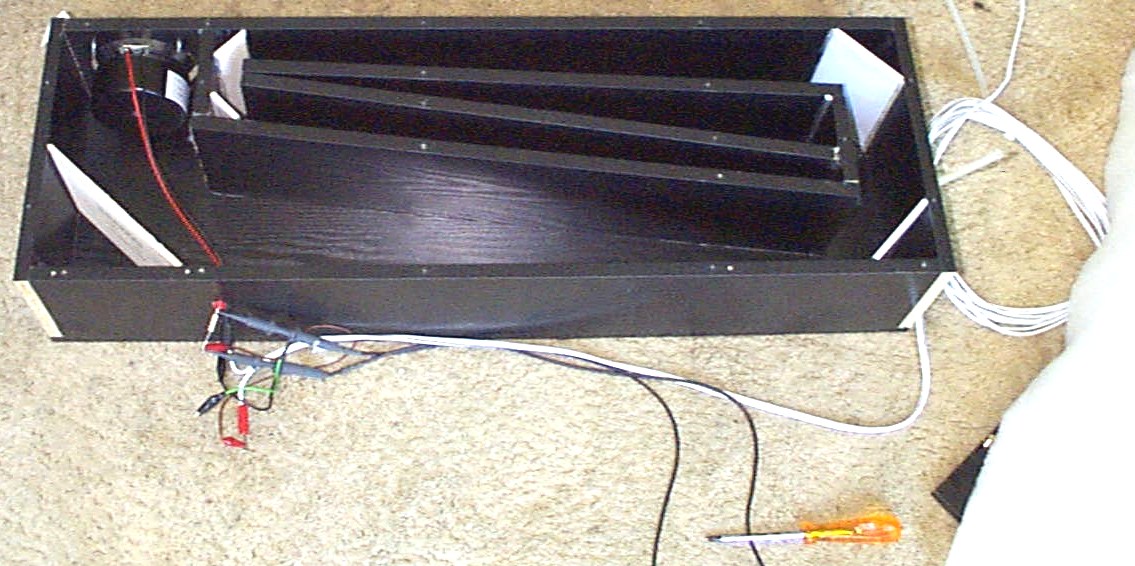
It looks like I was also doing an electrical impedance test here,
comparing the results of the sealed up final article and the lid
taken off. This would in theory give you a free air impedance
measurement of the driver and a measurement when loaded into the
enclosure. The measurement wasn't particularly cleverly done, and
would have involved measuring across a low value resistor with an
oscilloscope while driving from a sine signal generator via a
suitable amplifier.
Performance
It's so
difficult to judge without actually getting them into an
anechoic chamber and actually measuring it. Certainly I
expected more and lower bass, even with these diminuitive
drivers. When I checked the electrical resonance it peaks at
about 65Hz.
Transmission Line Speaker With Wide
Range Driver Completed
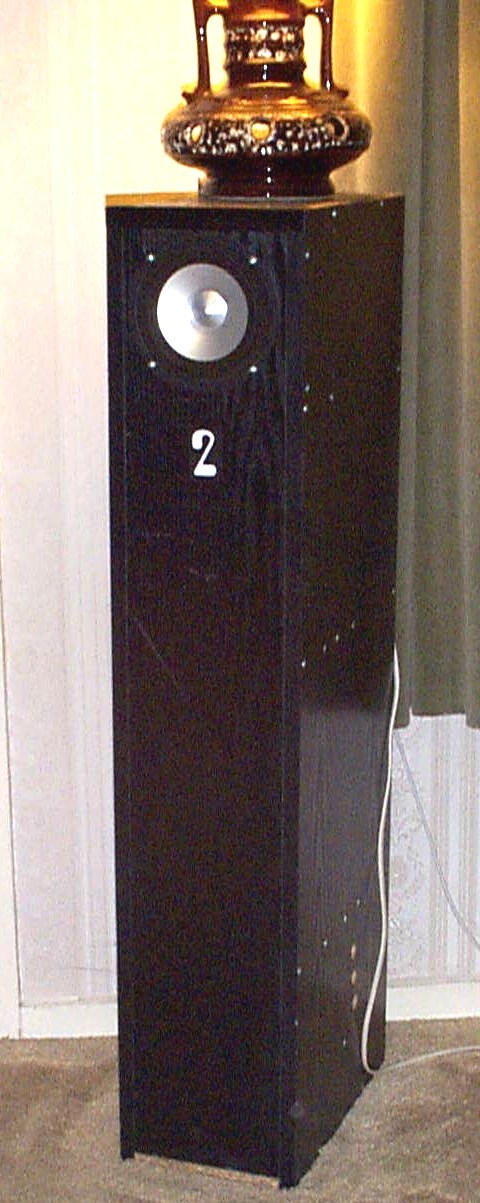
This is a picture of the finished article, speaker number 2 of 8
in the Ambisonic surround rig. It makes a great stand for
quality lighting pieces too. Careful observers may note that the
cropped furniture board ends are somewhat crudely finished with
black gaffa tape. Oh well, "function before beauty" is a fair
motto.
More Sensible Designs
I think that you could rationalise
this design a lot and have equally good or better performance by
not going quite so overboard on the line tapering. I particularly
think that the final taper section before the vent is over the
top. A new design would probably have the very first section along
the top of the enclosure the same area, and have the rest slightly
smaller equal area. The first reflector would be compromised a
little. These adjustments might make it more resonant and allow
the bass to extend, which could be controlled easily with a bit of
wadding in the line. The construction would be easier with no
awkward angles, and there would be more same length bits of wood.
Also, the internal butt joints would all be at 90 degrees so they
wouldn't require quite so much filling up with hot glue as mine
did.
Here is a dedicated transmission line speaker website. There are
lots of interesting designs, parts of which have clearly followed
similar thought processes to mine. I'm sure there is plenty more
transmission line speaker wisdom there.
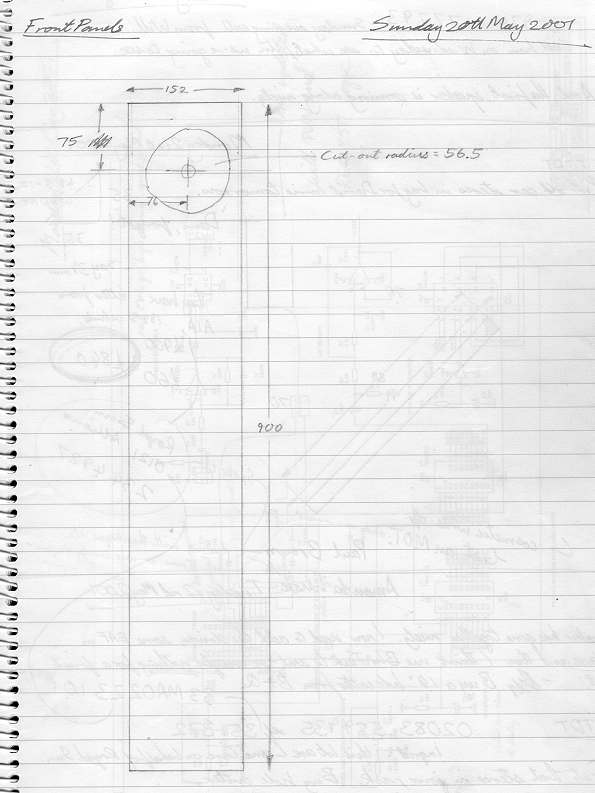
Due to popular demand, here are my original log-book drawings
showing measurements.
Small TX Line Speaker Prototype Side Plan

I wish I knew where these had gone. I think I made two. They may
still be lurking somewhere, but I suspect that I dumped them
during a house move. I have a use for one of these now, not least
some playing about with elliptical drivers and piezo tweeters. The
prototypes helped to establish that the build method was going to
be useable. This use of standard size 15mm thickness furniture
board, fine chipboard screws going straight into the edges of the
board, cut ceramic tiles, PVA adhesive, and hot glue construction
was not necessarily going to work. As it turned out, it was
adequate to quite good.
Small Prototype TX Line Speaker Side Panel Drilling Plan

Final Full Size TX Line Design Side Plan

Final Full Size TX Line Speaker Side Panel Drilling Plan

Final Full Size TX Line Speaker Front Panel Cut Out Plan
DIY Transmission Line Speaker
Enclosures From A 2026 Perspective
Transmission Line Speakers in Use
As Front Surround Speakers
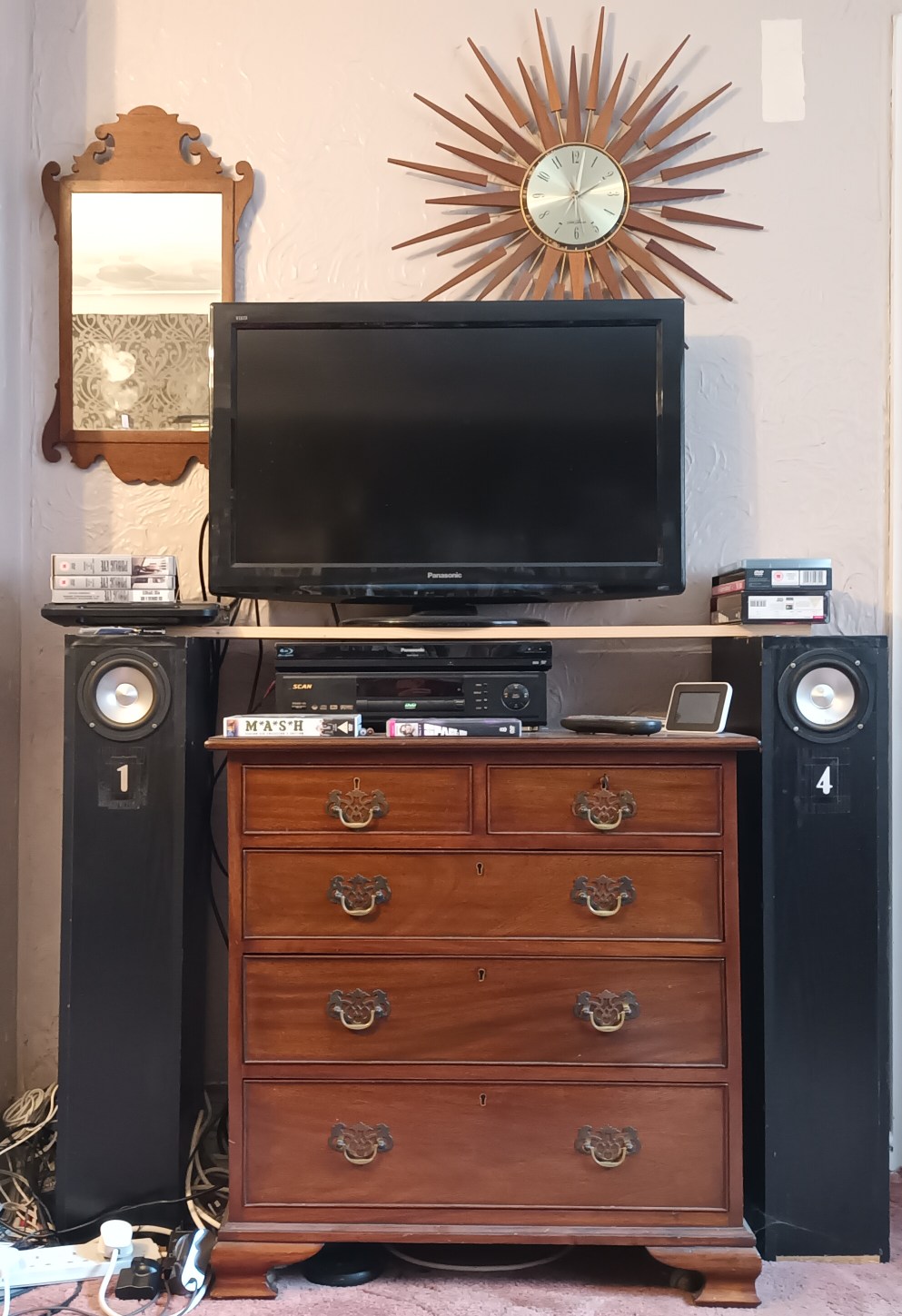
I'm still
using them, and with the help of some pine floorboard, they
offer side pillars to keep the weight of the TV off the DVD
player. Here, two of the speakers are used as the front pair for
watching movies with surround sound using an Ambisonic
decoder, which has the vectors in more or less the same
directions as Dolby Stereo analogue soundtracks, and has none of
the unpleasant analogue logic direction enhancement VCAs. They
sound pretty good when viewing in Surround Mono as well:)
Transmission Line Speaker Close Up
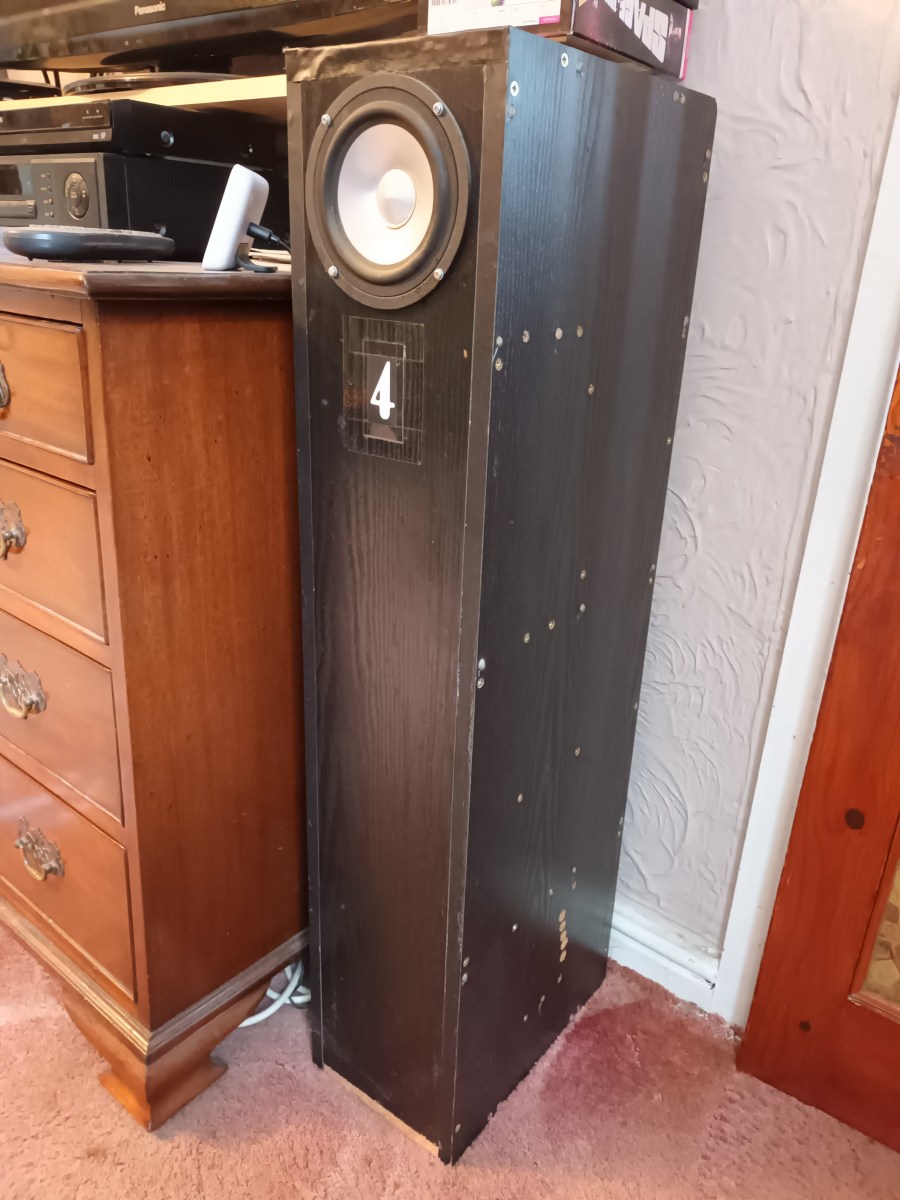
Here's a less fuzzy recent picture. They have taken some knocks
over the years. I heartily recommend some form of protection over
the nice aluminium cones, or eventually they will get a
bashing from something.
The V.
Capel Babani Book, "An Introduction To Loudspeaker And
Enclosure Design"
Front
Cover Picture
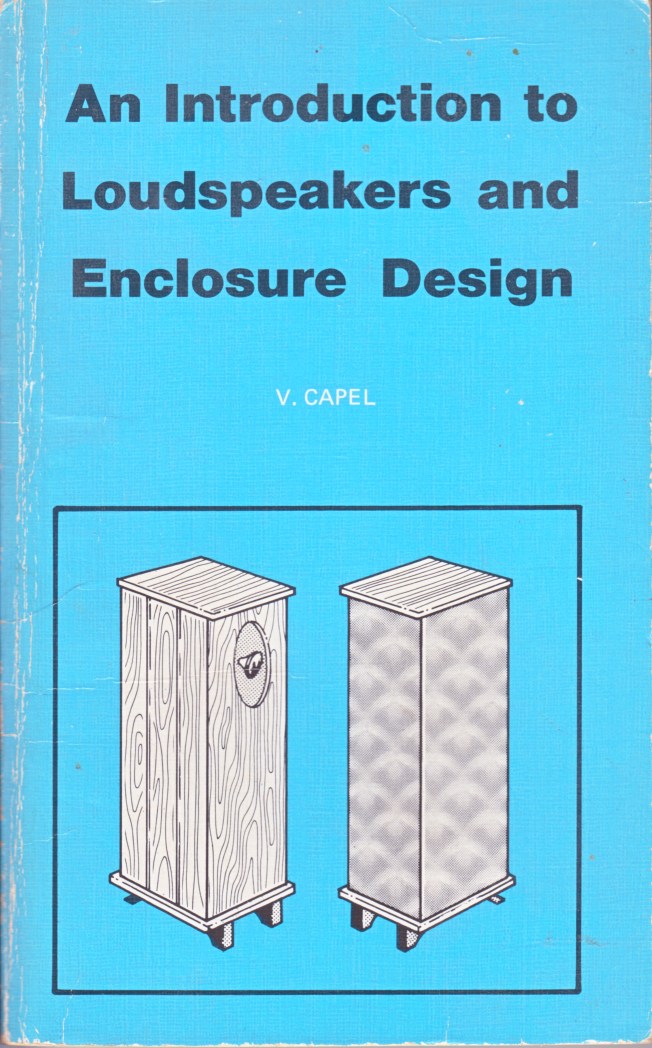
Rear Cover Picture
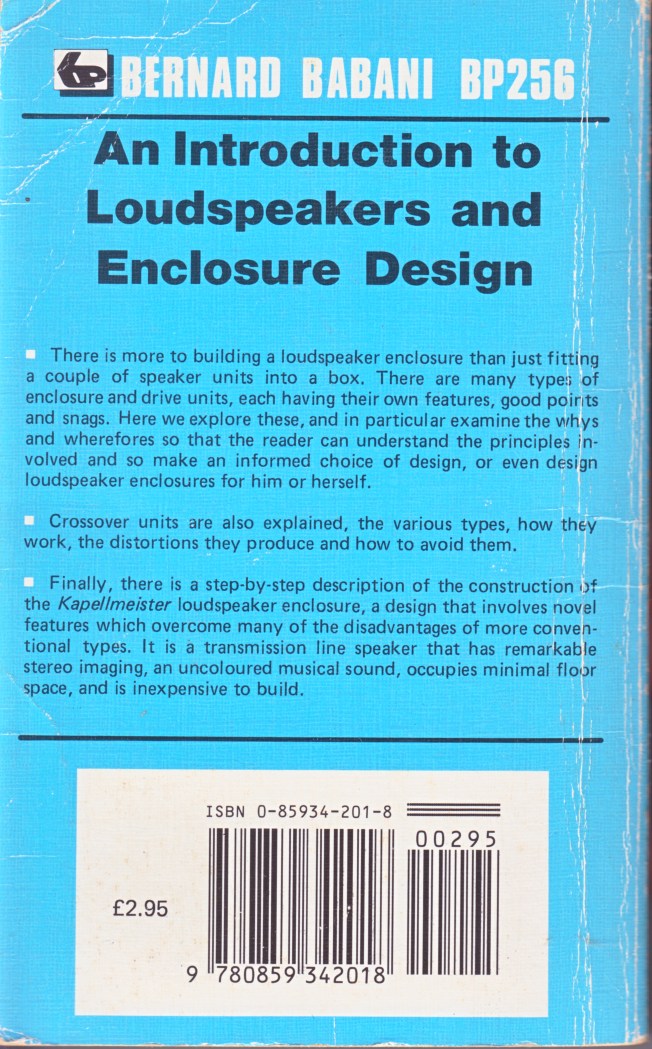
Showing the ISBN and EAN Numbers. It is still available. In
typical Babani Press style, 5" X 8" elliptical speakers with HF
centre cones are most certainly not.
Page 119 Of BP256 by V. Capel
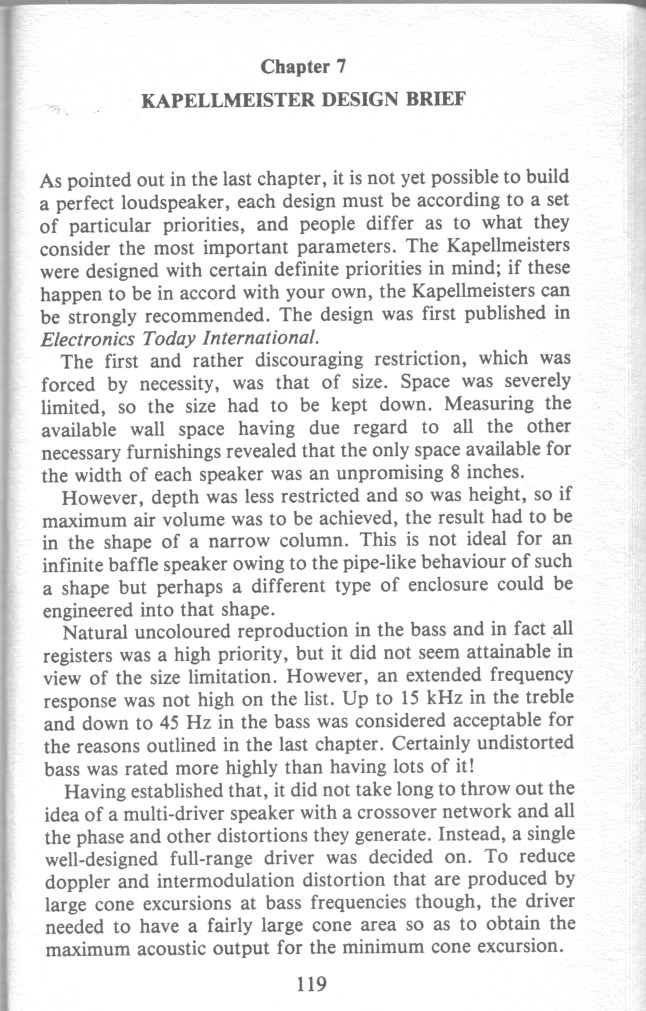
Here we meet the Kappelmeister transmission line design brief,
which you can't help but think that we've been led to favour in
the all the previous chapters. Fair enough. But some of us might
not be restricted to 8" of width. It's very handy for making the
front panel out of 6" furniture board and using 4" wide drivers
though, which is a rather better reason for limited width given
that it's not a personal feature of my own front room.
Page 122 Of BP256 by V. Capel
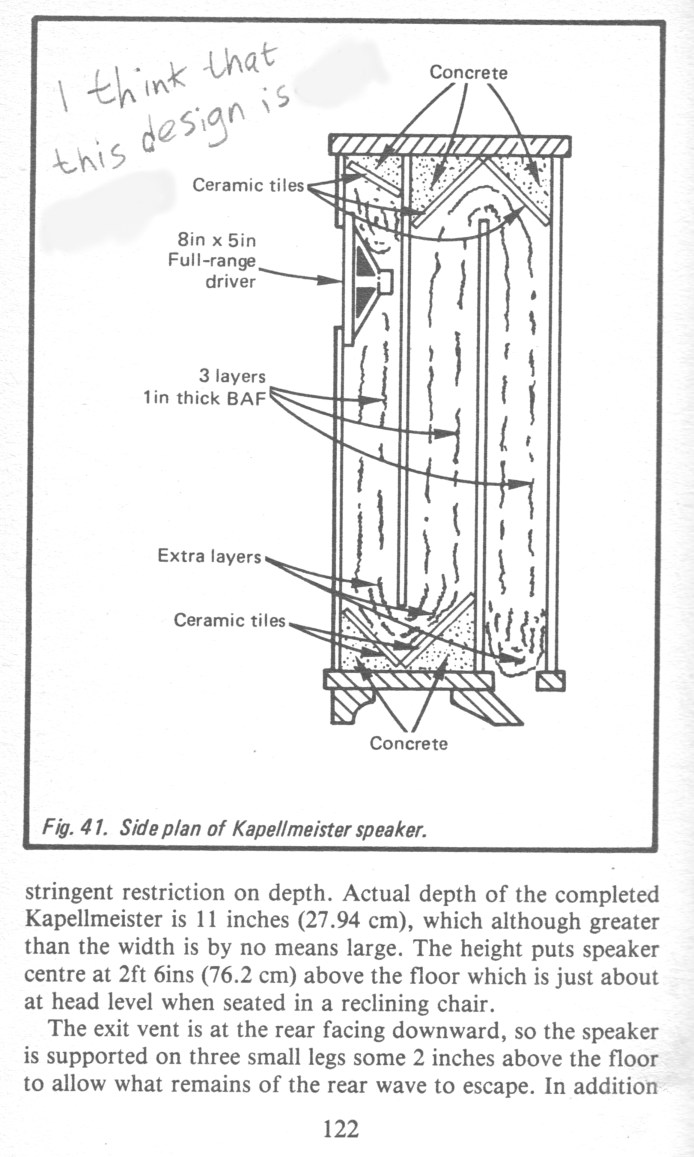
That's the basic design, and you can see that it's fundamentally
the same as what I've made. I've erased my initial rude and
unfair comment scrawled in the book.
Likes
Using a single wide range driver, so no passive crossover
Ceramic tile reflectors. Clever
Transmission line design
Dislikes
Way too much BAF, surely. That's just completely blocked at the
corners. It would never flush:)
No 45 degree initial reflector, just a straight back out of the
speaker reflector surface
Concrete filled corners, really?
Lots of different bits of wood, if you buy the book and read on
Concrete? Blimey. I thought furniture board was heavy.
That's just too much. I'm all for mounting the tiles with a more
finessed method than hot glue, but concrete. Jeez!
I shouldn't be too rude about the Babani Press books. They were
cheap, and are like Ladybird books for electronics engineers, full
of interesting ideas. Sometimes though, for beginners they are
full of elephant traps, and were frequently a bit outdated even
when they were still being published. This one is well worth a
read, and as it says in the title, it's an Introduction to
Loudspeaker and Enclosure Design, not The Bible.
Cheapskate Duvet BAF
If you need some BAF wadding for your
speaker design and can't get any from a speaker making outlet, you
might consider what the material is inside of an inexpensive
synthetic duvet. As far as I can see, it's identical.
Piezo Element Tweeters
I've not had a hearing test for a long
time, but I could no longer hear the 15.625 kHz horizontal line
frequency whine from a 625 line PAL CRT based television when they
were still in use. If you have better high frequency hearing you
might find the lack of high frequency response to be inadequate.
If so, you could try the old trick used in Philips and other
manufacturers' ghetto blasters, that of using an inexpensive piezo
element as a tweeter and connecting it directly across the main
speaker. You'd then mount it behind another small hole in the
front panel of the speaker, or perhaps some other scheme which
doesn't involve making a hole in your carefully crafted
transmission line. The piezo elements are capacitive and have a
high frequency response. This means that you can get away with
that simple connection strategy without a crossover network. If it
was too trebley, you could just fit a 100 Ohm pot in series with
it and adjust to taste.
Number Of Speakers In Ambisonic
Surround Arrays
I mention in the original discussion
that I had eight speakers for a horizontal only 1st order
Ambisonic surround sound system. At the time, I thought that when
it came to the number of speakers required, it was a case of the
more the merrier. Wrong! Due to a phenomenon known as spatial
alising, that was far too many. The right number is somewhere
around four. You can really hear the difference, even in a highly
imperfect listening area. In modern higher order systems using DSP
digital signal processing, more speakers is a good thing.
And Finally...
Can you still get wide range 4"
speakers from E.J. Jordan, or anything else like that? I've not
checked. There's no substitute for a good quality driver for Hi-Fi
or Mid-Fi use. That's not going to stop me digging out those old
prototype enclosures and putting some crappy modern elliptical
speakers into them, for use as a communications speaker attached
to a Murphy B40 via a matching transformer from a Mk.I Bush TR-82.
Henry's general email address:
Navigate
Up
Recent Edit
History
24-JUL-2003: page created
20-JAN-2025: small update, page background colour
10-FEB-2026: major update, bigger pictures, html incantations