A Good Loud
Crystal Radio Design With Some Justifications And Digressions
If you're enjoying these pages and you
have an interest in hobby type electronics or repair jobs, you
might like to visit my other website www.usefulcomponents.com,
where there are details of some components for sale and good radio
kits.
Or, Yet Another Crystal Set Radio
Design
If you're looking for a kit of modern parts that's quite sensitive
and easy to build I heartily recommend the HJW
Electronics Choccy Block Crystal Set Radio Kit, which now
includes a very good single
transistor radio cheating option. That design is
optimised for more practical aerial wire lengths.
This page was created in 2010. There are some useful updates lower
down.
I've discussed elsewhere my experiences recreating the full
version of the G.C. Dobbs Ladybird
Book "Making a Transistor Radio," Radio. But the first thing
in the book was a crystal set design, to ease the young radio
constructor into things gradually. This was what I tried to make
first as a kid, and had zero success with it for months if not
years, before figuring out one or two things by trial and error.
But first let's fast-forward to the present to see one way to make
a quite good crystal set radio if you have a long aerial.
I've tinkered with this over the years, and always had quite poor
results due to various things, but the main one has always been a
lack of space and location in which to erect a proper long wire
aerial. Well, while walking back from lunch from one of my works
buildings to another, I chanced to look skyward and noted the
four-storey nature of these buildings and the adjacent
multi-storey car parks. Tall buildings, with easy access to a
rooftop balcony on one, and the top floor of the car park on the
other, about 80 metres apart, on a private site? Hmmm. You can see
where this is leading. So I decided that slinging up a nice wire
aerial over the quiet Christmas season shouldn't attract too much
attention and would be a good proving ground for a decent crystal
set. But first, we need a design for this decent crystal set.
There's no shortage of designs on the web. Double tuned designs,
designs with exotic spider web coils, double-diode detectors,
voltage doubler detectors, low impedance headphones with audio
transformers; The choice is endless. So what I'm going to present
here is yet another design that is nothing special but which I
quite like. I particularly like it because it is possible to
optimise it for loudness in the particular conditions and
components that you find yourself with. Once you find the optimum
matching points by sliding the coils up and down, you then know
that it's as good as it's going to get, and you can stop fiddling
with it and go and do something more useful.
Parts That I Used
1 long ferrite rod from an old
transistor radio, about 7 or more inches long if you can get it.
2 medium wave coils from an old transistor radio (but see text)
1 aerial coupling coil from an old transistor radio
1 OA81, 1N60, or any other germanium diode from an old transistor
radio (a working one - the diodes are sometimes open circuit)
1 air spaced variable capacitor from an old radio, ideally an old
500pF whopper from a valve radio
1 100m reel of 7 X 0.2 wire
Here's The Circuit

This consists of three coils fitted onto the ferrite rod in such a
way that they can slide up and down on it. Coils from an old radio
should already be able to do this if you scrape off the sealing
wax. The main MW tuning coil is put in the middle of the rod and
the tuning capacitor is connected directly to it. Considering the
lengths that people go to when winding these coils in order to
keep their main tuning tank free of unwanted losses, it's sensible
to keep this wiring as short as possible. You only need the
resistor shown across the headphones if it's a ceramic type. You
only need the capacitor if they are iron diaphragm or moving coil
magnetic types.
I have to digress here. As suggested above, you can buy really
exotic coils made out of super Litz wire which exhibit Q factors
of 750 in a 300uH coil at 1MHz, or you could make one out of gold
plated 2 inch diameter copper tubing or some such. But there's a
limit to how much Q you could ever actually want in a crystal
radio coil, and it's worth going into this in some detail to see
how far we might want to go down the coil-winding craziness route.
High Q in an LC tank gives sharper tuning, which we want to some
extent. When we start taking energy out of the tuning tank in
order to actually listen to it, whatever Q you started with will
drop and inevitably the tuning gets broader. So what Q do we
actually want in the finished radio? Taking the tuning tank on its
own for the moment, lets assume a typical MW coil of 370uH tuning
into 1MHz using a 68pF capacitor. The RF bandwidth of an AM radio
station in Europe is about 12KHz, so you would never want to go
any narrower than that or you would start to filter out the treble
content which provides some of the loudness. 12kHz bandwidth at
1MHz equates to a Q of 83 and that would be equivalent to a
perfect LC tank with a 195kOhm resistor in parallel. Now the
aerial coupling coil and output coupling coil will load the
system, reducing the Q. When the three coils are coupled
optimally, this boils down to having three equal resistances in
parallel which are the lossy parts of each circuit, aerial, tuning
tank and output. It's these three resistances in parallel that in
the complete system should never be more than 195kOhms. So, each
of those resistances need never be higher than 195k X 3 which is
585 kOhms.
So if the perfect tuning tank had this made-up 585K Ohms across
it, what is the Q? The answer is 2.pi.Fo.C = 254.
I still haven't answered the question of how far into coil-winding
craziness we need to go to get a decent loud crystal set coil. So
I measured the Q values of LC tanks that you can make with some
reasonably available parts.
a) A standard wire coil with spaced turns on a ferrite rod from a
1960s transistor radio. Q = 173 (+/- 20%?)
b) A coil made from 7 X 0.2 close spaced hookup wire in a double
pile on an old ferrite rod. Q = 98 (+/- 10 %?)
c) A modern Litz wire MW coil on a ferrite rod. To Be Measured
d) A coil made from 7 X 0.2 hookup wire wound on a cardboard box.
To Be Measured
e) A coil made from 5mm diameter copper sheathed coax cable on a
cardboard box. To Be Measured
The ferrite rod has some losses in it of course, as all magnetic
cores do. But this is partly made up for by the fact that you need
much less wire in the coil to get the same inductance. Less wire
=> less resistance loss.
All these were measured by making a tank circuit using short
connections to an airspaced radio capacitor at about 1MHz using a
10 MOhm scope probe. I induced a signal using very slight
inductive coupling from a signal generator and varied the
frequency either side of the peak until the voltage was 1/root2
times the maximum. The difference between those two frequencies I
took as the -3dB bandwidth, and yes, the results are approximate.
It's not easy to do it this way as the Q values get higher. The
error in the frequency and voltage measurements gets wider even
with a good digital scope with measurement averaging, as the
physical stray fields and capacitances drift around with
positioning of the human involved. Measuring higher than Q = 200
is going to be difficult in any circumstances without some special
equipment.
So, having a Q of 173, the conclusion of this so far is that the
1960s transistor radio ferrite rod and coil are getting pretty
close to the point where you wouldn't want to go any further, and
the fact that we had some small input coupling loading and a 10M
'scope probe in the system is working in our favour in that the
real Q must have been slightly higher than what I measured. The
double pile of standard 7 X 0.2 PVC covered hookup wire is still
quite good for the tuning tank. This suggests that using lesser
coils for aerial and output coils is definitely a go-er.
/digress
On the left of the tuning coil is the aerial coupling coil. One
end of this connects to your ground connection and the other end
connects to your aerial. The aerial coupling coil will typically
have something like ten to twenty turns on it. Another slight
digression worth mentioning here is that you can sometimes get a
static charge building up on a long wire aerial in certain
circumstances. Coupling into your system with this DC connection
to earth avoids this build up.
On the right is the output coupling coil and in my trial I used
another MW radio tuning coil. I will experiment with something
that doesn't need to be bought at a future date. This is connected
via the usual germanium diode to a 10nF capacitor and the
headphones. The capacitor serves to remove the residual RF from
the rectified audio signal and makes it easier to measure the
audio on an oscilloscope. In my set it made no difference to the
loudness but I would recommend to include it as it stops
radiofrequency energy going up the earphone circuit. This helps
make the tuning less sensitive to where you are sitting or how you
are moving about. Both earpieces of my magnetic type headphones
were connected in series and measured 90 Ohms DC on each earpiece
making 180 Ohms DC total. But they were quite inductive and at
1kHz measured about 1.5KOhms total.
Assuming you've built the radio as shown and connected up a good
aerial and an earth connection like a central heating radiator, if
you now move the tuning control around you should be able to tune
in the stonger MW stations, but they might be a bit quiet. You now
need to move the output coil closer to or further away from the
tuning coil until you find a maximum point. The maximum point will
be quite broad and you might find that if your aerial isn't very
long or the station is weak, you find that it is loudest when
right up next to the tuning coil. Now you need to do the same with
the aerial coil. Move it to and fro on the rod until you find the
broad point where the station is strongest. This may also be right
up close to the tuning coil. You might need to re-adjust the
tuning control while you do this as it can be changed slightly by
moving the other coils, but that effect should not be too large.
If you have a good aerial and earth then on a strong station you
should find that you need to move the output coil at least a
couple of inches away from the tuning coil for maximum loudness
and you should also find that maximum loudness is achieved with
the aerial coupling coil backed away from the tuning coil
slightly. If this is not the case, you can add a few more turns to
the aerial coupling coil. What have we done with this moving
around of the coils for maximum loudness?
What we've done here is to optimise the amount of coupling between
the three coil circuits in the system to allow maximum power
transfer between them for the conditions of your particular
components, your particular aerial system, and the frequency and
strength of the particular station that you've tuned in. The fact
that we have found maximum loudness positions on the rod for
aerial and output coils some distance away from the tuning coil,
rather than just going for maximum coupling right next to the
tuning coil is particularly gratifying. It shows that we've
reached an optimum point which can't be improved further by
fiddling with the coupling any more.
If you have a stronger station you should find that the optimum
position for the output coupling coil is further away from the
tuning coil. Why is this? That's because the output coil doesn't
load the system at all before the diode starts conducting
properly, and you need a certain amount of signal before that
happens. So a stronger station results in more output loading
because the diode is conducting too much.
Counter-intuitively, you have to back off the output coil for
maximum loudness.
Things That You'll See That Don't
Work
This crystal radio story wouldn't be
complete without me getting a bit tetchy and describing some
things that you'll see in the popular literature which either
don't work or which are pointless. Let's start with some of the
more imaginative output and rectifier circuits that you'll see.
Full Wave Rectifiers And Voltage
Doubling Output Circuits
The aim of the full wave rectifier
design is to use two diodes to rectify the positive and
the negative cycles of the RF waveform from the output coil and
store them across the output smoothing capacitor, in that way
supposedly providing more output current. Voltage doublers have
more capacitors and diodes which pump-up the voltage in a stack, a
bit like a Cockcroft ladder. You would supposedly get double the
output voltage from a given input signal across the output. And if
we were dealing with a mains transformer closely coupled to a low
impedance input winding with lots of power available, that would
be true. It would also be true in our crystal radio if we didn't
need to connect our headphones across the output capacitor in
order to listen to the output signal. Unfortunately, we do need to
listen to that signal, and remember that we've already found the
optimum coupling amount by sliding the coil up and down with the
single diode circuit. The full wave rectifier circuit simply
presents a lower impedance load by rectifiying both half cycles of
the RF. If you were to use this in the radio you've already made,
you'd just end up having to move the output coil further away from
the tuning coil to reduce the coupling into this heavier load.
This is particularly pointless when you've gone to all the trouble
of finding those high impedance headphones. From the point of view
of the tuning coil, a voltage doubler has just effectively divided
the impedance of your load by a factor of four. So what should you
do now? Go out and find some even higher impedance headphones? No.
The circuit is pointless.
Audio Transformers
This section could otherwise be called
"diode forward resistance, power loss and headphone impedance."
There used to be some rash statements in here about successfully
using lower impedance headphones without audio matching, just
relying on the radio frequency matching between the tuning and
output coils. This considered the resistance of the diode which is
only about 3 Ohms when it's conducting properly but failed to take
into account the power loss across the diode forward voltage Vf.
That power is about Vf times the current. Lower impedance
headphone means more current, so more power loss in the diode and
less in the headphones being turned into sound. So you either need
some reasonably high impedance headphones or an audio transformer
and I'll be adding more information on that in due course. See the
Crystal
Radio Set V2.
Signal Strength Versus Output
Loading
I've mentioned this already but with a
weak signal, the diode isn't conducting very much until the Vf is
approached. If it's not conducting it's not loading the system
much. You'll find that you need to move the output coil closer to
the tuning coil to reach the peak loudness. If your aerial isn't
so good, you might find that you need it close up all the time,
and the best suggestion there is to try to improve the aerial or
earth.
The Classic Crappy
I told you that I was going to get a
bit tetchy on this subject and here is the circuit diagram of what
I'm going to call the "Classic Crappy."

You'll find this touted around in kid's books, some places that
should know better like The Open University Crystal Radio, and it
is the perrenial favourite in the little educational kits that you
can buy. The output you can see is connected directly acoss the
top of the tuning coil, as is the aerial. The only thing that I'm
willing to admit about this circuit is that it will work, poorly,
in some conditions. We've already seen how important it is to get
the input and output coupling right, and it's not a small
difference that it makes, it's a big difference, as in
perhaps 20dB. That's the difference between loud, and hardly
anything at all. What do you do with this circuit if you think
it's a bit quiet, such that you have to strain to listen to it or
hear nothing at all? Well you put up a better aerial. That brings
in a bit more signal, enough to hear something, but now the diode
is starting to conduct and then the output loading is far too
strong so what should have made a big difference makes a pathetic
improvement. It's bad, and it's an example of over-simplification
to the point where something deosn't really work at all. So, if
you see this design in a text book, hobby book (G.C.Dobbs, I'm
looking at You) or on a website, ask yourself if the person
displaying it has actually tried it. Crystal radios can be quite
fun and give real useful results, not the "straining to listen to
one station in a silent room" experience that you might expect.
But you need those extra couple of coils or another way to adjust
the input and output coupling if you expect proper results, or
indeed any results at all.
I mentioned that this was my experience as a youngster. I got
around the input coupling side of this by connecting the aerial
into the top of the tuning coil with another variable capacitor.
The reduced loading allowed some actual tuning to occur with my
quite capacitive indoor aerial wires and lo, some small signal
came out into the crystal earpiece on a couple of stations with a
particular favourite (probably leaky) earpiece. But winding
another couple of coils was hardly beyond me, if only I'd known
what made a difference and what didn't!
Another slight digression. These are always the best bits, right?
The crystal earpieces that you can buy used to be made of a bit of
fine foil, with the two electrodes joining at an apex on some form
of piezo crystal and touching the foil from behind the foil side
where you would listen from with the thing stuck in your ear. The
modern ones have a piezo element much like the element found in
1980s beeping watches and I've no reason to suspect that they are
any less effective; They are probably more consistant nowadays.
But if you use a modern ceramic element earpiece, you absolutely have
to have a bleed resistor of some 100K Ohms across it as shown in
my diagram. Excuse me for putting another nail in the already
peppered Crappy coffin, but this isn't a, "Nice to have." You may
find a crystal earpiece, fundamentally a capacitor which is leaky
to AC by virtue of delivering sound to the outside world, which is
lucky enough to be leaky at DC as well. This rare device will work
in your crystal radio. But most modern crystal earpieces, and many
of the old ones, will just behave like a capacitor and charge up
to whatever peak DC voltage is generated by the diode and the AM
signal tuned in, thus creating no sound.
Again, another "The Crappy" nail. Assuming that you had a
non-leaky crystal earpiece that just charged up to peak voltage
and stayed there in silence, you might be lucky and get a leaky
OC81 diode from an old radiogram. The reverse leakage in the dodgy
diode would actually make your previously silent crystal radio
burst into life! Maybe those Mullard diodes, hand crafted by
Simonstone's or Blackburn's finest ladies in white coats were
better in the old days eh? Nope, sorry, it was just a poor design
you were building which needed an unusual component with certain
poor properties.
So, The Actual 80 Metre Long Aerial
Experiment
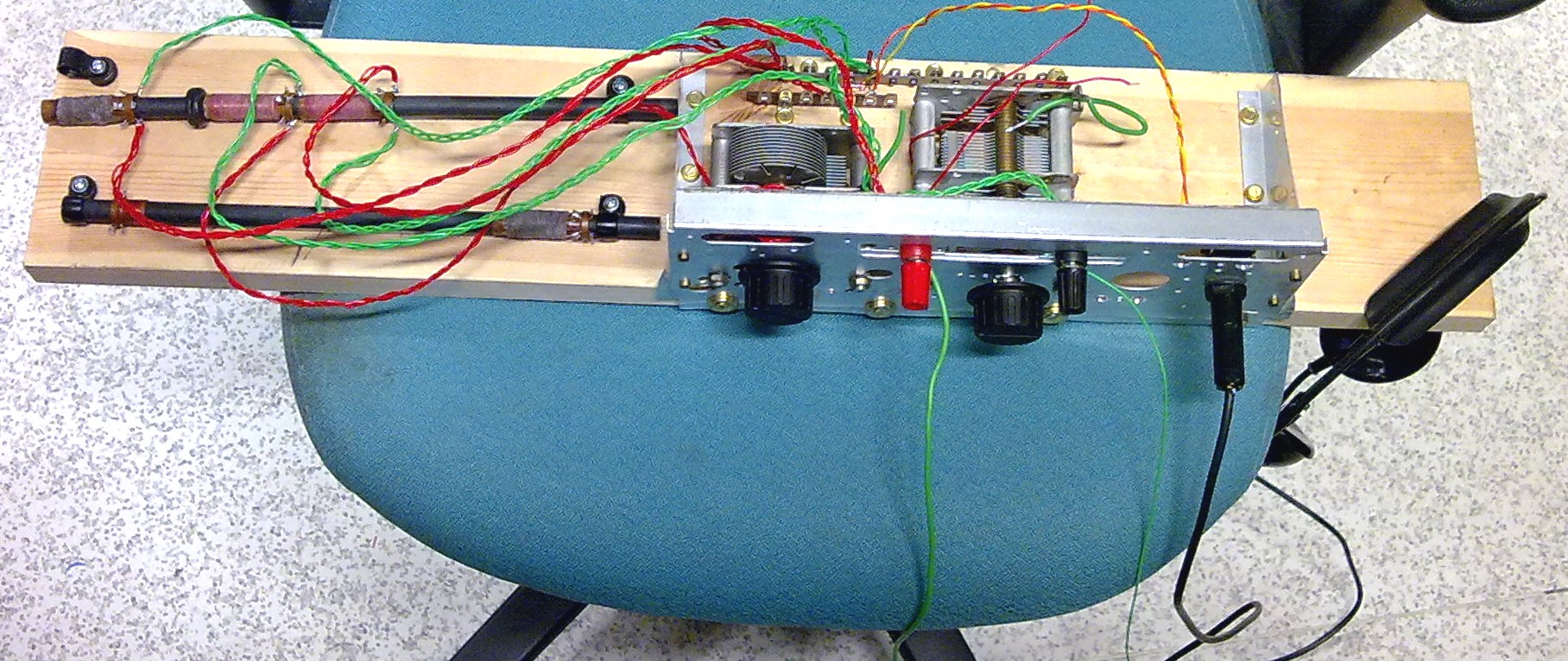
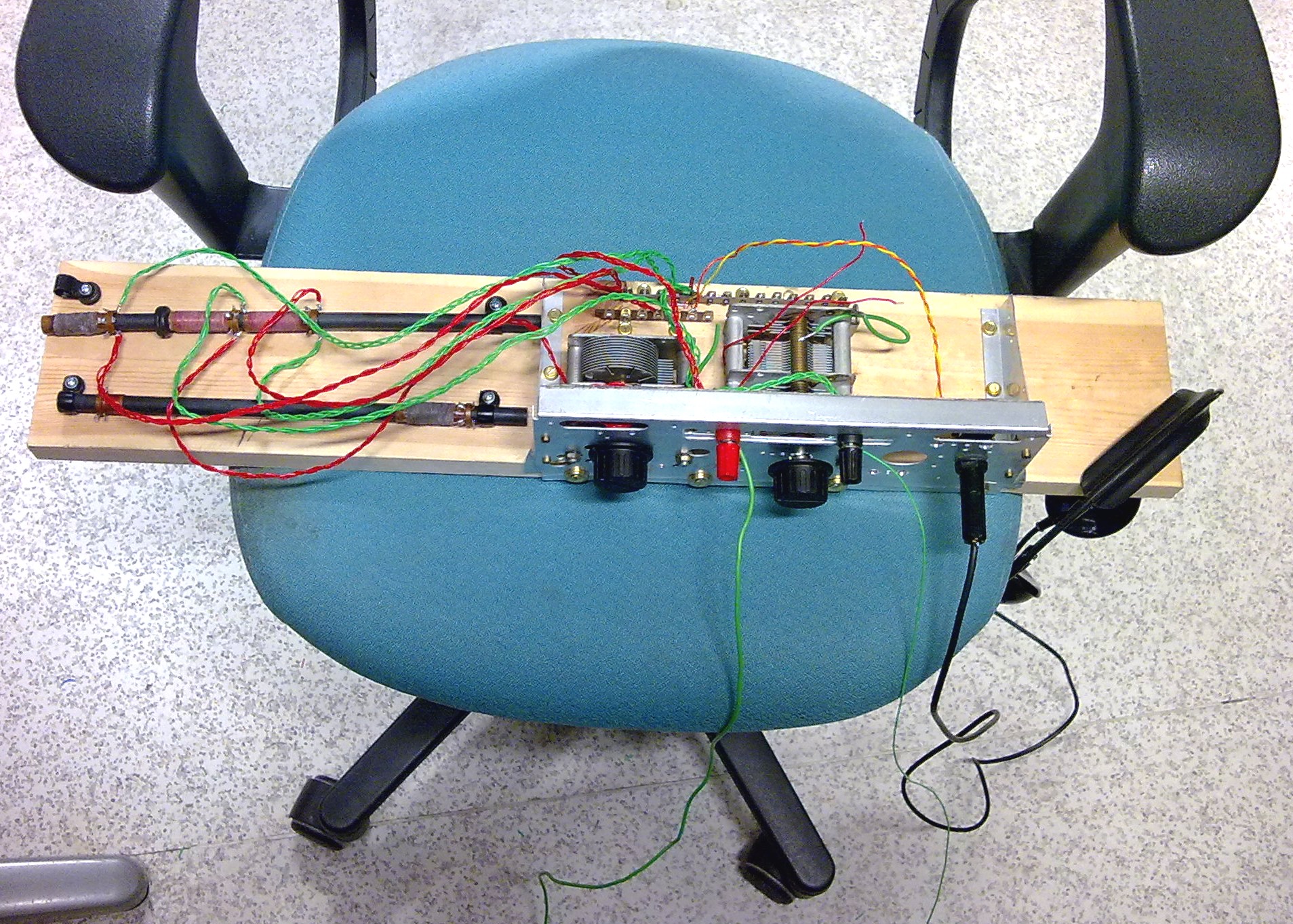
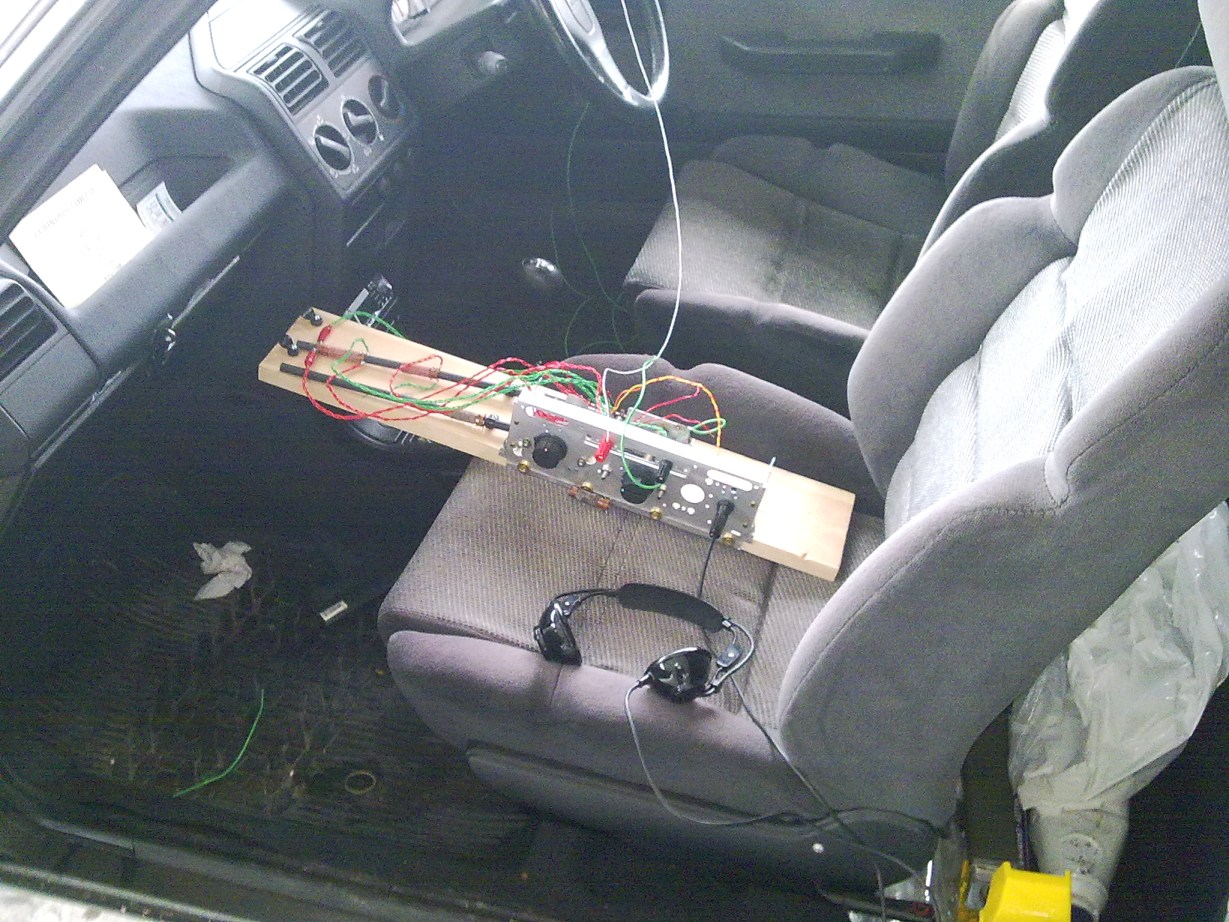
Shown here is my experimental test bed
which had two ferrite rods and two dual tuning capacitors. In the
event, only one rod and one section of one variable capacitor were
used.
Experimental Loud Crystal Radio Set Test Bed
A lot of the initial playing around that I did with this design
was using a very simple AM modulated RF signal generator coupled
into the aerial winding with a resistor of around 2K Ohms.
Initially I had a double tuned design which used both sections of
a 500pF dual gang variable capacitor. Here, the output coil was
tuned as well, but this either made setting up the tuning more
critical, or in different coupling situations made an
insignificant difference. I think that double tuned designs don't
really gain you an awful lot, and I'll leave this statement
hanging in the air as a challenge to their fans. As we've
established, tuning sharpness is dominated in the final analysis
by the need to take energy out of the system to listen to the
signal. With a decent signal, the output coil is so damped by the
output transducer that there's little to be gained by trying to
save energy by making it resonant, and if you achieved this, the
tuning point also changes as you move the coil up and down to get
the best coupling. That turns the process of tuning in a station
with best loudness into a multi-parameter procedure, possibly with
two separate capacitor controls, and the popular engineering term
for that is a "ballache."
Finally we get to how well this worked in practice, and what
aerial and earth system were used. The location was a fairly flat,
open area near junction 4A of the M3 in Hampshire, amoung a group
of office buildings. Have you guessed where it is yet? I was keen
to see just how good a crystal radio could be, having arrived at
this design and so decided to go full out for a bit of fun aerial
rigging. For convenience I had the radio in my car on a high floor
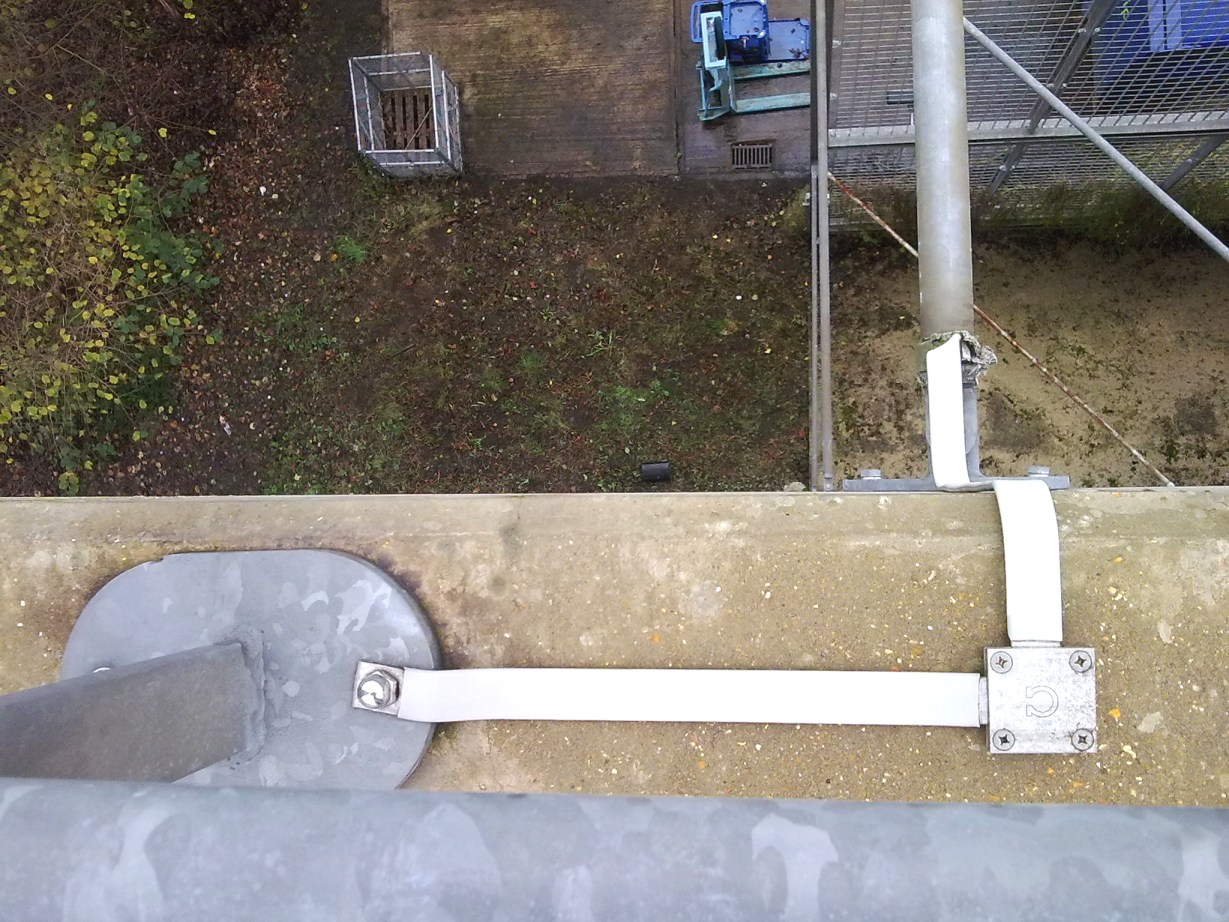
of the multi-storey car park. This car park is covered in a metal
lattice structure that was once-upon-a-time intended to be covered
in green creeping plants to make it look prettier. This never
worked but the structure is well grounded to the reinforced
concrete and made a good ground connection. The aerial was about
80 metres of 7 X 0.2 PVC insulated hookup wire. Initially I threw
this reel over the side of the car park and unwound it to a point
at the ground level of the target building some 80 metres away. A
quick check showed some stations coming in pretty well, but the
aim was to string the far end up to the top floor of the target
building. The building conveniently has a balcony on top, so
pulling up the aerial wire with another length of wire and tying
it off with a long loop of insulating tape was easy. We have now
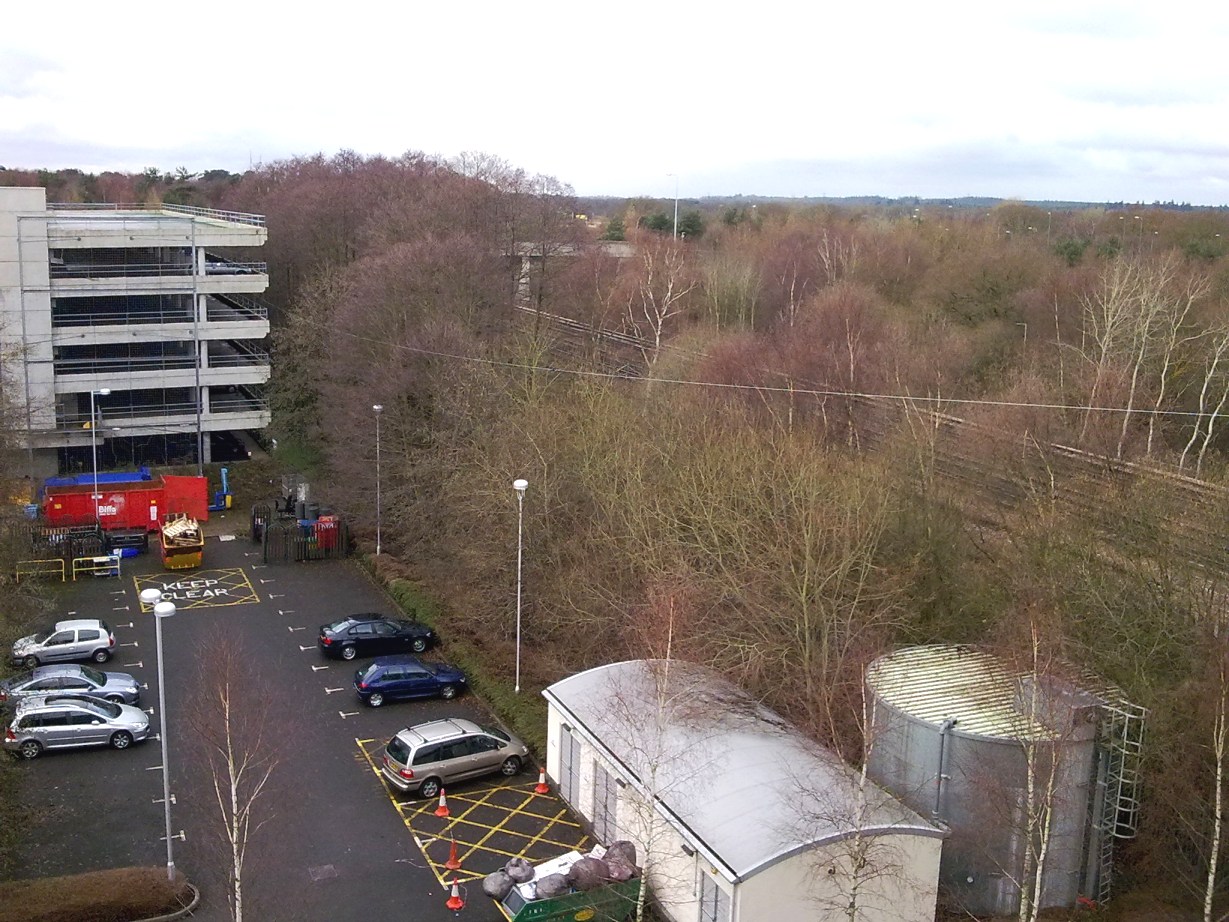
established an 80 metre long aerial wire some four floors, perhaps
25 metres off the ground. It's not made of the best wire which
would probably be several separated strands of the same thing,
like those old "Hoop aerials" that you see on pictures of ships in
the 1920s, but it's pretty good and surprisingly heavy and
stretchy enough as it is anyway without adding more mass to the
system.
Eighty Metre Long Aerial Wire Between Two Buildings
Typical Car Park Earth Bonding Point Used For The Earth
Connection
The Antenna Wire Tied Off To A Rail At The Far End
In an ideal world, you'd secure the end of the wire with an
insulator and not just tie it round the railing. In practice, when
you have that much wire length, it doesn't make a tremendous
amount of difference for a temporary set-up. I used some
insulating tape.
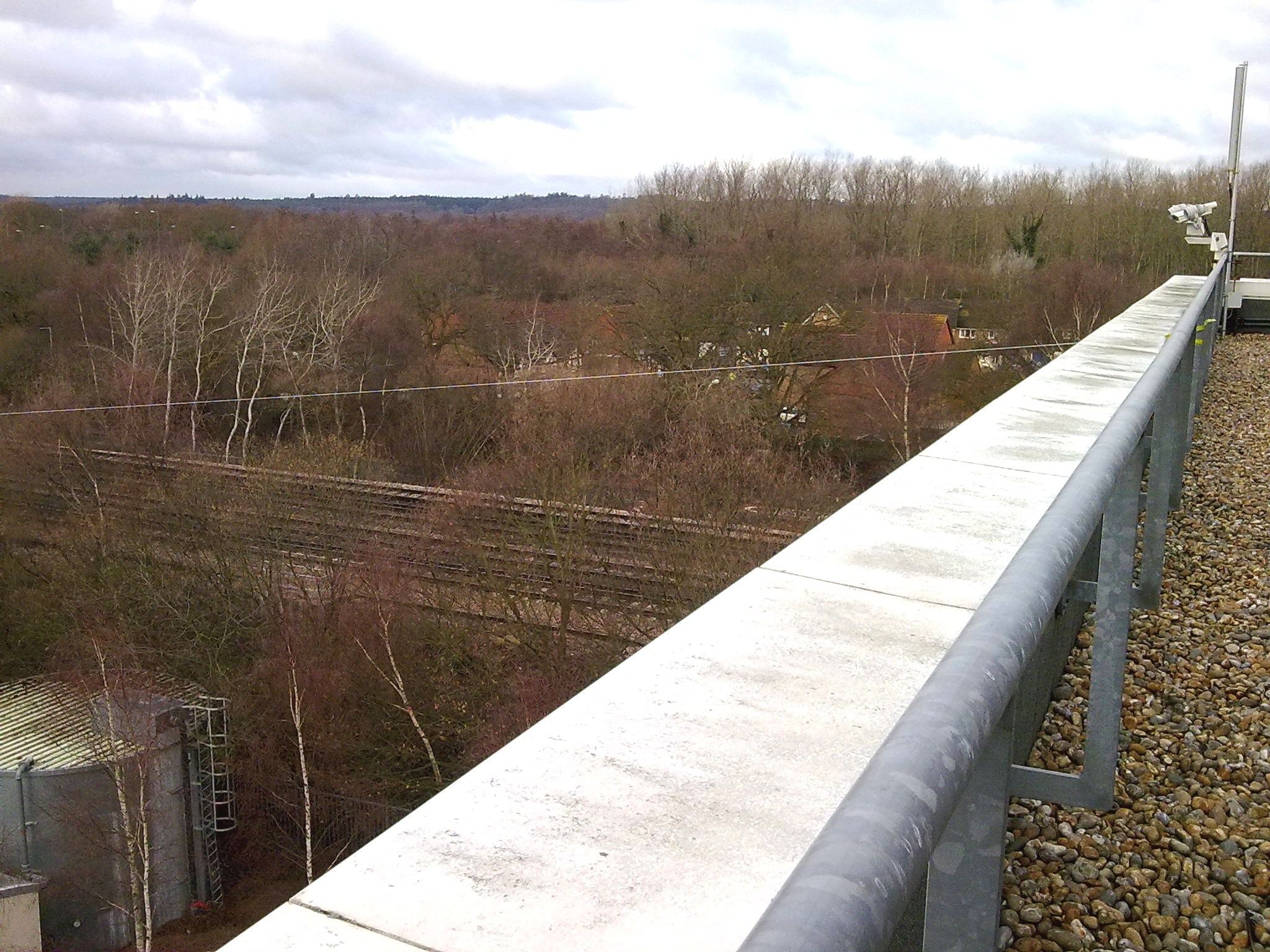
You Can Just See The Car On The Fourth Floor
I'm not
sure why I didn't use the top foor. Probably to keep out of the
wind, rain, and to placate security.

Is it working? Let's run back to the car park end and see!
Yes it is, and working very nicely too. The ideal output coupling
coil position is quite dependant on the strength of the station as
I expected. The fairly small number of turns on the aerial coil
meant that it was very close to the tuning coil for maximum
output, but not quite all the way there, showing that I had
optimised the input coupling too. I could separate both the main
1215 kHz and the secondary 1260 KHz Guildford transmitters of
Absolute radio (terrible name eh? Always begs the question
Absolute what...), Talk Sport, and an Asian station down the lower
end. Listening volume was very good and you wouldn't want it any
louder on the main stations. I thought that I would have a play
with using a spare LW coil as an aerial input. As it turned out,
when almost fully on the rod this coil and aerial system self
resonated at 198 KHz, dominating the MW coil and brought in Radio
4 at a level that was uncomfortable to listen to when adjusted for
maximum output. RTE1 and a French LW station could also be heard
but as the radio wasn't optimised for this mode it was harder to
get rid of Radio 4 to receive these properly. This could easily be
corrected by redesigning it for switching in a LW main tuning
coil.
Crystal Radio Set In The Car "Gertrude," The Trusty 1992
Peugeot 205 1360cc XT
The best car eva:)
Loudspeaker Operation
Ultimately what I would like to try would be to connect a very
large, efficient PA horn speaker to the output and make a little
self-powered arty listening post on the top of the car park. That
way you could come up and sit outside listening to genuinely free
radio on your lunch break in the Summer. I had the 16 Ohm Adastra
PA driver available for this but hadn't got round to buying the
large horn to attach to it yet. So I tried a standard 8 Ohm
elliptical speaker with a matching transformer. (Remember the
diode resistance?) You could hear the signal with your ear close
to it, but this wasn't very useful. Now that I know about how much
signal I got in the headphones, I can try this at home with a
signal generator. Testing the loudspeaker project properly is one
for the next opportunity that I get for stringing up another long
wire, which will most likely be next Christmas when the site is
nice and quiet again.
Further Asides
The crystal earpieces tend not to fit
in your ear if you're a kid, can be quite uncomfortable and
instantly get covered in earwax regardless of the age of the user.
They're not very nice in this respect, especially if you plan to
share the earpiece and consequently any ear infections that you
might have.
If you're worrying about having the diode the wrong way round in
the circuit then don't. In a single diode crystal set you can have
it either way around and the listening result will be exactly the
same. You will just be using the opposite polarity half of the
radio waveform to produce the audio signal.
When visiting the Thamesmead estate in East London in the summer,
it occurred to me while supping an afternoon pint at the Lakeside
Bar (dead posh y'kno) that the three tower blocks on the opposite
side of the lake would make outrageously good anchor points for a
similar experiment, possibly even with two dipole arms meeting at
the block in the middle. One of which would go to the ground
connection on the set, and the other to the 'aerial'. But don't
try this at home, kids. Or at least make sure you're below
lightning conductor level.
I've completely neglected the reactive properties of the aerial
which could be tuned out, or perhaps more accurately stated tuned
in with more controls. But that would be frequency dependant and
we've already been down the two tuning controls route and decided
that's a bit of a fag. In practice, if you've hit a maximum on the
Mr. Slidey rod, this has already happened by interaction with the
main tuning capacitor.
Some old germanium transistors have a transparent filling
underneath the black painted glass encapsulation. These will
actually generate 100uA of photocurrent when under a lamp or
certainly in sunlight. I once met a circuit in an old library book
from the 1960s which used just such an item in a Hartley
oscillator using a small audio output transformer. It would
oscillate audibly with no power applied into a crystal
earpiece when you shone a light onto it. I was impressed by this
piece of cleverness. So maybe you could even use an old OC45 as
the demodulating diode and get some gain out of such a crystal set
when there is light available. You could argue that this is
cheating by using an external power source, but if a candle or the
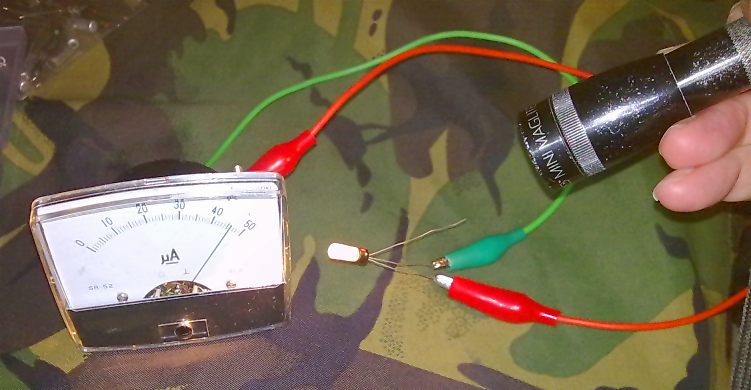
sun will work I think we're still qualifying. I've tried an
initial experiment as shown in the picture below where you can see
45uA coming out of just such a scraped-off OC45. The current is
measured between emitter and base and also occurs between base and
collector. The current is very dependant on finding the exact
sweet spot with the torch. It can go much higher than 50uA and I'm
sure in sunlight it would be higher still.
I tried using a transistor like this, with the base and collector
shorted, as a demodulator. The Vf was very low, about 200mV and
was louder than the best OA81 that I've found so far. It was
leakier in the reverse direction though. Shining a light onto it
made no magic difference, with strong or weak input signals, so
more fiddling with this is a project for the back burner. You can
get germanium junction diodes made in the Soviet Union back when.
They are good, too.
Glear Glass OC45 Germanium Transistor Generating Current In
Light
If anyone has tried and suffered "The Crappy" crystal radio set
design before, I hope this page offers some light. Those people in
the 1920s weren't so daft and they weren't necessarily straining
to listen to their crystal radio.
A 2026 Update Perspective
All those European LW stations have
gone. BBC Radio 4 on 198 kHz soldiers on. Algiers Chaine 3 from
North Africa is still there on 252 kHz radiating a spectacular 1.5
Megawatts from a full height quarter-wavelength mast at Tiapazia.
You can hear it on a proper LW radio in Southampton as a routine
daytime experience. It would be wonderful to see if that was
audible in the UK using this crystal radio set-up now that RTE
have vacated 252. It would also be wonderful to see what
you could hear at night. Virgin/Absolute radio on 1215
kHz etc. are long gone, dropping off-air under an Ofcom cloud when
their electricity bill got too expensive. BBC Five Live, Talk
Sport, BBC Wales, BBC Scotland, Caroline, Punjab, Lyca, and others
continue on AM MW in the UK.
There was an American mythbuster type programme on TV or Youtube
where they "busted the myth" (ooo, Hark, luvs!) that you could run
a 1.5V digital watch or calculator from a crystal set generating a
DC voltage. They weren't trying hard enough. You could easily do
it with this system, just by replacing the headphones with a 100nF
capacitor to smooth off the audio.
The Ladybird Not Very Good Crystal Set
Here's the ladybird book not very good crystal set. I recently
noted that in this construction, apart from suffering from all the
problems mentioned above, the ferrite rod is secured to the
baseboard using two loops of conductive wire. That's two shorted
turns around the rod killing your signal and ruining the
selectivity. Arrrrrgh! Infuriating. Use PVC insulation or anything
non-conductive. I used some PVC terry clips.
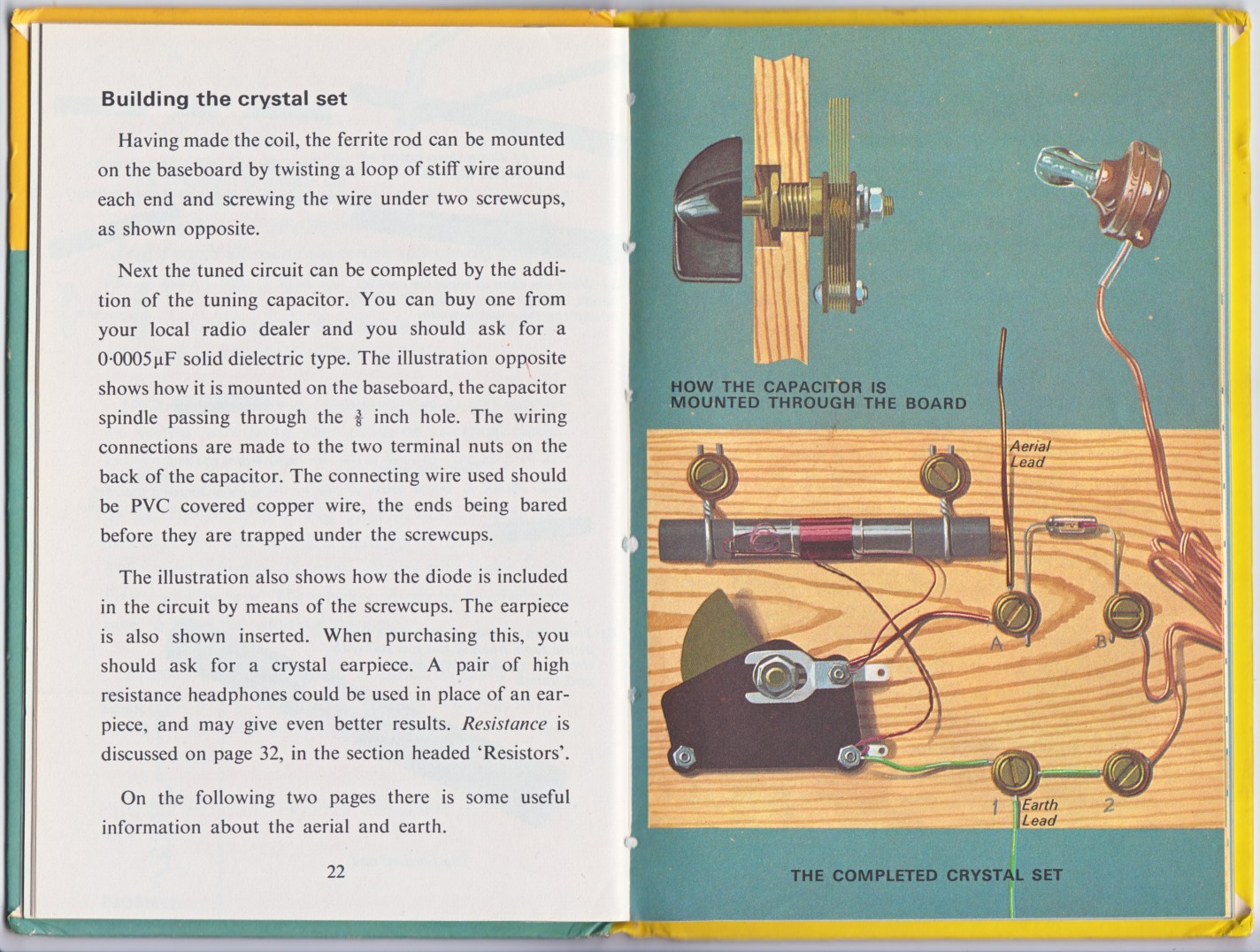
To quote page 22, "A pair of high resistance headphones could be
used in place of an earpiece, and may give even better results."
Could. Could? May? Have you actually even bothered
to try it? No. Infuriating:)
Older Crystal Earpieces
I've recently found a few of the older type crystal earpieces at a
radio rally. They are highly variable and have probably aged
badly. I've been informed that the Rochelle salt crystal used in
them is hygroscopic. The crystal absorbs water over time and tends
to turn into dust, so watch out if you're offered a bag of
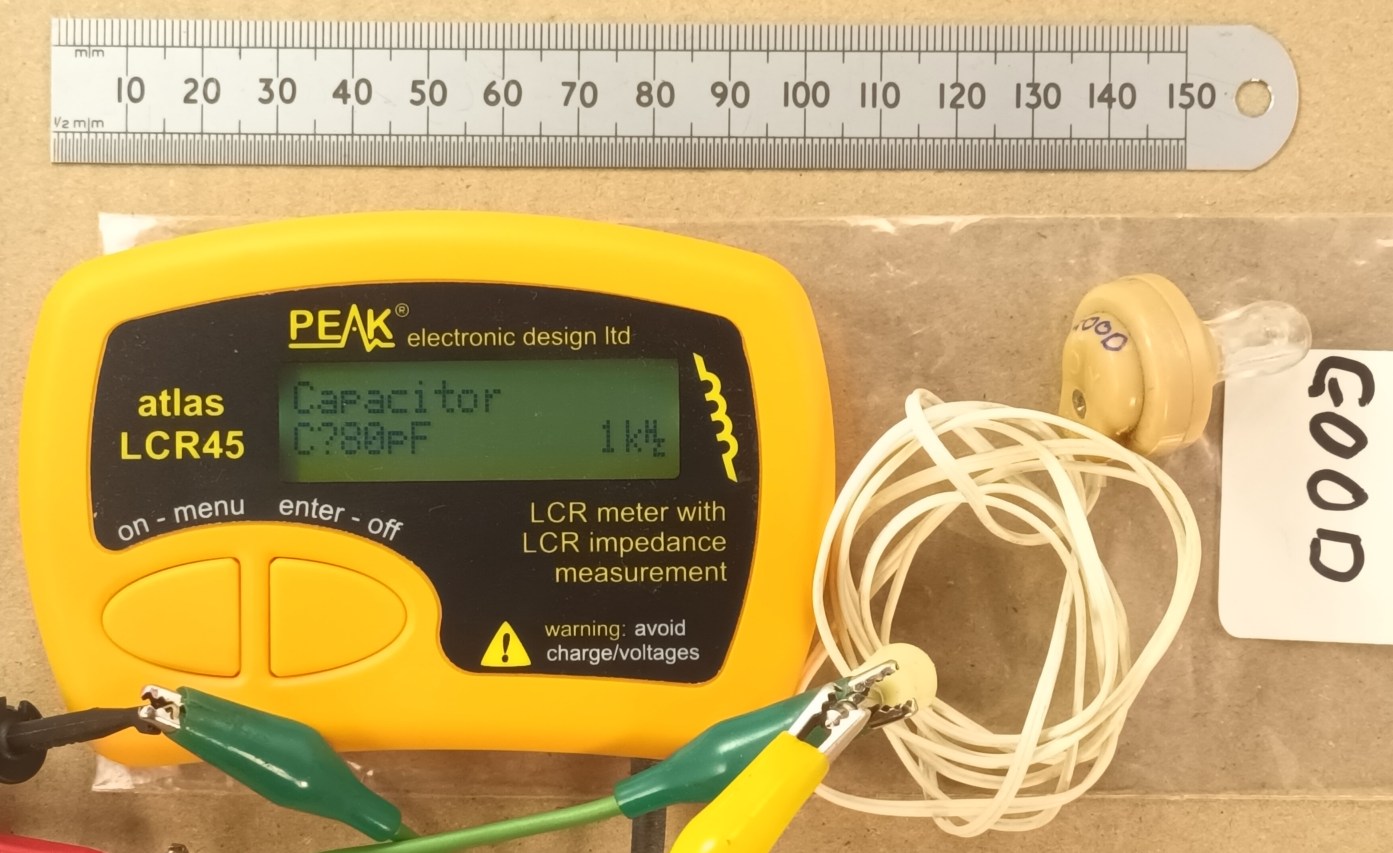
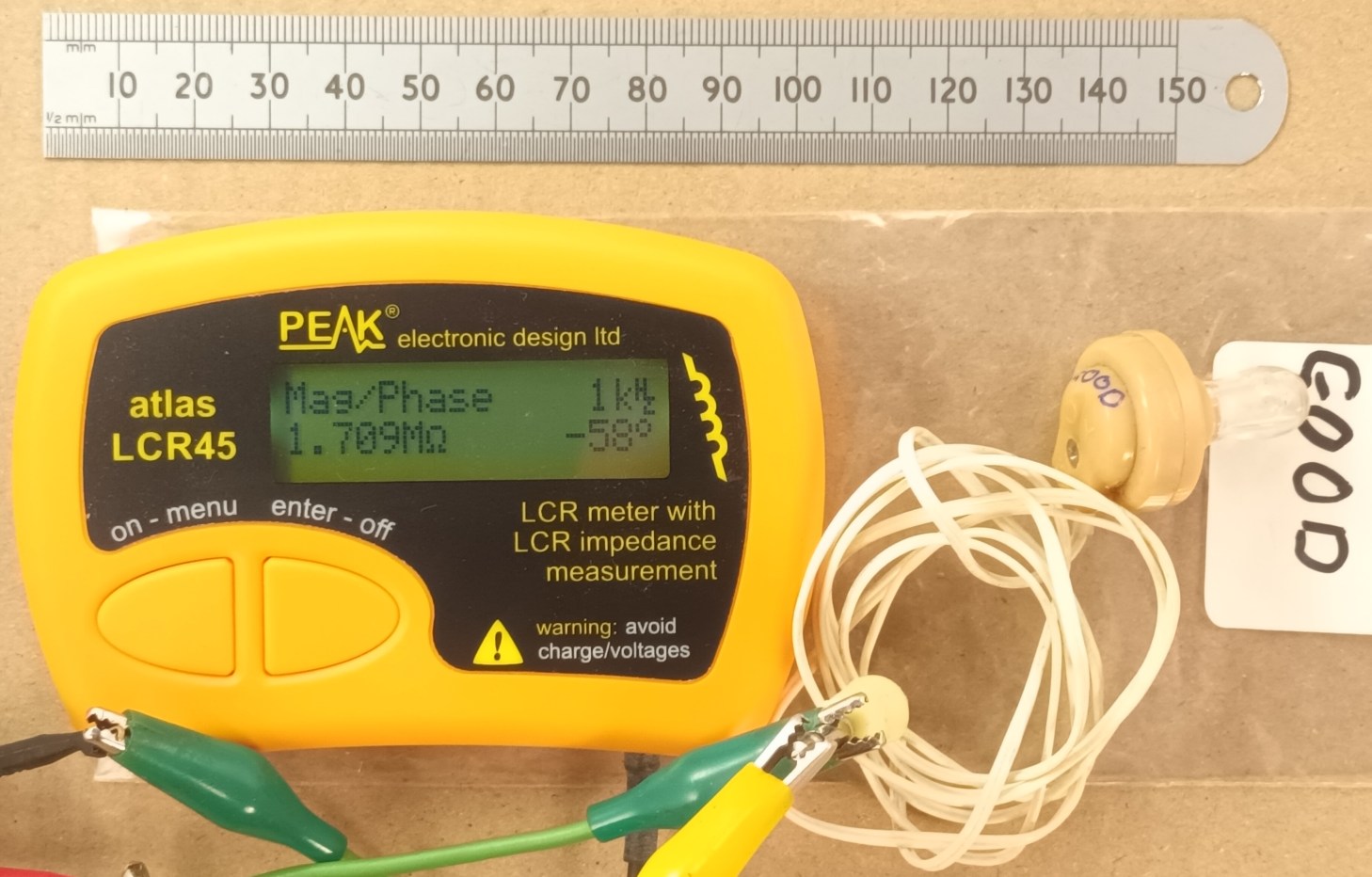
hundreds of them. A few good ones measure about 80pF, 60M
resistive, and have similar if not better sensitivity than the
modern ceramic element ones. You can hear a decent level of mains
hum just by grounding the plug sleeve and putting your finger on
the tip. You can see the test results below, though it's a pretty
low capacitance for a precise measurement.
Old Proper Piezo Crystal Eapiece Capacitance Test At 1kHz
Old Proper Piezo Crystal Earpiece Mag Phase Reading At 1kHz
Henry's general email address:
Navigate
Up
Recent
Edit History
01-FEB-2010: page created
21-JAN-2025: bit of an update
28-JAN-2026: major update, html incantations, direct refs,
bigger pictures