Constructing The 1972 Ladybird Book
Transistor Radio
If you're enjoying these pages and you
have an interest in hobby type electronics or repair jobs, you
might like to visit my other website www.usefulcomponents.com,
where there are details of various components for sale and some
good radio kits as seen below.
If you want to make a radio kit with modern parts that doesn't
require soldering, I heartily recommend the following:
The
HJW Electronics Choccy Block Six Transistor Radio Kit
This is a much more stable design than the final radio described
in the 1972 book, and it uses no funny electronic tricks.
The
HJW Electronics Breadboard Six Transistor Radio Kit
This is the same circuit as above, it is somewhat cheaper, and is
quicker and easier to build.
The
HJW Electronics Crystal Set Radio Kit
This comes with an additional single transistor option. Both the
crystal set and the single transistor option are a whole lot
better than those options described in the earlier sections of the
1972 book. All the kits are available in the HJW
Electronics Amazon Store and on my HJW Electronics
Pattern Site

Background From 2008
There's more recent information and
pictures lower down the page.
Recently I was bought some Ladybird books for my birthday. I got
"How it Works, The Computer," "How It Works, Television," and "The
Story Of Nuclear Power," all of which were mid-1960s easily
digested thin children's hardbacks. This encouraged me to buy,
"Learnabout... Making A Transistor Radio," which I'd had as a kid.
It certainly tought me one thing about how to make a transistor
radio, that being one specific method which, try as I might, I
could not get to work. So, as I happened to have all of the parts
available, I thought that I would have a go at it in these
enlightened times of the 21st century. Any excuse to blow out the
dust from the 1960s germanium transistors drawer, after I'd writen
my "Thankyou letters," of course.
Well you can see the pictures of the one I've made and the
similarity to the illustrations in the book. There are some places
where you could trip up. The OA91 diodes that I had would have
been inserted the wrong way around if I'd followed the pictures,
which show the 'red' end of the transparent OA91as being the
anode. This is probably due to design changes over time, and in my
modern diodes the end with the red encapsulated termination was
the cathode. You can tell which end is really anode or cathode by
looking carefully to see which end the point contact wire is
attached to, and which has the germanium crystal on a little
mount.
Ladybird Radio Extra Components and Diodes

I also found that the first audio amplifier stage was fully
saturated with the OC81 transistors that came out of my drawer.
This would probably not have been the case with a scabby old low
beta OC71 in that position, but the transistor that I had there
was quite good and so would not work correctly. Before you
complain that I used the wrong type, the parts list text says that
you can use any red spot audio transistor. Sorry Ladybird books,
but transistor beta dependent design is bad design. The symptom in
my set was very low audio level which could only just be heard
when the R.F. stage was in full oscillation. The simple solution
is to fit a 1K Ohm emitter resistor in parallel with a 22uF bypass
capacitor to ground, instead of a direct connection to ground.
That stabilises the D.C. operating point while maintaining the
audio gain.
Ladybird Radio Schematic
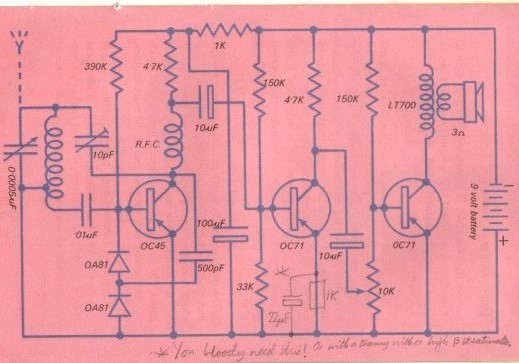
Interestingly, there is a spare screwcup position just where these
parts are required. They fit neatly between position 5 and the
previously unused position 6. Perhaps these components were
present in an original design and were removed in a misguided
attempt to save parts before publication. The final stage does not
suffer in the same way, partly due to it operating in a
transformer coupled class-C fashion, where the stored energy in
the inductance provides half of the output swing. It is rather
distorty, but cheap on current.
I'm not sure why my attempt to build this in the 1970s failed so
miserably. I suspect the problem with transistor beta mentioned
above may have played a part, but I never even got mine to
whistle. I do remember that the RF transistor that I had was a
metal canned one. These were well known for failing even when
"new," with internal tin whiskers growing out from the pure tin
plating on the inside of the transistor can, and then shorting out
to the internal leads of the transistor. Maybe that was my
problem. These trannies were pretty ancient history even in 1977,
so that wouldn't be too surprising.
The selectivity is very good indeed, though the whole set is
rather 'live' and detunes a little when you move it or the short
wire antenna. The setting of the reaction trimmer is, as stated in
the book, a little tricky but neither of these phenomena stop the
radio being usable, especially if you prefer one station. It's not
stunningly loud, but I'm not going to grumble too much from 3
transistors.
Ladybird Radio Rear Components

If you were going to give the kids something to do for their
science project at the weekend, then you'd avoid this design due
to the ancient transistors and the fairly expensive Jackson
capacitor. They are no longer available. There is something to be
said about building something up completely from separate parts
though, and the brass screwcup on softwood technique is
solderless, cheap, and has a bit of olde worlde charm to it. A
Radio 4 Longwave version might be interesting and this could
dispense with the main tuning capacitor.
If you really want to make one of these in an authentic fashion
for nostalgic or artistic reasons, the variable capacitor,
transistors, and the big RFC are going to be a problem. (Date:
26-JAN-2026)
While making up this radio I found some other interesting things
relating to the substitute parts list which is in the back cover
of the book. High leakage low Vbe transistors, which all tend to
go together in any given example can cause the output stage to do
a miniature version of thermal runaway and cease to give any
output at all. The transistor warms up a little then saturates,
pulling 100mA or so through the D.C. resistance of the output
transformer. The transistor and transformer usually survive,
providing you're just using a small PP3 battery. Really, the
output stage needs a low value emitter resistor and bypass
capacitor like I've suggested for the previous audio stage. Using
an OC71 here ensures that this shouldn't happen as there is some
inherent emitter resistance and lower gain anyway. Also, I've had
great trouble getting anything other than OC45s to work in the RF
stage. OC44s and working AF116 or AF117s tend to go into high
frequency oscillation rather than operate with usable
regeneration. I think that this is due to them having higher Ft,
basically more gain at high frequency, and coupling around the
loose layout involved with the screwcup design results in unwanted
high frequency oscillations.
I think what may have happened is that the Rev. Dobbs designed his
circuit and used cheap basic parts with the minimum of extras and
simplest layout. Then along came the book, and a need for more
general parts, so someone else had a look through the 1971 Mullard
data book to look for alternatives, suggesting the newer parts
listed by Mullard as replacements for the cheap but obsolete
items. Not realising that in this design, the 'improved'
transistor parameters could leave the target audience in heaps of
trouble.
Don't try to use plywood, MDF, a piece of solid oak from Grandad's
wood shed or any other hardwood type substance as the baseboard.
You will spend most of the afternoon trying to get the screws to
go in, and get very bored when you find that the first hole that
you've eventually mangled out with the bradawl is now too big for
the screws to get a grip in. Some soft pine is what you want, and
offcuts from the local DIY store are about 50pee.
Well, if I get bored again I might decide to try a few variations.
Replacing the transistors with something more modern is simple
enough, and it would be good to get rid of that Jackson dilecon,
perhaps replacing it with a "Mr Slidey," variable inductance
ferrite on a stick arrangement. It would need more screwcups and
perhaps smaller, no.8 ones, but a second output transistor in a
class B stage would get rid of that transformer as well. Beyond
that, we're probably talking superheterodyne designs with IFTs
wound on biro plastic. But at that point it would probably be
getting a bit complex, a dual gang variable capacitor would be
back in and the fun element would be rapidly disappearing.
Reflections In 2026
I certainly don't supply a kit for the
original Ladybird radio any more, and the Jackson capacitors are
definitely not still being made. I think I bought the last of them
which were manufactured from the remaining stock of bits. The
audio transistor problems are more to do with leakage due to ion
diffusion over time than saturation due to high gain. I've tried
replacing the diodes with Schottky BAT48s and they are OK.
Replacing the big RFC with a 470uH SMCC ferrite cored inductor
just about works. I occasionally still use this radio to test
germanium audio transistors and OC45s, after they've had a go for
D.C. parameters on an Atlas DCA55 tester. Don't rely on a standard
multimeter to test germanium transistors. They assume a silicon
Vbe of about 0.65V and take no account of leakage. This tends to
give you a massively inflated Hfe reading. Pictures of the radio
as it currently exists, and a short video follow shortly.
How is transistor leakage Ice0 defined? It is the collector to
emitter current with the base open circuit. That's from
the 1960s Mullard valve and semiconductor data book, so if it
sounds a bit unfair for normal in-circuit use, tough. That's the
definition. The 0 in "Ice0" is a zero for zero base current,
whether that's going into the base or being pulled out of the base
due to the bias resistors.
Did I mention the ferrite rod mounting method? It's so tempting to
use two loops of non-insulated wire, twisted around and secured
under two screwcups. That would be two shorted turns on your
ferrite rod which would eat up a lot of the signal. Gosh. That's
exactly what's shown in the book! I just tried it, and you'll see
it used above in my 2008 rendition. On this radio it's not
so terrible, because the regeneration compensates for the loss.
It's also used in the crystal set earlier in the book though. In
that situation, or this, no. Use something non-conductive like the
PVC sleeving shown below.
The Completed Ladybird Radio Front Angle, Now With New Improved
Chicken Head Knobs
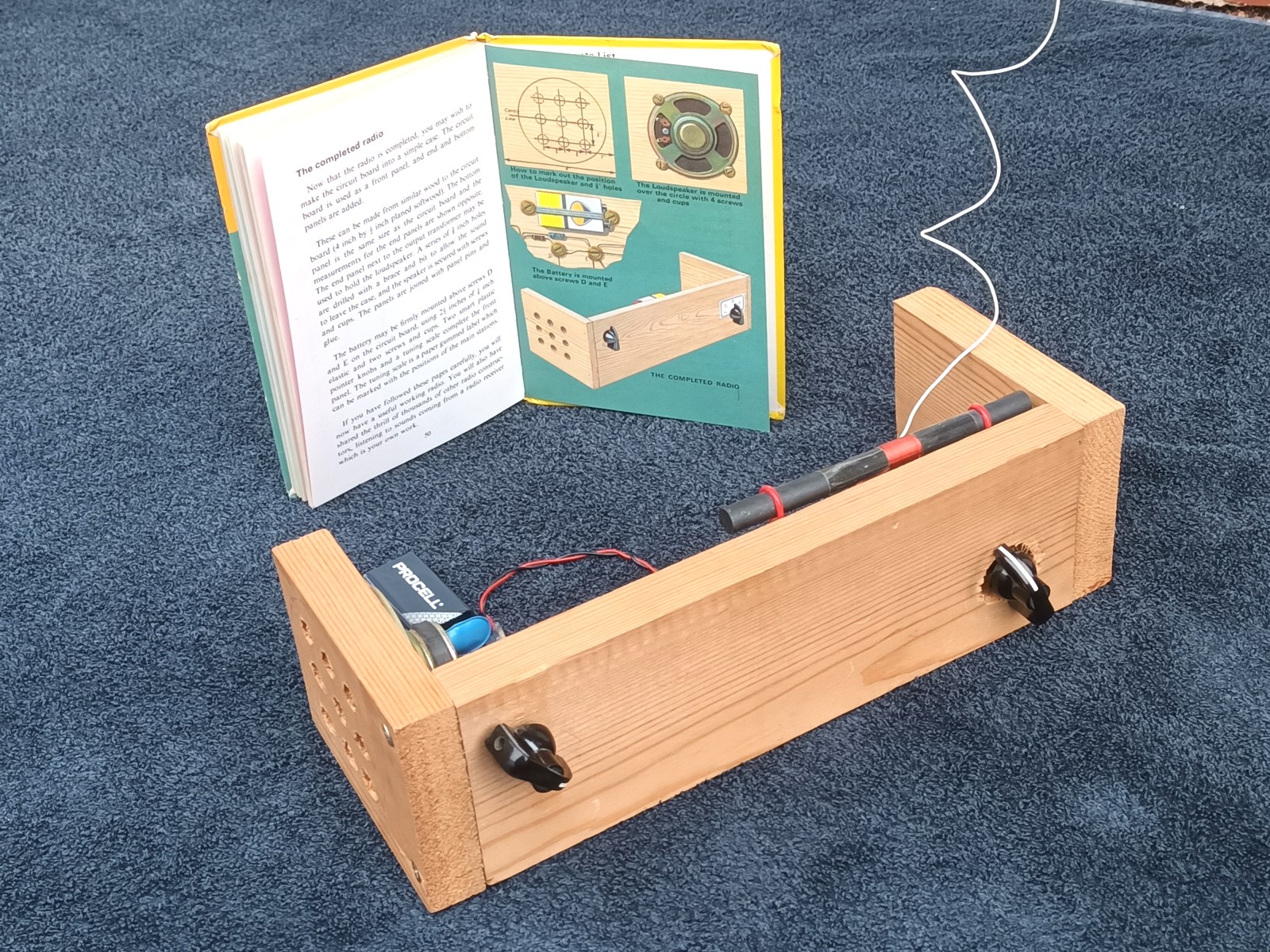
The Completed Ladybird Radio Rear Angle Showing the Current
Components
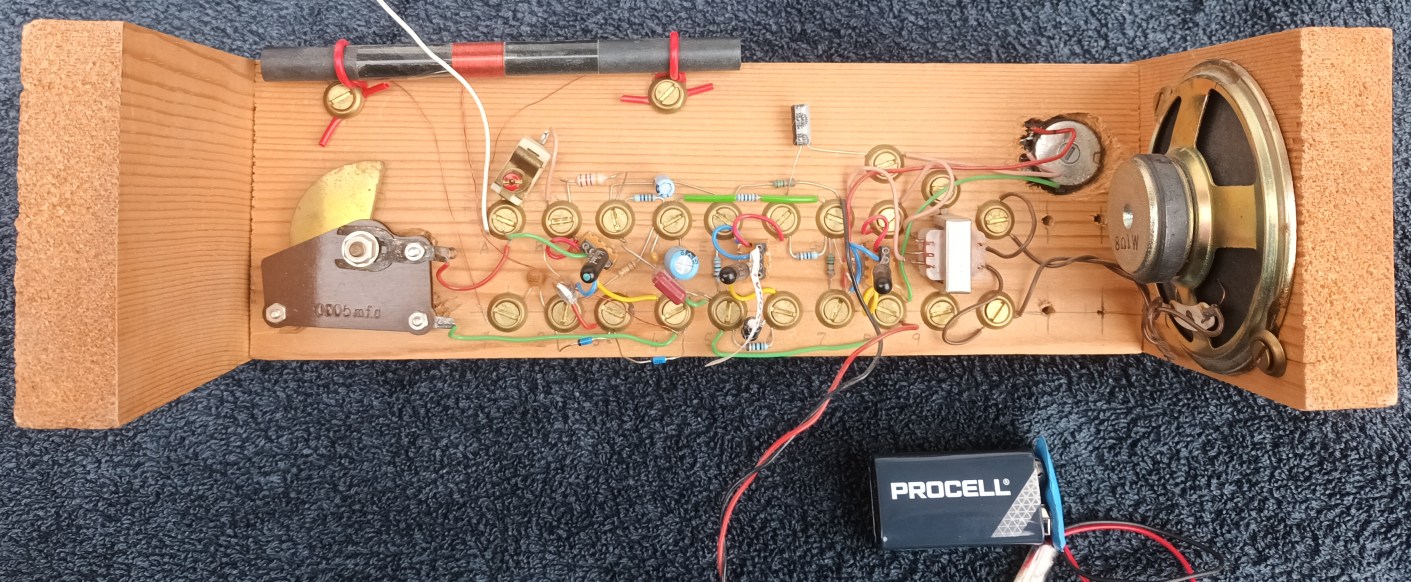
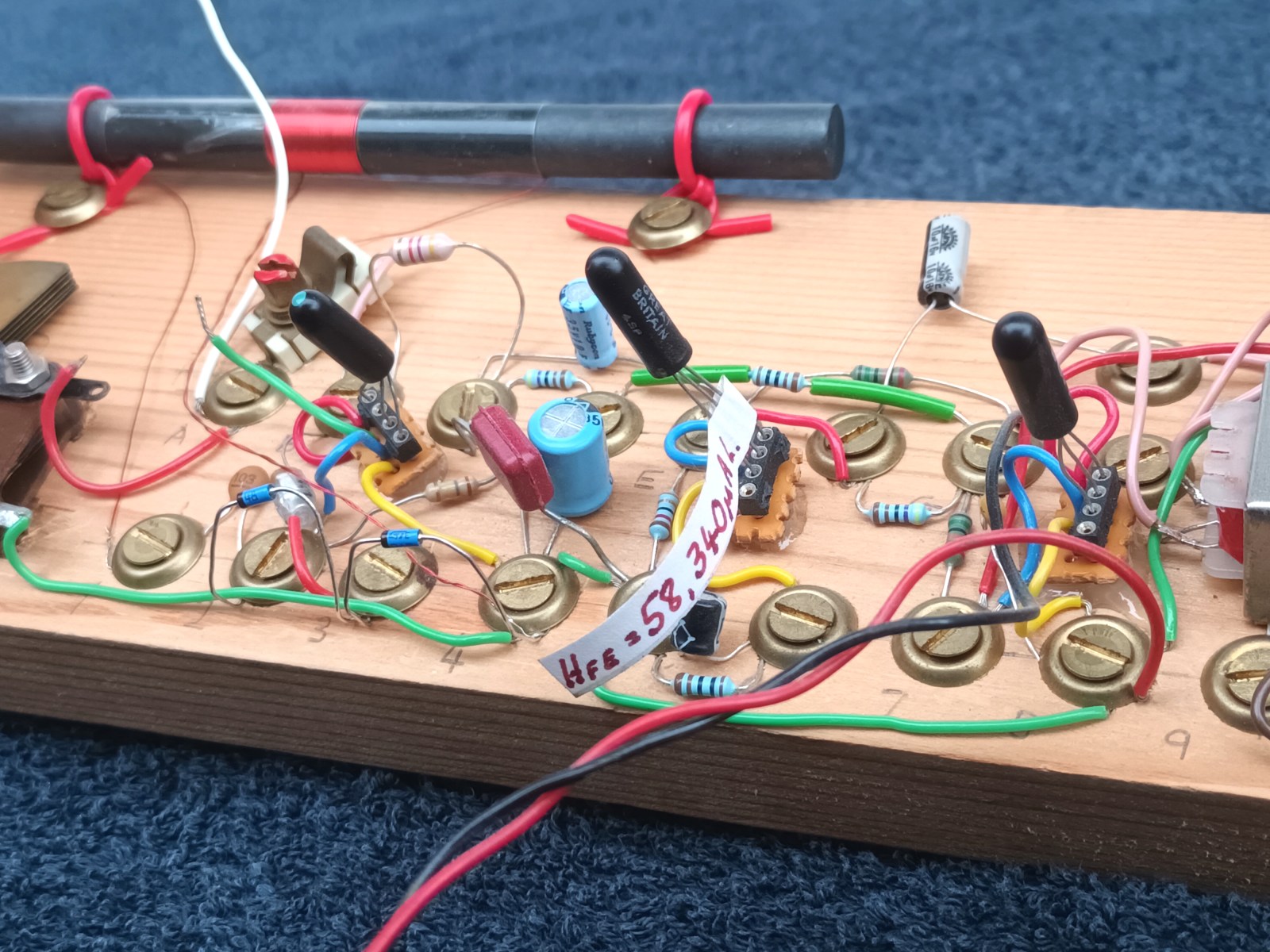
The Completed Ladybird Radio Showing OC45 and OC71
Transistors
A leakage measurement of 340uA on an OC71 is not good, but it
will still work.
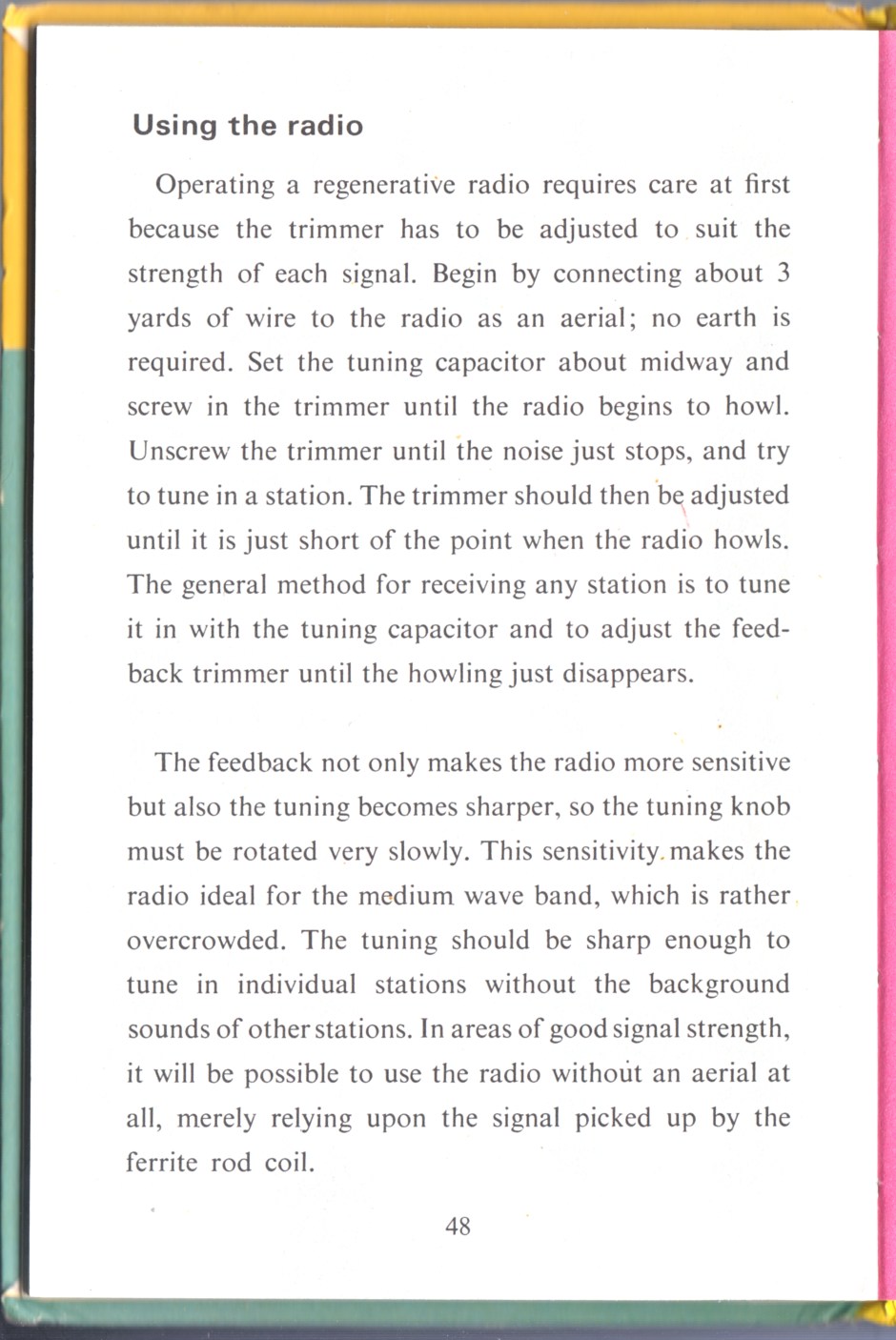
The "Using The Radio," Text From The Ladybird Radio Book Page
48
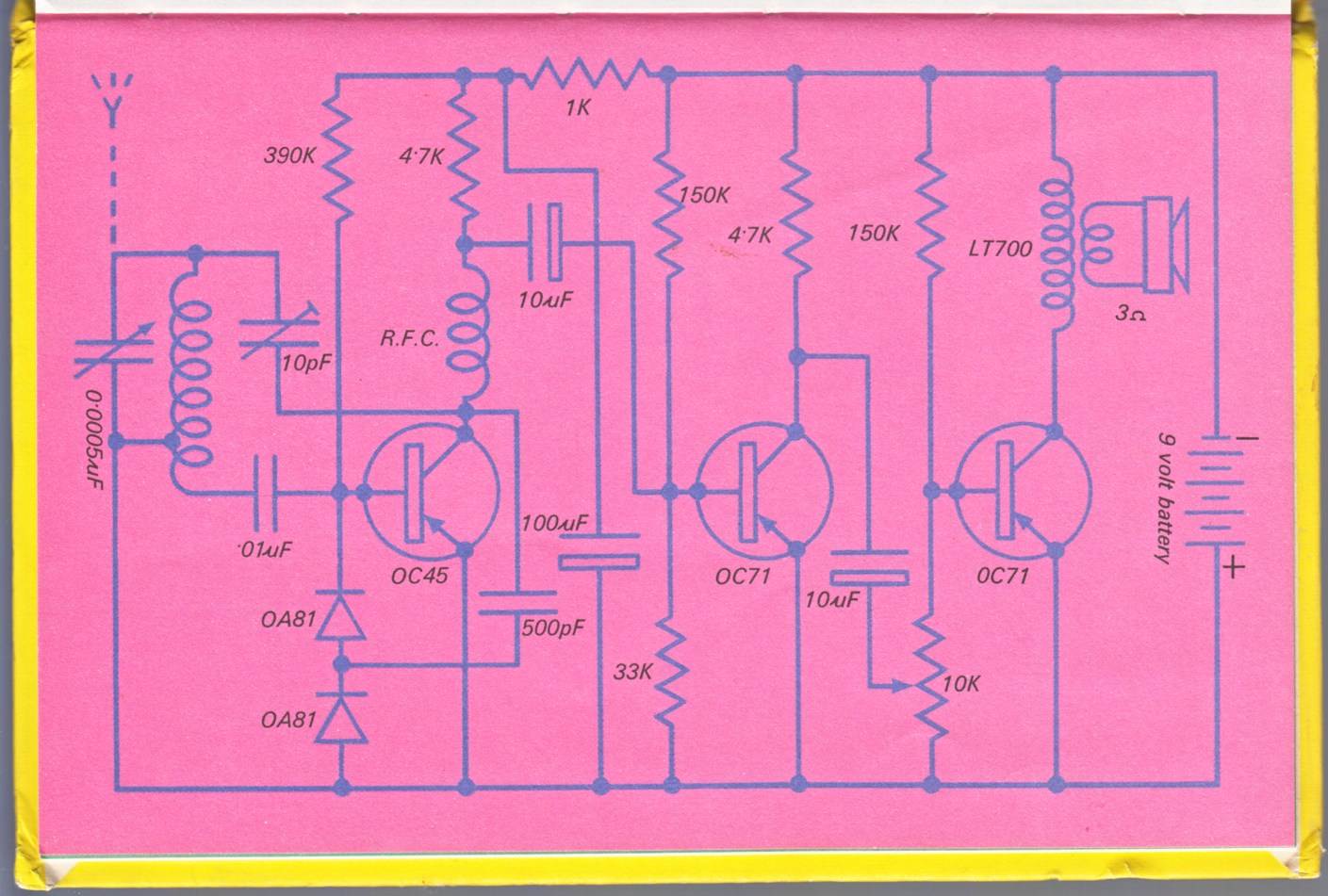
The Schematic Diagram Of The Final Regenerative Reflex
Transistor Radio From The Ladybird Book
Ink, other than bright pink is clearly at a premium in 1972, as
printing a zero before .01uF was deemed unnecessary. Worse, the
variable capacitor has the correct preceeding zero shown,
"0.0005uF." Sometimes, in fact often, you'll see 1960's
electronic hobby books where a capacitor might just be labelled
"100," and you're supposed to know if that's 100pF rather than
100nF or 100uF. Maybe. Such laziness drives me crazy. How are you
supposed to know unless you're an electronics engineer? Is
that too picky? You'd be surprised. Passenger aeroplanes have
fallen from the sky due to such omissions, and it confuses
everyone else. Reference? Mentour Pilot on YouTube, who know's his
stuff and does fab detailed videos including The Varig
Flight 254 Crash. Also in that episode, some fascinating
insights on longwave radio beacons and night time LF propagation.
Click here for A
Short Video Of The Ladybird Radio Working
I'll see if I can dig out a picture that I took down a microscope
of the insides of a hairy AF117. Yes, I can:)
A Hairy Tin Whiskered AF117 With Scale
This was taken down a decent stereo microscope by putting a
mobile phone camera up to one eyepiece. Not great, but not
terrible.
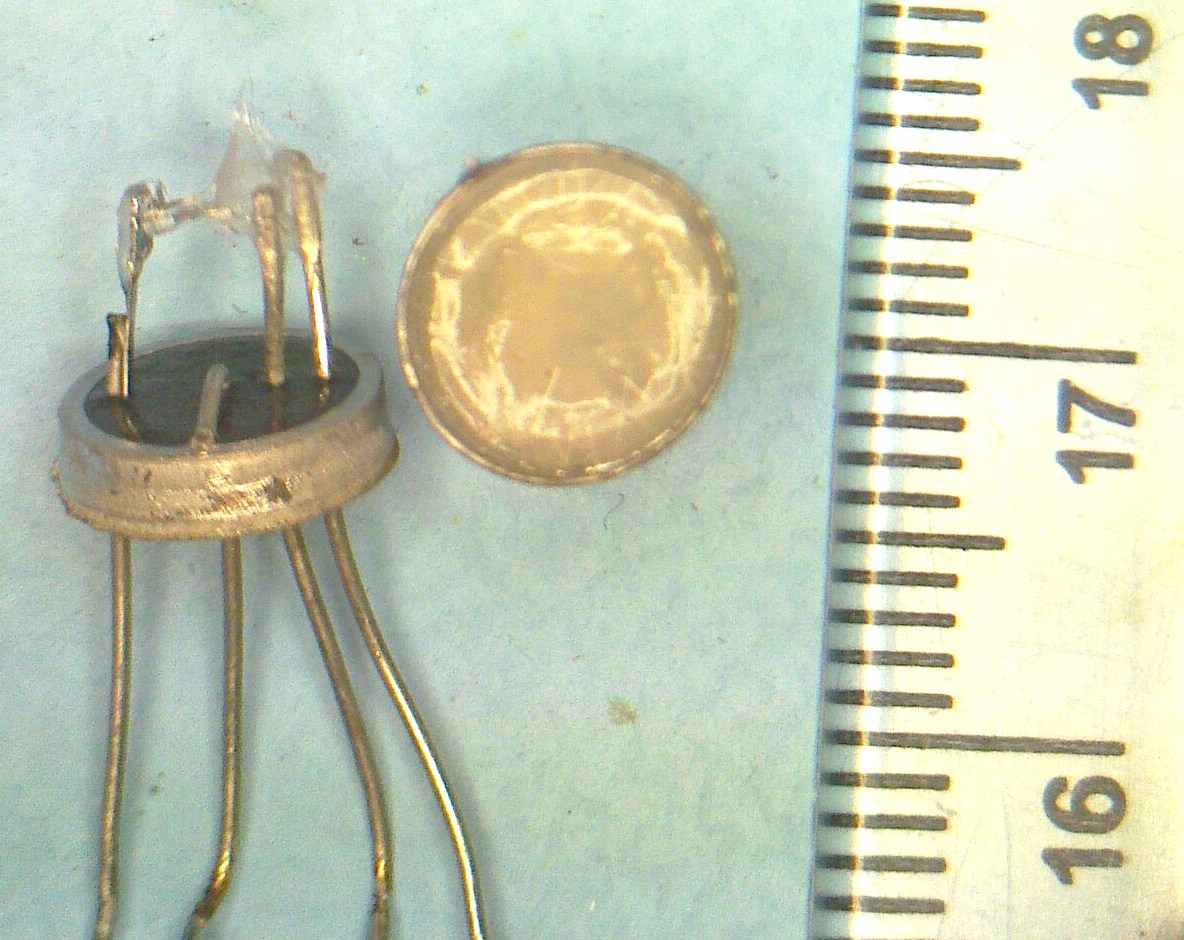
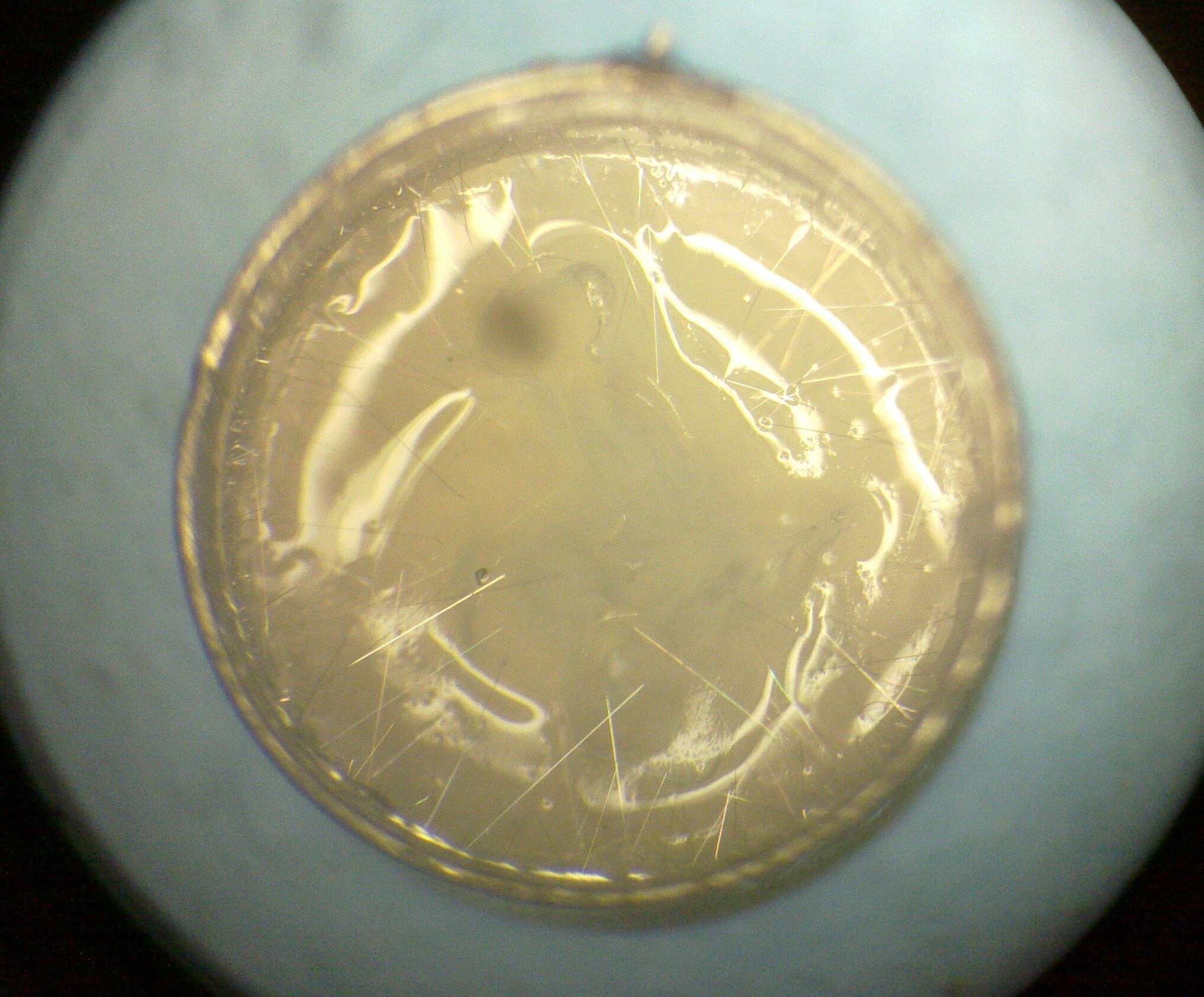
Tin Whiskers Growing On The Insides Of An AF117 Can
You can actually see where some of the whiskers are penetrating
the non-conductive gel, so filling the can with delicious jelly
didn't work, did it Mullard? I got inside some of these by
de-soldering the can. The picture shown is not atypical. Most of
them are like this to some extent.
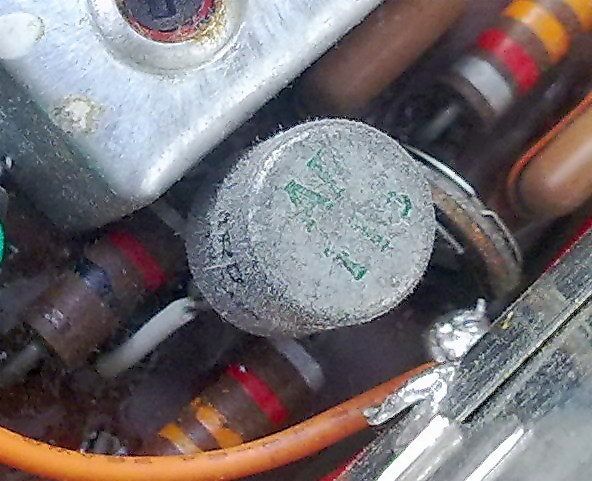
Tin Whiskers On The Outside Of A Hairy AF115
This was in an old Roberts radio. Most of them have probably
dropped off, but the whiskers can grow on the outside as well. The
last time I did some research, even NASA didn't understand the
exact mechanism for this peculiar phenomenon. In the past, it has
been known to disable satellites when relay contacts have become
shorted across. Using very pure tin plating seems to encourage it.
You can see some extraordinary examples elsewhere online.
Henry's email address
Navigate
Up
Recent Edit History
16-DEC-2008: page created
29-DEC-2025: background colour, some small changes
26-JAN-2026: major update, better pictures, video, html
incantations, direct refs
28-JAN-2026: tin whiskers