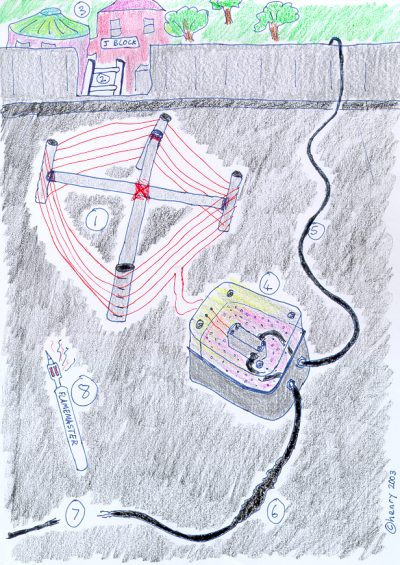
In this particular case, an "artists" impression of one of the K-block transmitters, seen looking towards reception. Points of special scientific interest are numbered with corresponding explanations below.
This is made of some old bits of
thin drainpipe tied together in the middle with insulation tape.
The perpendicular bits at each corner have the cross pipe
stuffed in a hole made in them and then bound in
insulation tape. Cuts are made in the end bits to support the
windings which are shown here in relatively excellent condition.
Usually they are considerably saggier than this, and generally
sitting in a puddle on the flat roof if it is outdoor like this
example. If you change frequencies from, say, 963 to 1602kHz,
you have to go round every transmitter and take a couple of
turns off, and re-peak the trimmer in the amplifier in the ally
box inside. Each transmitter only covered a maximum of 100m in
any direction, so you need lots of them. As the wavelength is so
long, there is virtually no electromagnetic radiation from these
loops, but the RF magnetic field is picked up on the punters'
radios in the rooms below. The magnetic field decays with
something like an inverse fourth power as opposed to the inverse
square that a proper electromagnetic signal does. Hence the
Radio Authority phrase, "Restricted service stations operating
primarily in the induction field"
Ooooooh excuse me Mater, I'm off the play on the Graahnd
primarily induction field restricted service transmitter...
The problem with rooftop aerials is getting onto the roof to service the damn things. This rickety ladder, craftily borrowed from Harry Hammerhands (the man from university maintenance) is perched atop the entrance vestibule to K-block which is a mere one storey down. Here you can just see the top bit wobbling in the breeze - which is reassuring when you're on top of a three storey roof. Lots of maintenance was done on a Sunday, so that interfering hall of residence jobsworth's were fewer in number and this old aluminium thing could be nicked from its resting place behind the squash courts and pressed into service. This pales into insignificance with getting up to L-block roof, a four storey climb on a rented three section ladder. There was always some rumour passed from one technical manager to the next that there was some sort of Hall's covering insurance in case you fell off a roof and were turned into a cabbage. Yeah right, you've convinced me:) I never worried about it too much, assuming that no-one would spot the difference.
Paint Along With Nancy had such a cool theme tune - the best part being that you got the whole tune while watching the speeded up painting done at the end of the programme.
Oh, OK then,... ermmm, water resistant.
Well, fair enough, it's a fair cop... water absorbent Transmitter Box. Absorb water today with Radio Glen patent Absorbitex Boxettes! Away with workaday floods, away with the drudgery of flat roof puddles etc.etc. The supposedly waterproof boxes were filled with indicating silica gel which was always, without fail, bright pink indicating maximum dampnessosity. I collected all this stuff and roasted it in the oven on warp factor 6 overnight. It stank out the flat and went a kind of browny-blue colour which I took to indicate sufficient dryness. The little aluminium box inside contains the actual amplifier which drives the resonant loop. I'll cover the details of this elsewhere.
Seen dangling around all the buildings, badly fixed and suffering from years of exposure. There were two main cables driven from a main driver (amusing referred to as a 'transmitter') in the F-block technical cupboard. One went to all the newer buildings and the other went to the older brick flats and old terraces. This carried the AM RF signal at about 1Vpp riding on a 30V d.c. power supply for the rooftop loop drivers. Of course if you get any damp in the cable the 30V power supply immediately turns the copper cable into a black oxidised mess. The cables were (meant to be) terminated with a.c. coupled 50 Ohm loads. More often there was a break somewhere in the cable at any given time, so you got standing waves and patchy coverage even in the areas before the cable break.
In common with all university maintenance policy, flat roofs obviously have to be incinerated, oh sorry, repaired by the cheapest, crappiest bunch of pyromaniac arses with a bucket of tar and a blowtorch in town. Unmarked Radio Glen cables rarely stood a chance, and the result is a melted shorted section that needs to be cut out and repaired by soldering it back together and wrapping it up tightly in top quality insulting tape.
Why does Harry Hammerhands and his "work"man mates always assume that any given cable works much better when sliced into a million separate little bits? It defies logic, but this was the usual source of breakdowns.
I think the instructions said something like "Take care not to poke stuff into the catalyst wool at the top, as it is delicate and easily damaged" What they should have said is, "Take care not to ever actually use this soldering iron, as the catalyst wool gets blown out by the gas as soon as you turn the flippin' thing on." This is used for rooftop and dangling-off-a-ladder type cable repairs. Usually when it's raining and blowing a gale. And dark. And when you've been in the bar for an hour already.
Speaking of which, I once bought a really good one of these and accidentally left it in the new studios after doing some work for Ummit and his chums about 1995. I never saw it again, but if the thieving Gypsy bastard is out there, you know who you are.
Despite the disadvantages of induction field service, it did actually work. When it was working it even worked quite well. What really amazes me is the amount of effort that went into this old system when built in 1977 or so. If it really was a third year electronics project, it deserves top marks for the task of completing such an incredible cabling and sheer manufacturing effort of more than 20 such aerials. That's before we even consider the studio and mixer construction.
There was a character called P.
Blitz present in the early 1980s days, though I don't know if
this prominent technical manager was actually the Radio Glen
progenitor. His spoor is present on many a hand-drawn, coffee
stained schematic, and even in comments by DJs in some old
station log books. "Blitz was between my legs soldering the desk
back together most of the time - but despite, or maybe because
of this, a great show."
Henry's main email address:
Recent Edit History
05-JAN-2025: standard
incantations, formatting, bigger picture