Random Flashing Christmas Lights
With Geiger Counter Sound Effect Output
If you're enjoying these pages and you
have an interest in hobby type electronics or repair jobs, you
might like to visit my other website www.usefulcomponents.com,
where there are details of some components for sale and some good
electronics kits.
65535
Bit LFSR XOR And D-Type Board

Some substantial time ago, things were a bit slow at work and the
joyous season of goodwill was almost upon us. How might it be
possible to relieve the tedium and simultaneously look a bit like
you're doing some work? Ah Hah! You can make some annoying
flashing Christmas lights, but not any old annoying flashing
Christmas lights, no. These use a linear feedback shift register
to generate a pseudo-random flashing sequence and make a pretty
LED display. You can also connect up a loudspeaker to one of the
outputs to make a pseudo-random clicking effect like a Geiger
counter, white noise or the interesting grinding noise of the
sequence repeating if you turn up the clock rate.
The Linear Feedback Shift Register
Pseudo-Random Sequence Generator
I'll not go into the full details of
the theory here and I'd recommend looking up Linear Feedback Shift Register on Wikipedia.
Suffice to say that they are very useful and easy to make, either
using old logic chips like I've done or a spot of VHDL or
programming. I've made a maximal length sequence for a 16-bit
shift register using taps 4,13,15,16 (the numbers are one step out
in the schematic) which creates a sequence 65535 bits long. If you
clock this at 10Hz, it will be almost two hours before the
sequence repeats.
XMAS
LFSR Electronic Schematic Description And PDF
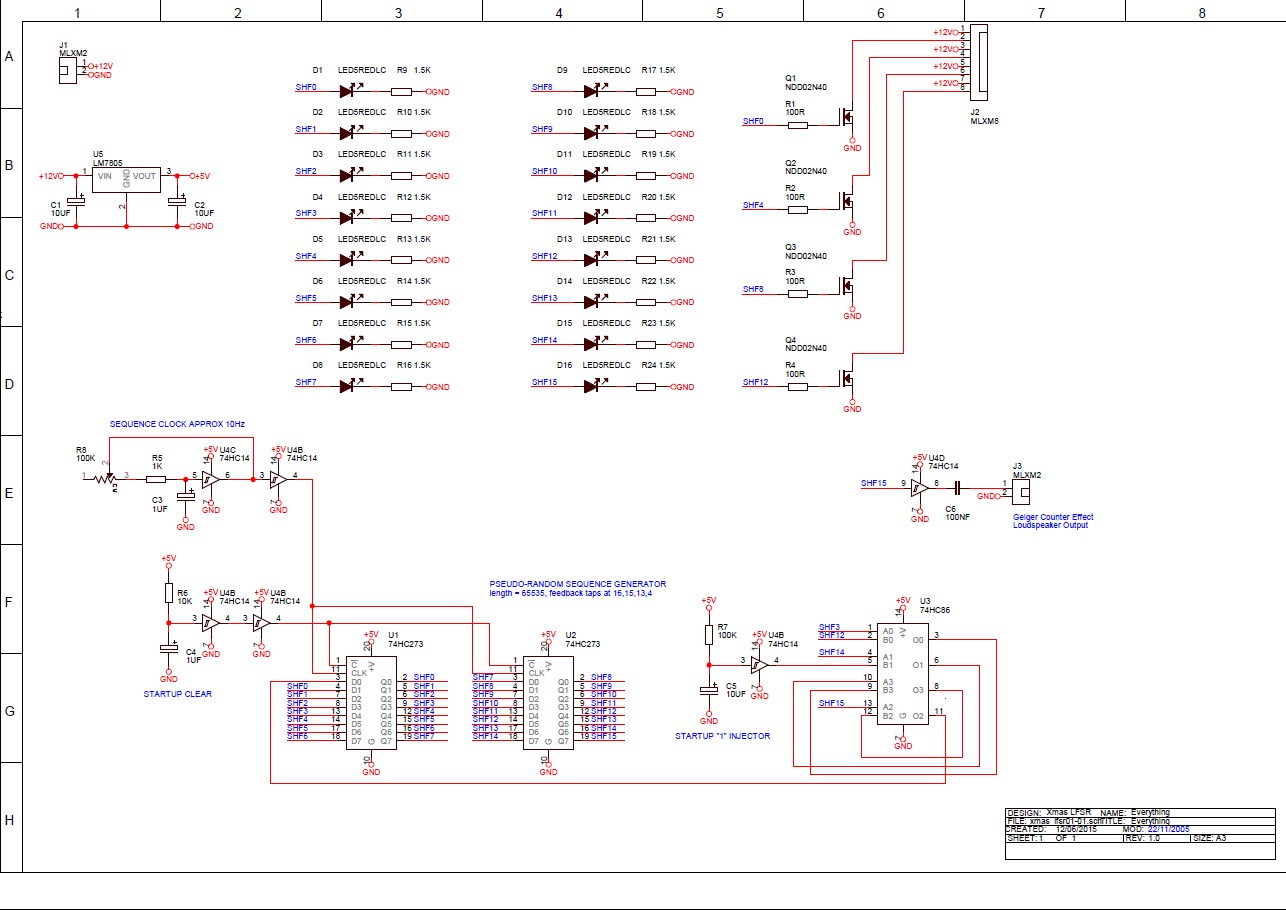
Linear Feedback Shift Register 65535 Bits Using XOR Gates
Schematic Walkthrough Of
Irritating Christmas Lights Linear Feedback Shift Register
The intention is to run from 12V DC
overall and a standard 5V linear regulator provides 5V for the HC
logic devices. The main shift register is comprised of U1 and U2
74HC273 D latch devices and this allows access to all possible
tapping points, unlike some other dedicated shift register chips.
They are cleared at start-up by an RC clear generator with a
relatively short period. A similar circuit with a longer period
injects an essential '1' into the system. U3 74HC86 provides the
XOR gates. The state of the shift register is shown on the LEDs
which need to be 2mA low current types. Four logic level gate
threshold N channel MOSFETs provide pull-down output drive for
external LEDs supplied from the 12V rail. Depending on what
external devices you intend to drive with the output transistors,
they are not particularly critical. My prototype used IRF611
because they happened to be available. You need to have suitable
current limiting resistors appropriate for 12V on the external LED
circuits. The NDD02N40 shown on the schematic is a good, small, 2V
gate drive voltage FET which has very good parameters at 5V gate
drive. The choice of taps to drive the output transistors is not
important, or is an artistic decision. A simple Schmitt inverter
clock generator provides a variable rate clock signal and this can
be adjusted for maximum irritation effect. The clock signal to the
shift register has to be good and sharp to avoid the sequence
generator jamming, so a second Schmitt gate is used after the
actual clock generator inverter. The final gate on U4 74HC14 can
be used to drive a small loudspeaker or amplifier via a DC
blocking capacitor C6. At low clock rates this sounds rather like
a Geiger counter audio output.
Creating Interesting Noises With
An LFSR
You can create interesting noises
using LFSRs. I've already suggested the Geiger counter effect, and
you can hear that by connecting a small loudspeaker to output J3.
If you reduce the value of C3 to about 1nF, you can create
pseudo-random white noise. If you turn the clock up fast enough
you can hear the lower frequency content of the sequence repeat. I
claim that low-pass filtered versions of these sequences, running
fast enough to hear the repetition, sometimes appear in sci-fi
film soundtracks and other places. An example would be the noise
underlying the DVD top menu on my box set of "The Prisoner" from
1967. Of course, there are many different sequences that you can
create using this technique by using different taps and
shift-register lengths. They will all sound different from each
other but when low-pass filtered, each one will have a unique and
reproducible grinding noise. It might be interesting to try two
identical sequence generators running at slightly different clock
speeds driving the left and right channels of stereo headphones or
speakers.
My Particular LFSR Implementation
Here are pictures of my particular
prototype and links to some YouTube videos of it running. I used
some high brightness white LEDs and various other bits scavenged
from mobile phones at the time to decorate a plastic Christmas
tree. Can you spot the type numbers of the mobile phones used? The
old Radio Shack solder breadboards in the shape of the plug-in
breadboards were a fantastic gimmick at the time which I thought
that I would try using because I happened to have some, and for a
bit of fun. Ordinary stripboard is better in practice.
Board Left Of LFSR Flashing Light Generator
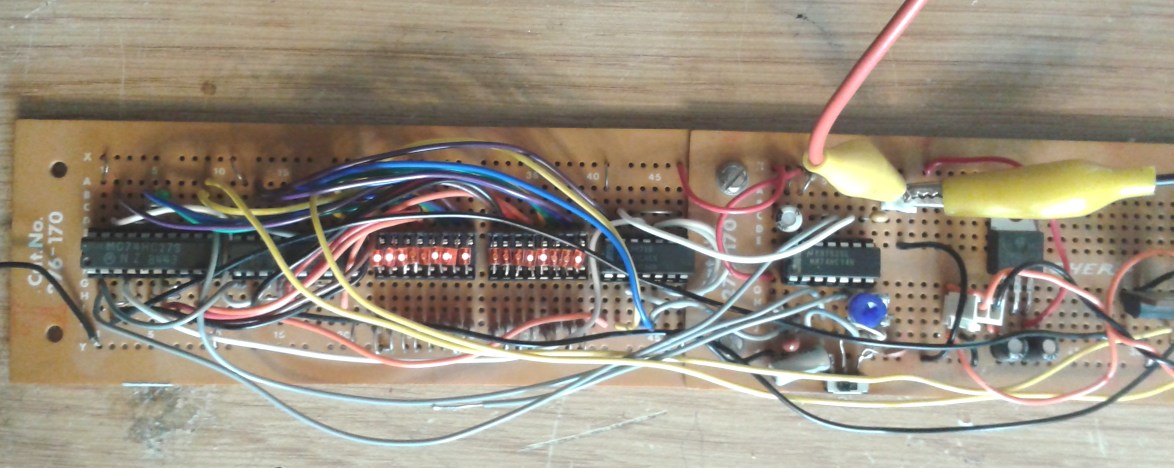
Tiny LEDs On The LFSR Board

I found some tiny orange LEDs from somewhere to indicate each
stage of the shift register.
5V Regulator And LED Driving MOSFETs

Rear
View of Archer / Tandy / Radio Shack Breadboard Type PCBs Cat
No. 276-170

The rear side of the Archer "plug-in breadboard" style solderable
breadboards Cat No. 276-170. Cool! Not immensely practical, but
having stumbled across them, these definitely had to be used for
something.
Scrap Mobile Phone Keyboards Used For Tree Decoration

Can you spot which Nokia mobile telephones the scrap keyboard PCBs
are from? No prizes. Nokia N80 in blue on the right I think, and
let's just say that we had quite a lot of the other horseshoe
shaped ones left over. And let that project never be mentioned
again in anyones CV, unless it's under, "Impossible
Engineering Tasks: How to avoid spending two years producing a
complete lemon when that's what you're repeatedly instructed to do
right from the start."
YouTube Video of The Linear Feedback Shift
Register Based Annoying Pseudo-Random Flashing Christmas Lights
Project.
Henry's general email address:
Navigate
Up
Recent Edit History:
01-MAR-2022: initial page.
02-MAY-2022: edit to include some pictures which never seem to
have appeared, or got lost in a bad update
13-FEB-2026: major update to some poor html, formatting