A Miniature CMOS 4069UBE PWM AM
MW Radio Transmitter
If you're enjoying these pages
and you have an interest in hobby type electronics or repair
jobs, you might like to visit my other website www.usefulcomponents.com,
where there are details of some components for sale and good
electronics kits.
4069 Logic Chip AM
Transmitter Oscilloscope Picture

The world isn't actually short of various designs using one or
two transistors to make little AM transmitter circuits that will
broadcast a few feet, so that you can listen to your iPod over
that classic valve radio that you just bought. But I needed a
circuit to use as a tutorial for some electronics basics and I
thought that I would see what I could create with a 4069
unbuffered hex inverter using some Pulse Width Modulation to
create the AM signal. You need to use the unbuffered 4069UBE
type for this. Parts with just 4069 or 4069UB should work.
74HC4069, or 4069B or BE will definitely not.
As we all know, with some output to input feedback, you can use
these old single stage unbuffered CMOS inverters as an inverting
amplifier in a linear mode where both of the transistors are
conducting. Over the years, engineers have delighted in using
this peculiarity to create analogue audio and radio systems from
this simple digital chip. When you see new designs like that
these days, when you can buy an LM324 quad op-amp for 10pee
you'd be forgiven for getting a bit infuriated with them for
making life unnecessarily difficult. LM324s won't do PWM at 1MHz
though, so you'll have to forgive me for using one of the
inverters in this 'trick' linear mode for the audio input
buffer, because I didn't want another whole IC in the design.
Schematic
Of Miniature PWM Logic Gate Based AM Transmitter PDF
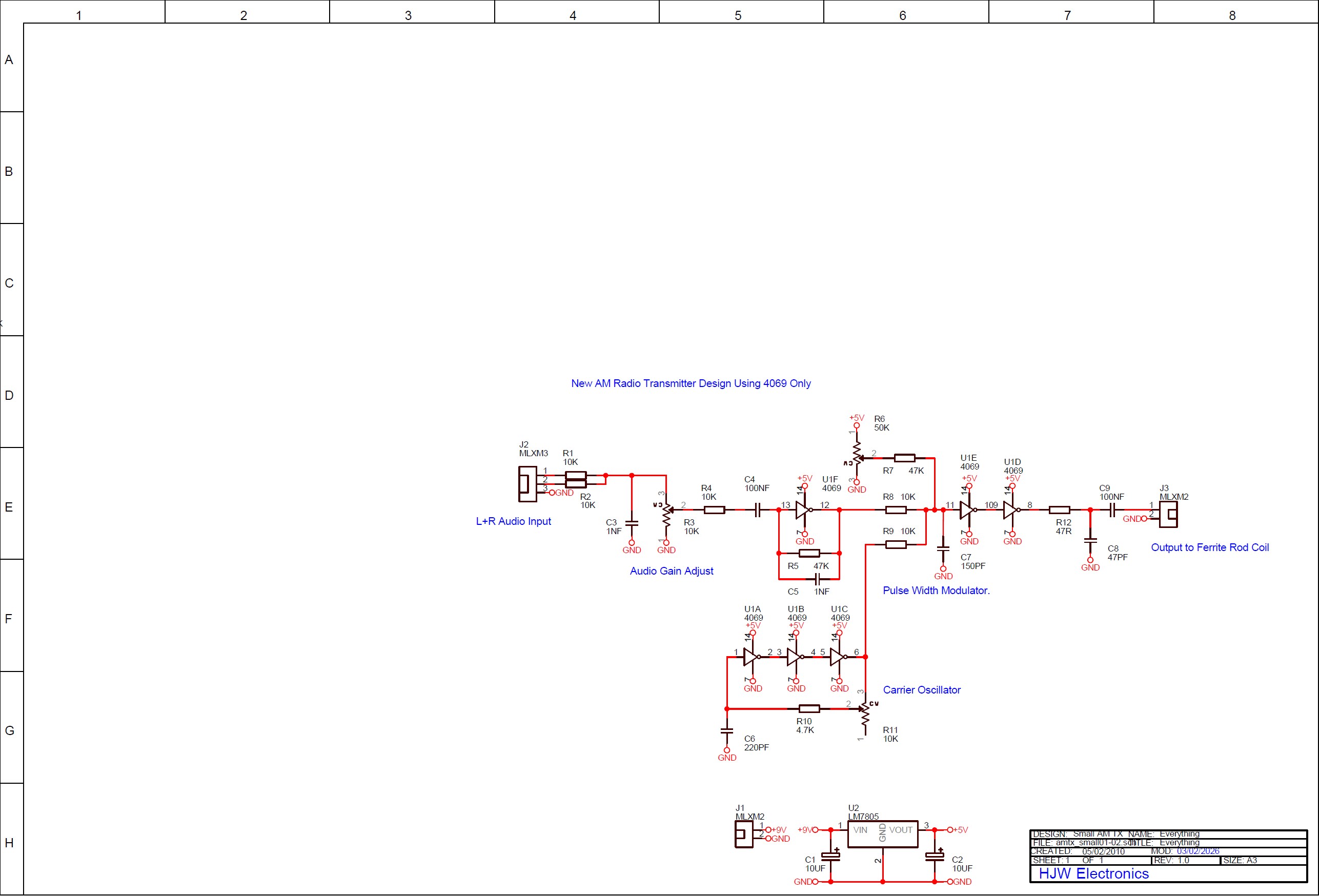
Let's start with the carrier oscillator. This is three inverters
in a ring oscillator configuration with the frequency primarily
set by the RC time constant of the feedback resistors and the
capacitor at the input. This is pretty simple so far and is
explained in a National Semiconductor application note on the
subject. You need three inverters to get enough gain, and if you
attempt to use just one you will end up with self biassing at
mid-rail.
Audio Input Buffer Amplifier
The audio input is designed to
take analogue left and right from a music player. The left and
right signals are summed by having 10k resistors R1 and R2 on
each input feeding R3, the 10K audio level pot. C3 to ground is
to filter out any RF getting into the inputs and to stop it
getting out into the source. The audio output is taken from the
pot wiper and AC coupled into the inverting amplifier consisting
of R4, R5 and C5. C5 provides a gentle roll-off above 6kHz so
that the transmission audio bandwidth is sensible. The point of
having an audio amplifier at the input is to isolate the inputs
from the general RF switching going on, and to keep the
sensitive part of the PWM nicely biassed by another of the
on-chip buffers.
PWM AM Modulator
With no audio input, the output
of U1F sits at mid rail. The centre modulation adjust R6 is
nominally at the mid-point. The capacitor on the input of U1E
sits at about mid rail and U1E is in an undefined condition,
possibly high or low depending on the exact setting of the
modulation 50% adjust pot. Then we inject the carrier square
wave through R9. When the carrier output is high the PWM input
capacitor C7 charges up and beyond a certain threshold, the
output of U1E will go low. When the carrier is low, the cap
discharges through R9 and beyond the threshold, the U1E output
goes high. The voltage on the cap rises and falls in the
expected exponential ramp seen when charging a cap from a
voltage source through a fixed resistance, but because the
amplitude of the signal here is quite small, we see only a small
part of that ramp, so small that it is very nearly a linear
ramp. The audio added onto the carrier through R8 shifts this
ramp up and down around the switching threshold, and so creates
a PWM output.
It's now possible to adjust R6 so that you get a 50% duty cycle
from U1E, and if you now feed in audio, you will see traditional
PWM coming out of U1E with the output spending more time high
for a high audio input voltage and vice-versa. (I'm referring
back to the actual audio input which is inverted in U1F and then
effectively inverted again in the PWM U1E.) But this isn't what
we want to make an AM radio signal at the carrier frequency. 50%
duty cycle coming from U1E will produce the maximum output from
our transmitter when driving into an inductor and suitably
filtered, which should happen when the audio input is peak high.
0 or 100% from U1E will produce zero output which should happen
when audio input is peak low. So with no audio input, R6 should
be set to about 25% or 75% PWM so that a signal will take the
modulator up to 50% and 'down' to 0 or 100.
A smaller cap or smaller input R8 or R9 will result in a bigger
ramp on the U1E input which will flatten more at its peaks. A
bigger ramp means less gain in the PWM section as the audio
signal has to be bigger to swing it about the logic threshold.
On the face of it, the less linear ramp will produce modulation
nonlinearity, but the flattening ramp on the input produces an
increase in the output. This will tend to be 2nd and even
harmonic distortion which makes the output AM signal have bigger
peaks. As there are odd harmonic "peak squashing" opposite
effects going on in the audio amp stage and in the output buffer
as the transmitter reaches modulation peaks, this is not
necessarily a bad thing as they work to cancel out. The values
shown in the schematic will work well, but it is certainly
possible to adjust them to alter the compromises between
non-linearity in various parts of the circuit, PWM threshold
noise, and audio gain. At the smaller end of the range, the ramp
signal needs to be big enough to get the PWM inverter to switch
properly, at the larger end, the gain will be low and the audio
input buffer will be beyond its limited drive range for a
reasonably linear behaviour, that being about 1Vpp.
With the slow drive signals at the input, the PWM output is
naturally quite slow, so it is buffered by the remaining
inverter which is AC coupled to the output.
Here's a picture of the prototype board with the power input mid
left, audio input top left and connection to the output coil top
right. The pot at the bottom is for frequency adjustment and the
one at the top right is the DC offset adjust into the pulse
width modulator.
CD4069 PWM AM Transmitter
Circuit Board
That's quite a venerable genuine
RCA CD4069UBE that I found there.

CD4069 PWM AM Transmitter
Output Circuit
You don't need such a long
ferrite rod. A few inches will do, just enough to fit the coils
on.

There's more than one way to do this. You could have a small
on-board resonant LC tank which would probably emit enough
magnetic signal into a close-by radio. In my prototype I have
R12 at a nominal 47 Ohm value on the output and a small value
capacitor C8 to roll off harmonics which will be present. In
practice the output buffer impedance is larger than R12 in any
case and as we are pushing the 4069 quite hard in terms of
frequency and driving various stages with slow inputs, the
output isn't that full of harmonics in any case. I connect this
output direct into a LW coil on an 8 inch ferrite rod which is
fitted with a MW coil and a parallel variable cap for tuning to
resonance. You could equally well make a 10cm diameter small
loop of 10 turns of hookup wire and this would be enough for
what we are actually making and would be untuned and allow easy
frequency changing. Or you could put more turns on your small
loop, (perhaps 50) and use a trimmer capacitor in place of C8 to
resonate that loop at your chosen output frequency. You'd need
an oscilloscope or a little tuning meter to do that.
Don't connect long wire antennas to this. The output power is
very small anyway but the circuit is only intended to create a
very local, primarily magnetic AM radio signal. Anything else is
very anti-social, and if you want to broadcast an AM radio
signal there are much better ways to do it.
Power Supply
The main circuit runs from a 9V
battery regulated down to 5V and uses less than 6mA. A
stabilised 5V is required particularly for the oscillator and
modulator and a small 78L05ACZ regulator provides that. The 1.7V
dropout on the regulator will discharge that down to less than
6.7V before the 5V rail sags, probably less at this low current.
This allows you to use a rechargeable if you want, and makes
good economical use of an alkaline type.
At 6mA, modern PP3 rechargables will last 20 hours or so, and
alkalines will last a couple of days.
Longwave Operation
There's nothing to stop you
changing the frequency to work on LW but you'll need to scale
the oscillator capacitor, the PWM capacitor and the output
filter capacitor by the same factor. Output loops will need more
turns too. Harmonic generation will be relatively higher when
using longwave as the 4069 has more gain there, so will present
relatively sharper edges. Because of this it would be best to
choose a frequency and make a resonant output loop for it,
either air or ferrite rod based.
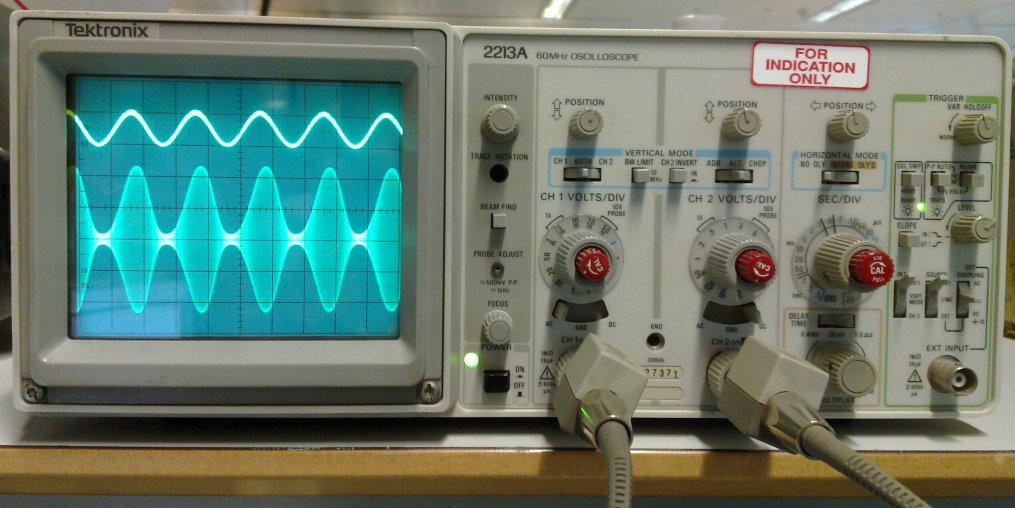
In the picture below you can see 1kHz 50mV audio input and 25Vpp
across the resonant tank. I'm sure that the linearity isn't
perfect but, well... I've seen worse:) You can click on
all the images to see the full size pictures.
PWM Based Mini MW
transmitter Near 100% Modulation Oscilloscope Picture
I loved that analogue Tektronix
'scope. Rock steady triggering, and everything you need for the
basics.
More Power Igor!
It's interesting to think about
how you might make an efficient high power AM transmitter by
taking the PWM signal all the way through the PA driver stages
to the output. This would allow all those stages to operate in
efficient saturated mode and makes the design easy. There'd be
no clever temperature compensated biassing required in the
output stage, just a suitable energy storage inductor or tank to
turn the PWM into AM, which you normally have anyway in some
form. I've no doubt that there are commercial designs around
where something like that has already been done. You would need
to fancy-up the circuit a lot though, to make sure that there
isn't a lot of phase modulation. There is lots of phase
modulation on this design, and the output is very broad on a
spectrum analyser as a result. I had a try using 8-bit pulse
density modulation at the carrier frequency to do something
similar. The 5V logic PDM generating circuit was an analogue
digital hybrid which was very cool to watch operating on the
oscilloscope. The result of trying to feed this into large
MOSFETs to generate a significant amount of output power was
radio frequency arcing through several layers of insulation,
vapourized oscilloscope probe tips, and plenty of loud bangs.
The output spectrum was awful.
It has been done in efficient modern AM transmitters
made in the USA using power combined multiple modular RF PAs,
driven with cleverly dithered digital thermometer codes. I can't
find the link where I read about the detail, but it's out there
somewhere.
Henry's general email address:
Navigate
Up
Recent Edit History
05-MAY-2010: page created
03-FEB-2026: significant update, html incantations