The Radio Glen Twin Line TBU Telebalance Unit

If you're enjoying these pages and you have an interest in hobby type electronics or repair jobs, you might like to visit my other website www.usefulcomponents.com, where there are details of some components for sale and some good electronic kits.

The Radio Glen Twin Line TBU
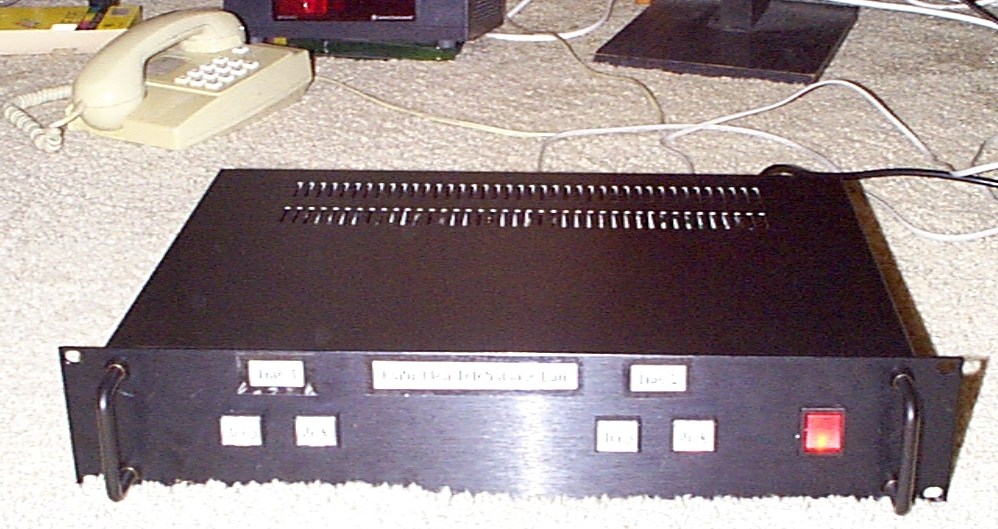
            Telebanace Unit From The Front

Introduction

This document summarises the workings of the Radio Glen TBU prototype. The TBU was constructed after a request from Radio Glen for a cheaper version of the standard Sonifex dual line TBUs which sell for about £1400. The deal was to make a dual TBU for £300 and Radio Glen would throw in their spare 19" bay-frame in return for having nice illuminated switches on the front.

General Description

The heart(s) of the unit are the ETAL P3400 line modules available from Farnell. These modules mop-up all of the line interface functions like ring detection, physical hybrid, on-off hook handling etc. This means that the TBU as a whole would probably pass PSTN type approval testing if it was subjected to it. Unfortunately these modules are no longer manufactured and future versions will require more design effort in the line interface area. The unit has two identical halves for two telephone lines. It is suggested that in the Radio Glen application, plug-in splitters are used at the phone sockets to accommodate both the TBU and desk telephones. In this way, either the TBU or the desk phones can be used to pick up the lines when a call is incoming.

Operation

Each line has an illuminated PICK and DROP switch. When the mains power is on and the phone lines are attached, the unit should be in the idle state with both of the green DROP lamps lit. When a call is incoming the PICK lamp on the appropriate line will flash. The call can be answered by pushing the flashing PICK lamp. The DROP lamp will go out and the PICK lamp will light to show that the TBU has taken the line off-hook and is sending audio to and from the line. The call can progress via the mixing desk and then the line can be dropped by hitting the DROP switch.

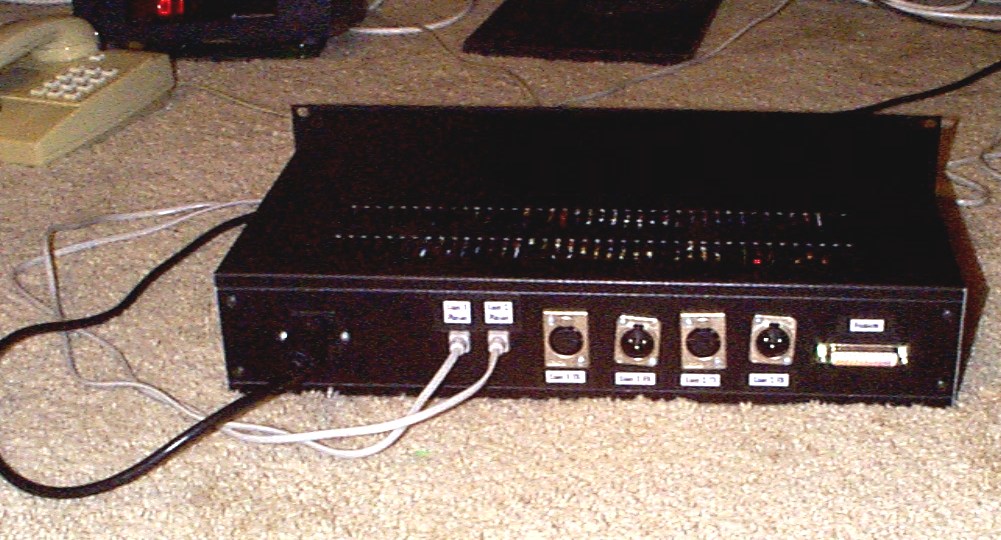
If the TBU needs to be placed in a technical cupboard, then it can be fully remote controlled via a 25-way male D connector on the rear. All of the front panel switch connections are available at this connector and momentarily closing the relevant contact is equivalent to a momentary push of the front panel switch. The lamp drive connections are also available on this connector and each output can provide 100mA of 12V external lamp drive. Isolated closing contact outputs are available which mimic the operation of the lamps in the front panel switches. Normally open and normally closed contacts are provided. These can be used to drive triac switching units for mains powered annunciator lamps, which may be particularly useful for ring indicators.

Hybrid crosstalk cancellation is provided by simple analogue subtraction circuitry with an additional phase-shift system to improve the cancellation up to broadcast standard.

Circuit Descriptions And Schematic Diagrams

PSU Regulators And Connectors TBU01-01 PDF

Radio Glen Twin Line TBU
            Telebalance Unit PSU And Connectors Electronic Schematic
            Diagram

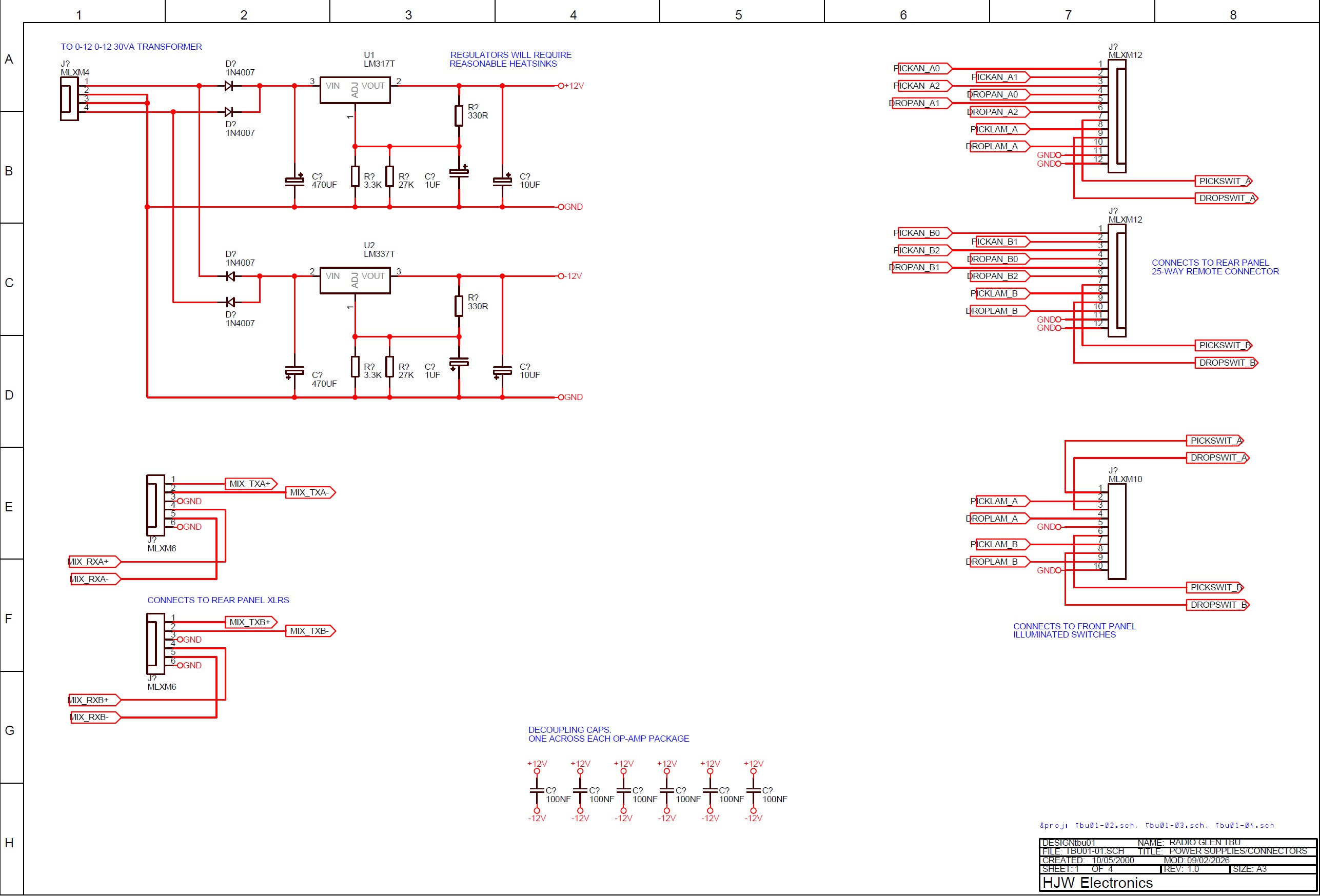
This sheet has the regulators and connectors to the external switches and panel connectors. 12V is chosen as the supply voltage as this can drive the relays and op-amps and happens to be the point where the regulators can just remain out of drop-out with the particular mains transformer used. This minimises dissipation in the regulators.

Line Interfaces, State Control And Lamp Switching TBU01-02 PDF

Electronic Schematic Diagram
            For The HJW Electronics Radio Glen Twin Line TBU Telebanace
            Unit, Line Interfaces, Hook State Control, And Lamp Relays

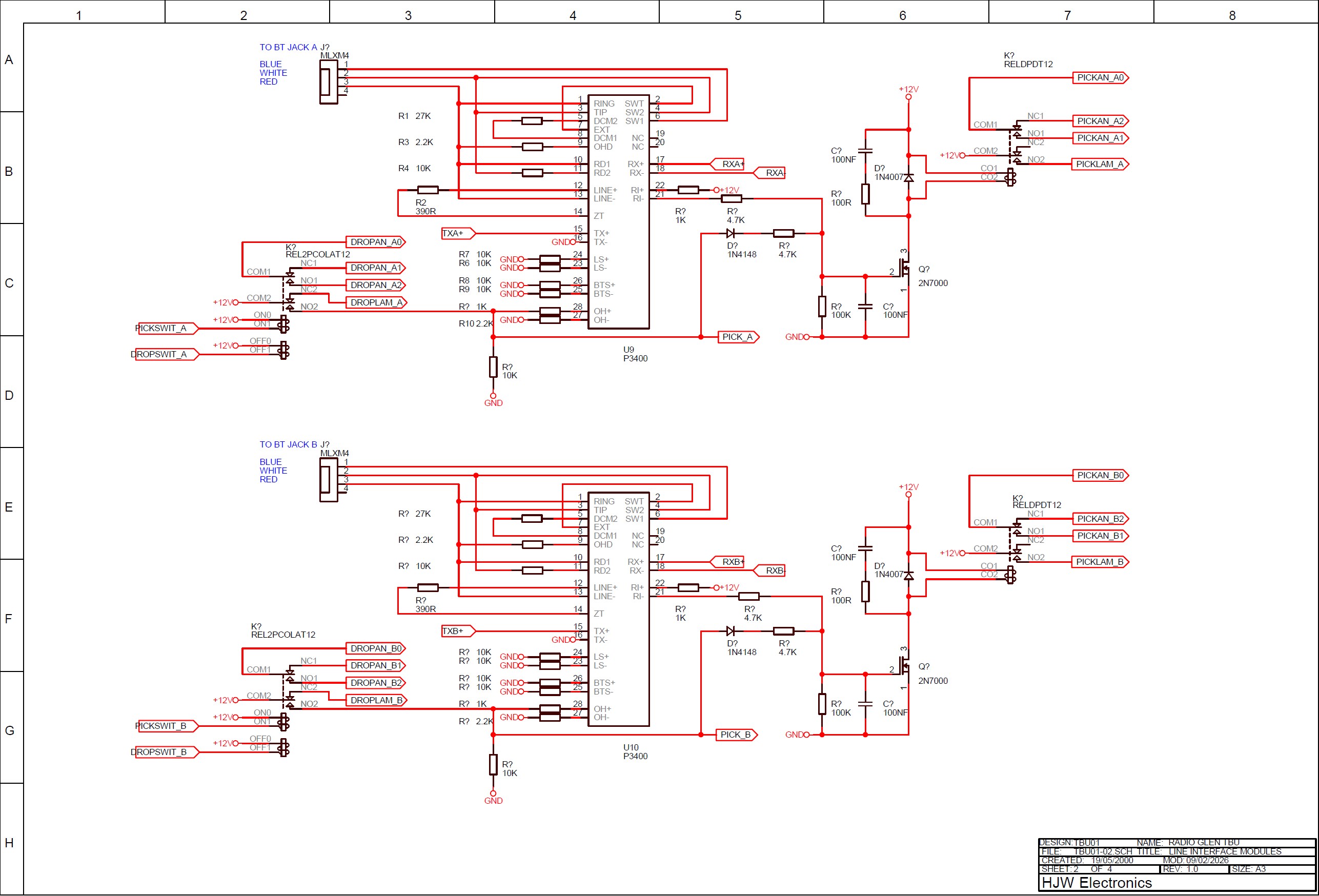
This sheet shows the P3400 line interface modules and the relays which control the front panel lamps and switching. A latching relay is used to control the on-hook off-hook state. The ringing indicator from the line interface module drives the PICK lamp relay to indicate an incoming call.

Crosstalk Cancellation And Uplink Signal Conditioning TBU01-03 PDF

HJW Electronics TBU Telebanace
            Unit Downlink Crosstalk Cancellation And Uplink Signal
            Conditioning Electronic Schematic Diagram

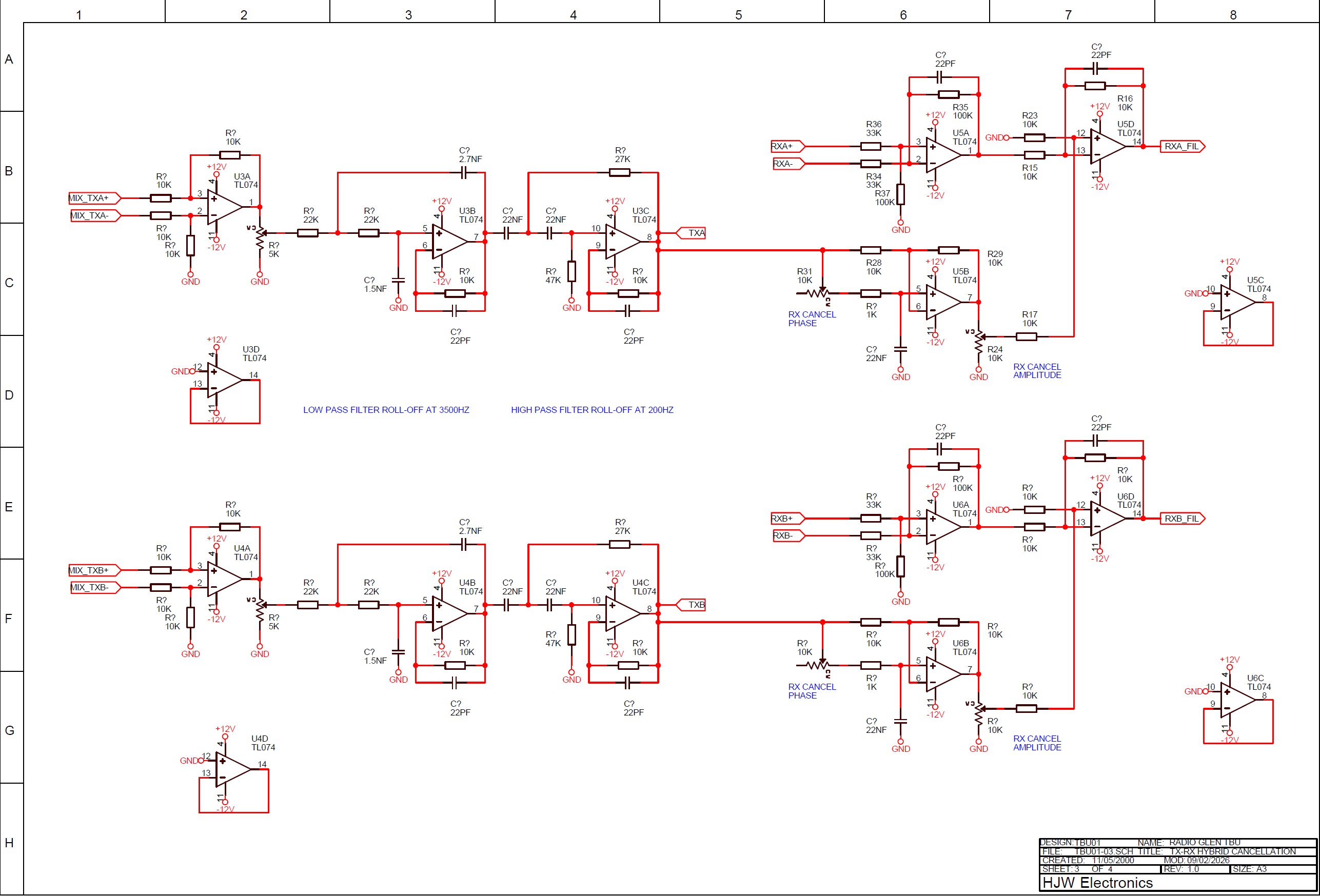
This sheet shows the differential amplifiers which take the signal from the RX side of the hybrid, and the differential amps which accept the mixer TX output for sending to the TX side of the hybrid. The TX signal is bandpass filtered with -3dB points of 200Hz and 3500Hz at -12dB/octave. This avoids sending unnecessarily wide audio to the telephone line and makes cancellation of the TX crosstalk easier.

RX refers to the signal being received from the far end of the phone line and sent to the studio mixer. TX refers to the signal going from the studio mixer to the phone line. Because of the imperfect nature of hybrids and phone lines, the RX signal typically has a roughly equal amount of the TX signal present due to crosstalk. This TX crosstalk is cancelled by subtracting the known TX signal from the RX signal. Measurements have shown that the TX crosstalk signal coming out of the RX side of the hybrid is also slightly phase shifted from the original TX signal. So an equivalent phase shift is added to the signal that is used to cancel the TX crosstalk signal. The cancellation amplitude and phase shift are adjustable on preset pots. To adjust these pots, the TBU has to be put into a call. The receiver of the phone that is dialled up may be simply left on a cushion to block the mouthpiece. A 1KHz sine is sent to the TX from the mixer and the amount of this sine on the RX is measured with an oscilloscope. The amplitude pot is adjusted first, to minimise the level of the crosstalk signal. Then the phase pot is adjusted to minimise the crosstalk signal. There is not much interaction between the two pots but it may be of benefit to readjust the amplitude pot and then the phase pot again. This adjustment should ideally be done when the TBU is connected to the actual line to be used in the field. In practice however, the difference between phone lines has a minimal impact and no adjustment should be needed.

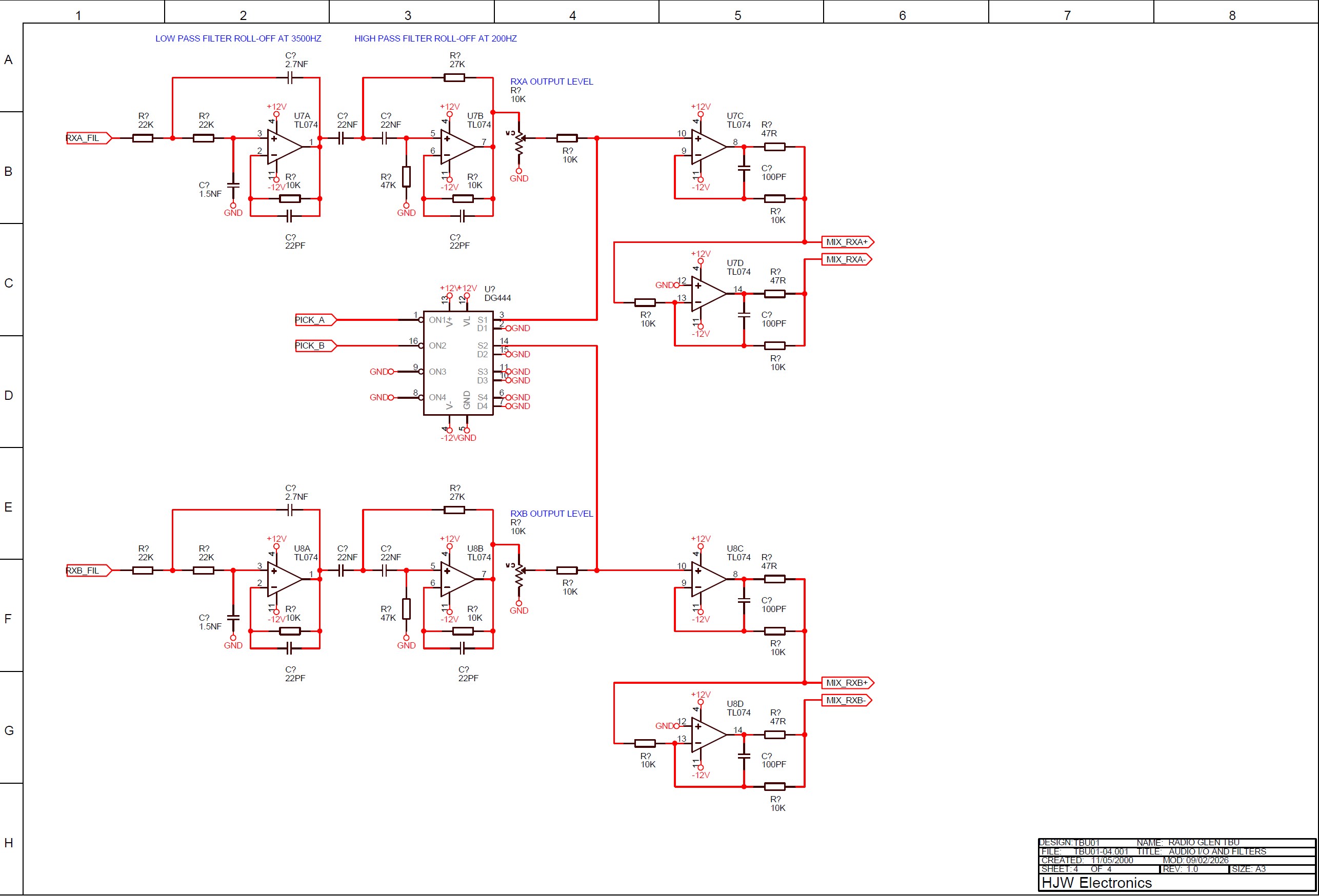
RX Audio Filtering, TX Cut-Off, RX Outputs TBU01-04 PDF

The HJW Electronics TBU
            Telebalance Unit Downlink Filtering, Uplink Cut Off And
            Downlink Ouputs Electronic Schematic Diagram

The RX signal from the cancellation circuitry is passed on to a bandpass filter which rolls off at 12dB/octave with -3dB Fo at 200Hz and 3500Hz. This provides for the full available telephone bandwidth while providing some cut-off of hum and high frequency noise that may be present. A differential driver output provides the balanced signal for the studio mixer. This output can drive an ordinary high impedance balanced input but will struggle if a true 600R balanced load is applied. The DG444 analogue switch cuts off the RX signal to the mixer when the TBU is on-hook. This cut-off of the RX audio prevents a feedback path from TX to RX which can occur when in the on-hook state. The switch drive signal is effectively 12V logic and comes from the latching relay which controls the hook state.

25-Way D Remote Control Connector Pin Assignments


Remote Connector Pin Assignments
Pin Function
1 line1 pick annunciator pole
2 line1 pick annunciator normally open
3 line1 pick annunciator nomally closed
4 line1 1 drop annunciator pole
5 line1 drop annunciator normally open
6 line1 drop annunciator normally closed
7 line1 remote pick switch (closing contact to GND)
8 line1 remote pick lamp (100mA max to GND)
9 line1 remote drop switch (closing contact to GND)
10 line1 remote drop lamp (100mA max to GND)
11 GND
12 GND
13 not connected
14 line 2 pick annunciator pole
15 line 2 pick annunciator normally open
16 line 2 pick annunciator nomally closed
17 line 2 drop annunciator pole
18 line 2 drop annunciator normally open
19 line 2 drop annunciator normally closed
20 line 2 remote pick switch (closing contact to GND)
21 line 2 remote pick lamp (100mA max to GND)
22 line 2 remote drop switch (closing contact to GND)
23 line 2 remote drop lamp (100mA max to GND)
24 GND
25 GND

Pictures

Twin Line Telebalance Unit Rear Panel Picture

HJW Electronics TBU Telebanace
          Unit Rear Connectors Picture

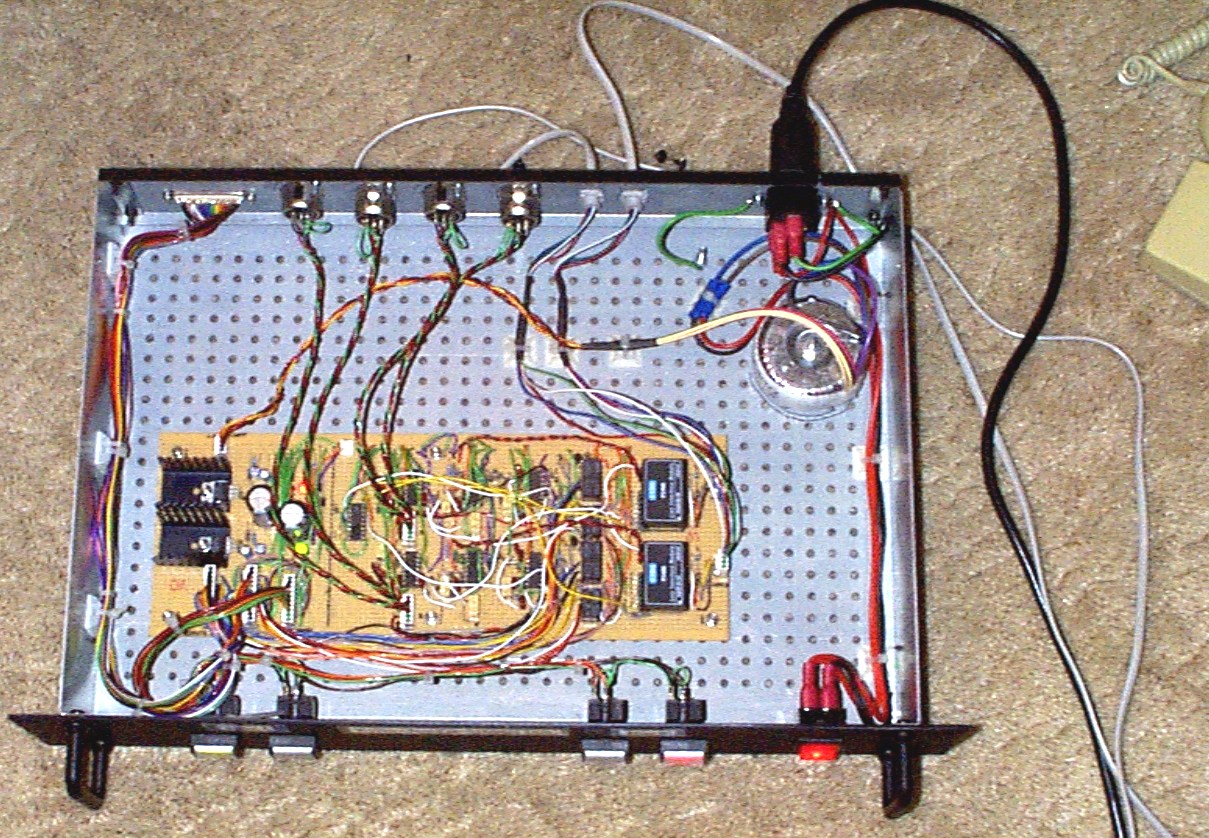
Telebalance Circuit Board Insides

The Useful Components Radio Glen
          TBU Telebalance Unit Insides Picture

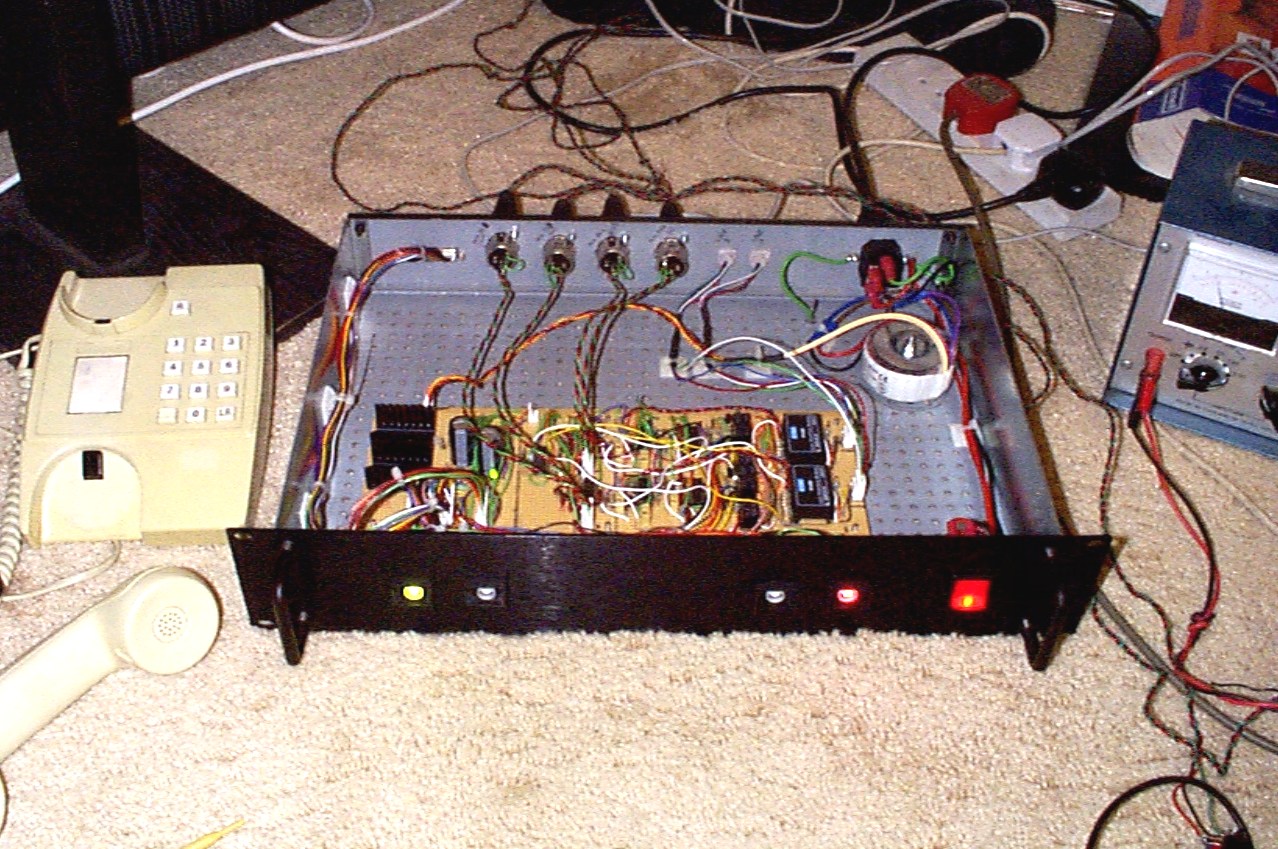
TBU Under Test At Home

HJW Electronics Radio Glen
          Telebalance TBU For Putting Callers On The Radio Under Test

Here is the TBU under test, complete with a high tech battery powered Levell oscillator for doing the sidetone cancellation set up.

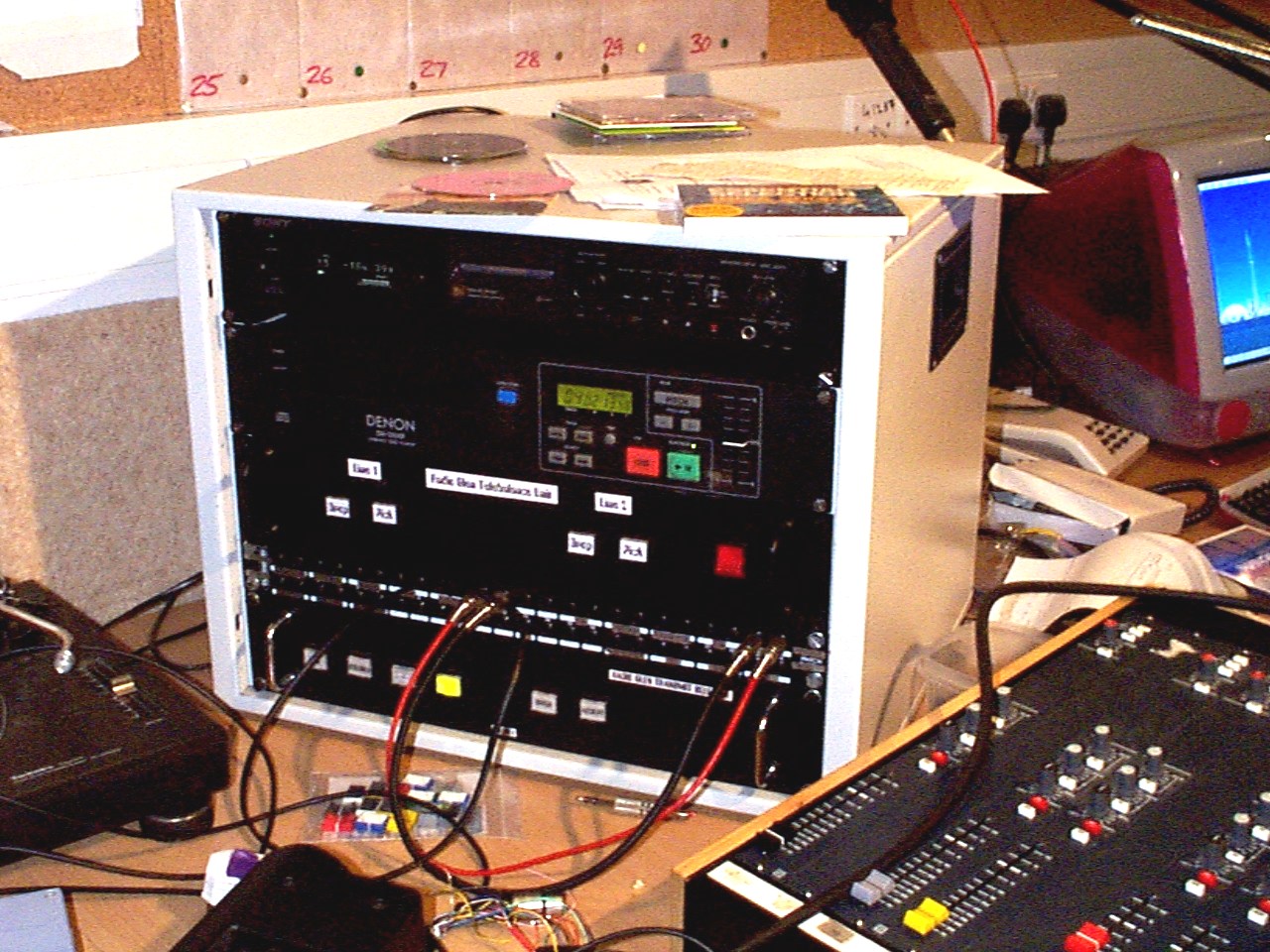
TBU Installed In Radio Glen New Terraces Studio 1

Radio Glen TBU Installed In New
          Terraces Studio 1 At Glen Eyre Halls Of Residence In
          Southampton

Post Scripts

I recently saw a circuit in Electronics Design News which showed a rather cunning way to improve the crosstalk cancellation despite variations in the line impedance. It used a ladder network in front of the hybrid which was similar to an RF isolator used to isolate RF PAs from changing antenna impedances. The trade off is that you need to drive more voltage swing into the isolator to overcome the losses in the resistor network, but voltage swing is not in short supply in a mains powered device. This could be a very useful trick.

2019 Update

The ETAL modules are long since gone and had a nasty habit of failing for no reason after some years in service. They were potted modules, so there was nothing that could be done about it. I had left a spare module taped inside the case, so that provided the station with one replacement. I also had a spare which I used in a related device, which I made for use at work. This would allow a mobile phone test set to connect to the copper telephone newtork to allow allow management and marketing to assess the sound quality of a mobile phone under development by receiving a call from it at their desk phone. The box had to include the standard pre-emphasis, de-emphasis, and the 2:1 compression expansion on both sides. Those audio functions were never provided on the 1G mobile phone test sets and could lead people to make bad judgements of audio quality. I got precisely zero brownie points or pay rises for that particular piece of invention. The ETAL module in that device was later removed and fitted into the TBU at the SURGE studio down in the depths of the Southampton University students union building.

It has long been assumed that potting modules up in epoxy or some similar substance is a good way to protect them from vibration and other forms of damage. A highly detailed study at my previous place of work showed that this tends not to work. Assuming that the potting compound doesn't decay into toxic mush anyway, thermal expansion gradients between the potting compound and the parts tended to break the components and the PCB tracks. It made the reliability worse. Maybe this was the problem with the ETAL parts.

The non-availability of telephone interface modules should not stop you from being a bit brave and adapting a good quality old BT British Telecom desk phone for this purpose. If you can find a DTMF type, you could put a keypad on the front panel for dialling out. As long as all the audio is electrically isolated using decent telecoms grade isolating transformers and telecoms relays for hook control and ring signal detection, there's no real difficulty. Unless you have £4000 already, in which case just buy a TBU off the shelf. Or you could modify a mobile phone headset and use a mobile, which no-doubt has its own interesting elephant traps to look out for. But I wouldn't know anything about that, right? BBC Radio 4 have developed a habit on some national radio programmes of pointing a microphone at a mobile phone with its crappy little internal speaker to put callers on-air. There's not much that I can say about that within the boundaries of common politeness. "Oh no, Sorry, The line's gone down." Again!

The Radio Glen TBU, A 2026 Perspective

UK landlines are going digital, though I thought that it was all supposed to have gone digital a year ago. Oh dear! Have we found some applications where people absolutely need to access the Plain Old Telephone System POTS but absolutely won't allow a digital signal of any kind into their control room? Well, who would have thunk it. I object to any landline system which requires power in the house to make it work, rather than relying on loop current and the batteries at the exchange. It's your last line of contact in a bad situation, and in just such a situation the mains power may be out. The impact on "falling over" alarms used for the elderly should also be considered. When are you more likely to fall over? When the lights have gone out. When are you more likely to have a fire? When you've lit a candle. When does your mobile not work? When you can't charge it. When is the internet off? When your router has no power...

Was It Any Good?

I never heard this on-air, but I was told that it was very good indeed. At one point the station had access to a commercial Sonifex TBU during an FM RSL Restricted Service License one month broadcast. I was informed that this unit was substantially better, particularly for audio levels on the TX uplink side. The 12dB/octave bandpass filtering on both RX and TX sides is a very nice touch, and the phase adjusted RX crosstalk cancellation is very nice indeed. As for having remote outputs for driving fancy mains powered lights mounted on the studio wall via a triac box. That's all part of the fun and should always be included.

And Finally...

Readers may enjoy seeing the previous lower tech version used in the Radio Glen F Block studio. This proves the concept of using a good quality telephone instead of a module. This one I certainly did use on air, and I do have full bandwidth recordings. Despite the extreme simplicity the device was safe, and the call quality was very good indeed. The Radio Glen 1992 Prisoner-Matic Telebalance Unit TBU.

Henry's general email address:https://www.interestingelectronics.com/email_addy_grey.jpg

Navigate Up

Recent Edit History

28-JUL-2000: first draft
14-SEP-2000: released to glen
29-JAN-2002: released to web
05-OCT-2019: web friendly updates
09-FEB-2026: major update, bigger pictures, html incantations