Electrostatic Negative Air Ioniser
With Rotating Ion Thrust Emitters
If you're enjoying these pages and you
have an interest in hobby type electronics or repair jobs, you
might like to visit my other website www.usefulcomponents.com,
where there are details of some components for sale, and some good
electronics kits.

Safety Precautions
This EHT power source is very safe when
constructed and boxed, as the output is current limited by the
high output resistance. However you can get a nasty shock from the
individual capacitors if you accidentally touch them while
connected to the mains and for a long time afterwards. Be sure to
disconnect from the mains and discharge the device by shorting the
current limited output to ground for some 10 seconds before
handling the insides. I also recommend running a ground lead with
a 100k Ohm resistor in line down the entire row of capacitors
before touching. It is possible to use the EHT output to charge a
high voltage external capacitor like a home made Leyden jar. This
could produce a lethal high current shock, so don't try anything
like that unless you really know what you're doing.
Simple Low Current EHT Generator
Circuit Design
Mains Driven High Voltage Supply For
Negative Air Ioniser mains_ioniser01-01.sch PDF
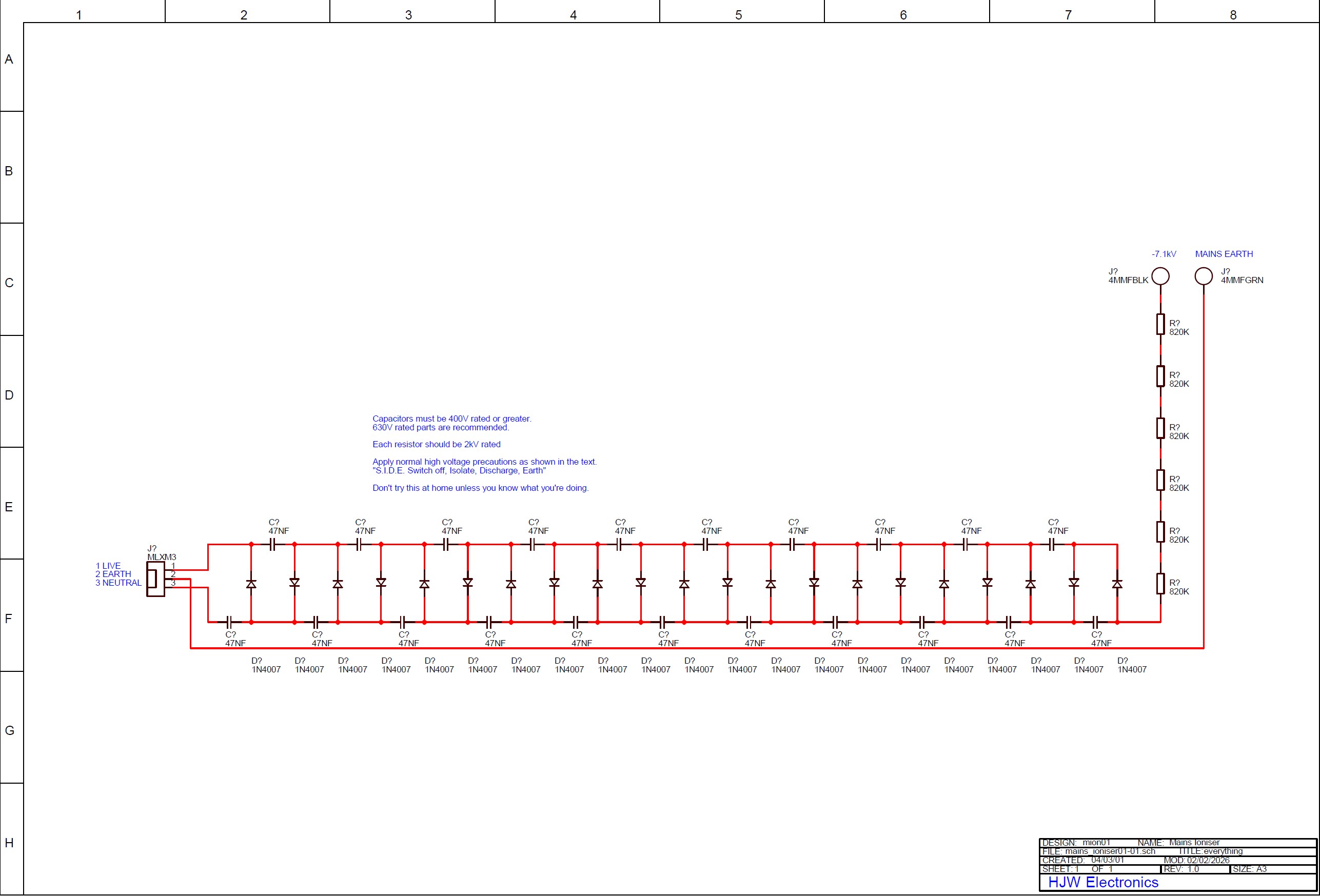
What does E.H.T. stand for? Extra High Tension, meaning a jolly
high voltage. A basic mains driven Cockroft ladder high voltage
generator is shown in the schematic. This is functionally the same
as a project in Electronics Today International many years ago.
The peak mains voltage of 340V appears across each capacitor and
this is negative with respect to mains neutral and the surrounding
environment. The orientation of the diodes defines the polarity.
As the capacitors are in series, the voltages sum and at the top
of the ladder about 7kV is present. A high value resistor is used
at the output end to current limit the output. It is important to
use a high voltage rated resistor or a string of lower voltage
ones in series, so that the resistors maintain their stated
resistance value. This design is for 220 to 240V mains power and a
double length ladder would be needed for a 110V supply. The ETI
version used just 10nF capacitors. This version uses 47nF so could
theoretically output 4.7 times the current. In practice this is
limited by the output resistor stack. What you could do, though,
is have two or more, maybe up to four outputs using separate
resistor stacks connected to the top of the ladder and still keep
the output voltage up at each emitting tip for air ionisation
purposes. For an air ioniser, you don't want any more than 10kV at
the tips. A higher voltage would produce ozone, which is quite
unhealthy.
EHT Source Construction
The diodes and capacitors are simply
wired together with solder using just the existing component
leads. This is a Cockroft-Walton diode capacitor EHT stack named
after the inventors. It was a 1930's creation and originally used
high voltage diode valves and capacitors to generate
well-controlled voltages for linear accelerators used in atom
smashing research.
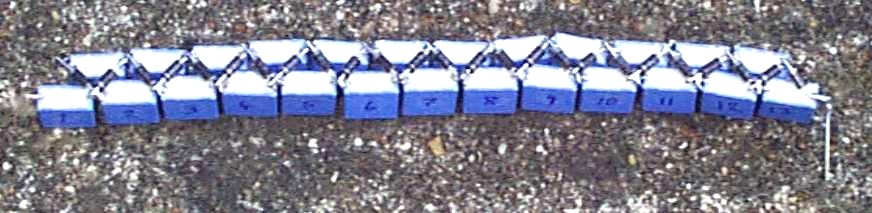
The ladder is put into a small plastic box and wired to the mains
IEC inlet and the EHT output socket. After an initial test to make
sure that the connections are correct, the box is filled with wax
made from melting down household candles in a saucepan. This stops
ionisation occuring inside the box which would otherwise reduce
the available output. The output socket is an ordinary 4mm socket
and a mains earth connection is also wired to an adjacent socket.
A 1 Amp plug-top fuse is used in the mains lead. Rather than the
wax method, you could use a proper anti corona spray.
Insides Of The Mains Powered Ioniser
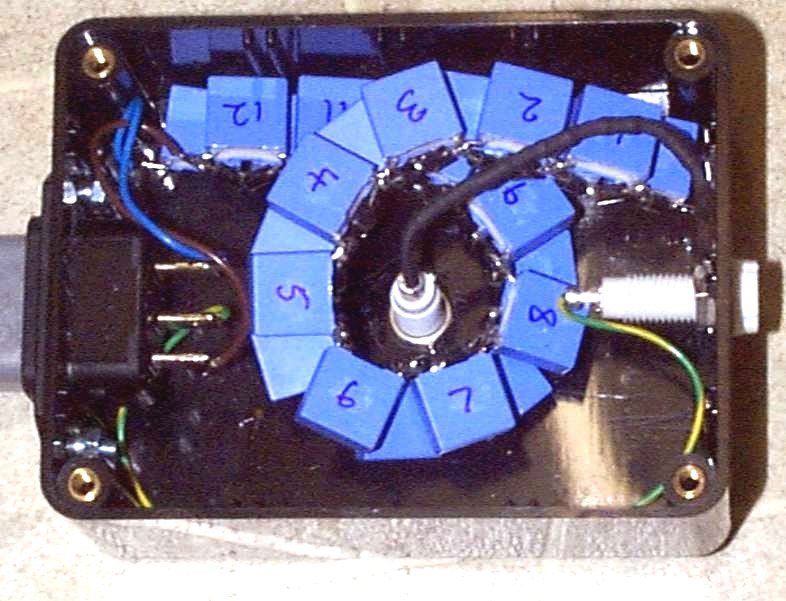
Insides of mains powered ioniser full of melted
paraffin wax from household candles
Negative Air Ion Emitters
If a single dressmaking pin or other sharp point is connected to
the EHT output you will be able to feel a slight breeze of
negatively charged air particles coming from the end of the point.
The high charge density at the sharp point causes this ionisation
and the negative ions are then repelled from the negatively
charged pin, causing this ion breeze. You can also hear the point
emitting a slight hiss and in very dark conditions you can just
see the point glow slightly. The ionisation at the point tends to
physically degrade it over time and this reduces the ionisation
occurring there. Some commercially available air ionisers have
precision shaped points of special alloys to counter this. One fun
way to make sure that your ioniser is still ionising is to use the
ion breeze thrust from the needles to spin a rotating emitter
pair.
Spinning Ion Emitters
A 12cm long piece of stout copper wire is soldered into a 4mm plug
and this is plugged into the EHT output. The top end of the wire
has an ordinary steel dressmaking pin soldered to it. This is the
point on which the spinning emitter arrangement balances. A
section of aluminium foil about 20 cm long and 6cm wide is folded
multiple times down its length until it is about 20cm long and
0.5cm wide. This gives the foil more strength. Try not to leave
any sharp edges or points as these may ionise the air in unwanted
places on the structure. If you can find a thick aluminium foil
pie-tin then this is better. You could just cut that to the
desired width and there will be no need for the multiple folding.
The head end of two pins are folded into each end of the foil
strip pointing in opposite directions. Then the strip is folded in
the middle so that it forms an inverted V shape. This can then be
placed on top of the balance point. When the power is turned on
the ion breeze will push the inverted V round and it will remain
spinning as long as there is sufficient ionisation happening at
the points. The spin speed can be increased by putting a sheet of
aluminium foil connected by wire to the ground terminal underneath
the whole arrangement. I put a white sheet of paper over this to
collect the fine dust and smoke particles that the ionised air
precipitates from the atmosphere.
I'm sure that this design can be changed and improved in myriad
ways, but this experiment demonstrates that spinning your ioniser
emitters under their own ion thrust is very easy. Maybe the
spinning action encourages ion emission by moving the needles
through relatively un-ionised air. Maybe you could aerofoil shape
the structure to gently fan air up or down past the system. There
are many possibilities, and the spinning emitter has great novelty
value.
23-FEB-2010
I've had two of these running now for about five years using
standard pins and a graphite pencil lead as the pivot. To keep
them rotating you just have to wipe dust from the emitter pins
every few months or so.
Video
Of The Rotating Ion Thrust Air Ioniser
The Spinning Emitter Air Ionizer, A
2026 Perspective
A Candle Wax Sealed Cockroft Ladder
After 20 Years
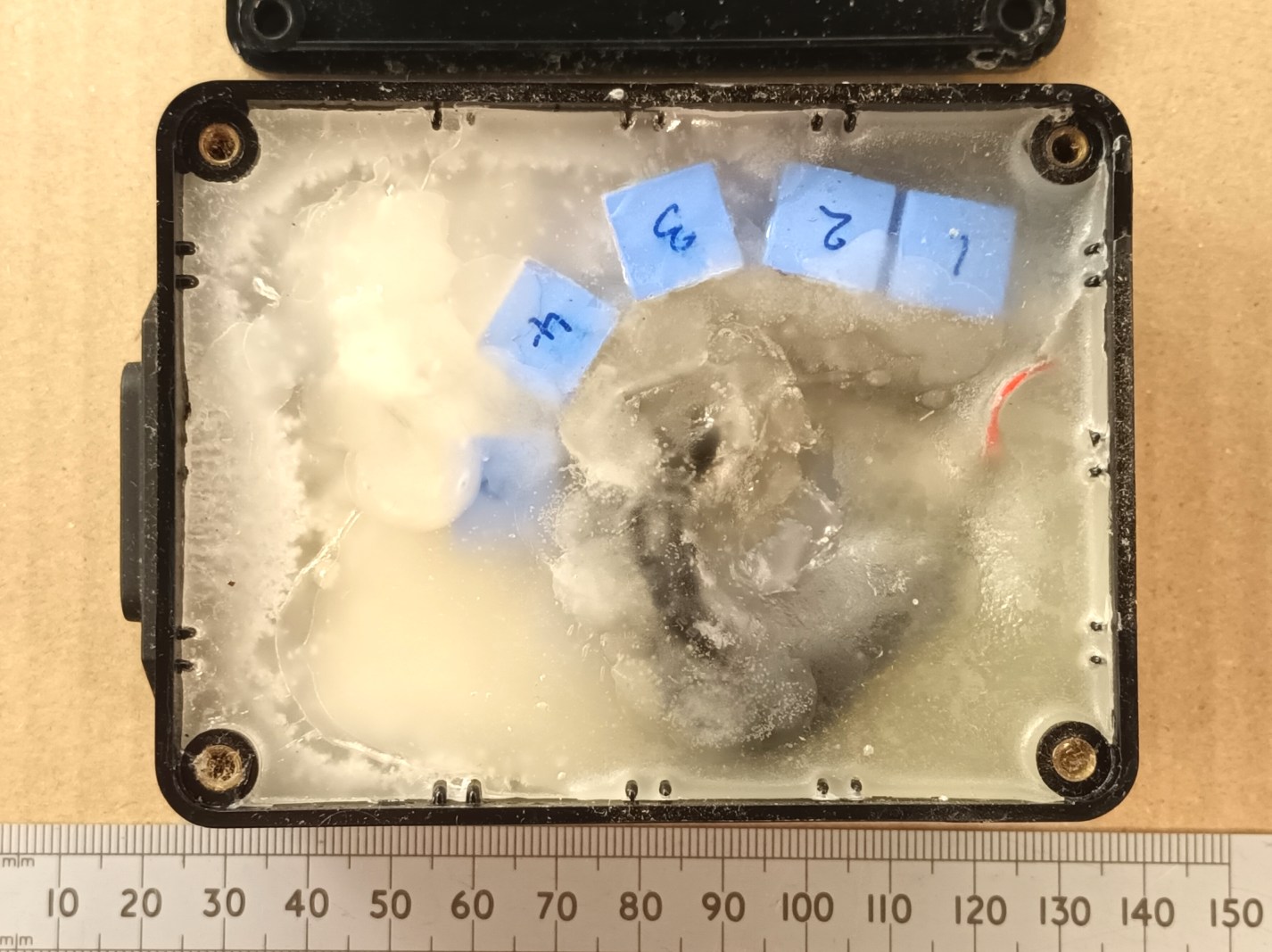
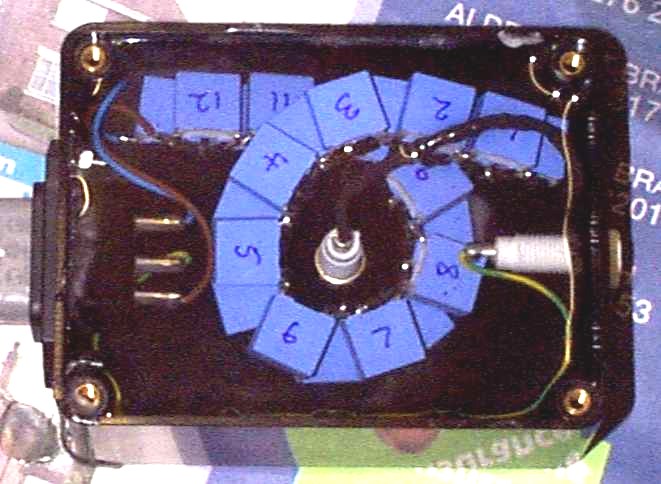
So, here's that project after a long time in continuous use. The
whiteness isn't any result of the high internal voltage as far as
I'm aware. It is pretty much as I remember it after the wax had
set. The output has reduced though. Either the paraffin candle wax
has degraded and it is conducting somewhat internally, or the
capacitor dielectric is exhausted after such a long time. It could
be the other components, but I suspect the capacitors. It still
generates EHT, but I can't get proper emitter rotation any more.
It's time to make another and investigate the cause afterwards.
When I switched from using a dressmaking pin point as the rotation
pivot to a pencil graphite, there were two reasons. One, the pin
point would wear into the foil and cause friction. Two, one day I
turned on the FM radio to hear the whole band splattered with the
worst, really weird sounding interference ever. It went like,
"blibbely-blobbleywibbleydiblob-dibblob." I searched everywhere,
before noting that this most odd interference had a periodic
nature. Yup. Having suffered from some wear and tear, it was the
dressmaking pin with the rotating aluminium emitter on top causing
one heck of an electromagnetic racket. Using the graphite made the
interference go away entirely.
I'm reminded of some of the outrageous health claims for air
ionisers in the 1970's and 1980's. What a LOB.
I have also been minded over the years to try using this kind of
thing to make all kinds of crazy dust extractors with the emitter
in a tube, produce acceleration with grids to make the air pump
through the tube to help with the aforementioned dust extractor,
and how about a negative air ion based amplifying triode? So, it
might be a bit low frequency and noisy using charged air paticles
instead of electrons in a vacuum, but imagine if you could make it
oscillate at audio frequency thus proving gain. That would be,
hil-"air"-rious. I'll stop now:)
Henry's email address:
Navigate
Up
Recent Edit History
23-FEB-2010: small update to show some device longevity
02-FEB-2026: significant update, html incantations, bigger
pictures, air triode oscillator invention mention